Showing posts with label devil. Show all posts

Sunday, 31 May 2026

Ancient Underworld ‘Hellmouth’ Gateways from the ‘Ploutonion’ to Porta Magica

An Underworld Travel Guide - legendary ‘Gateways to Hell’ that still exist in Europe

The ‘Ploutonion’ at ancient Hierapolis (near modern Pamukkale in Turkey) was a religious site and a supposed entrance to hell dedicated to the grim god Pluto, he who ruled over the dead in Hades.

Discovered in 1965 by Italian archaeologists, and followed by studies carried out in 1998, the Ploutonion and the nearby Apollo's Oracle of Hierapolis are linked to a seismic fault, on which both sanctuaries were purposely built as part the Gateway to Hades/Hell/The Underworld. The site has been partially restored, with statues of Hades and his three-headed hound Cerberus now guarding the remains of the complex.
underworld
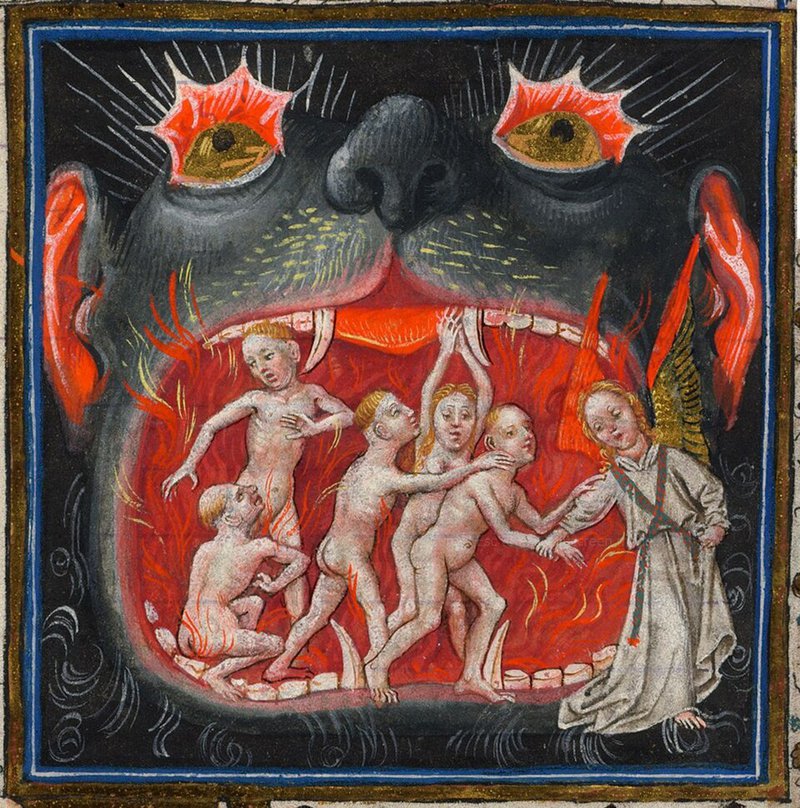
“Hellmouth” - Miniature from the Hours of Catherine of Cleves, Morgan Library & Museum
​Master of Catherine of Cleves, Public domain, via Wikimedia Commons

Pluto’s sanctuary is built on top of a cave which emits lethal toxic gas; animals would be thrown into the cave and pulled back, instantly dead. Fumes emitted from the cavern are still fatal; passing birds have suffocated after breathing the fumes emanating from the site.

Lethal gas said to be sent by Pluto, god of the underworld

The Ploutonion is a small cave, large enough for one person to enter. Behind the roofed chamber is a deep cleft, through which fast-flowing hot water passes, releasing the lethal gas, said to be sent by Pluto, god of the underworld. The fumes were so strong they could kill a human within just one minute of exposure.

Gelded priests of Cybele (‘the Galli’) descended into the chamber, crawling on the floor to inhale pockets of oxygen, or simply holding their breath. They then returned to the surface claiming a miracle had occurred and they were uniquely under Pluto’s protection.

In front of the ‘Gateway’ an enclosed area of 22,000 square feet was covered by the swirling, deadly gas, instantly killing many who dared to enter this area, except for the wised-up servants of Pluto who were aware the gases pooled closer to the ground, so kept their mouths and noses above the deadly clouds below; unlike the animals (including bulls) that were led to their deaths. The acquisitive priests naturally sold birds and other animals to visitors, who used them to test the deathly air as sacrifices. But their regular exposure to the CO2 in the surrounding atmosphere would have doubtless contributed to the hallucinations and eccentric behaviour displayed by the Pluto’s servitors.

Greek historian Strabo (63 BC – c. 24 AD) described the gate: “Any animal that passes inside meets instant death. I threw in sparrows and they immediately breathed their last and fell.”

For a fee, supplicants asked questions of Pluto’s human oracle, again topping up the sanctuary’s coffers; but when Christianity came to dominance, the area was closed off, and in time largely forgotten. The temple was mostly destroyed by an earthquakes in the 6th century AD.

But Pluto’s shrine is still deadly to some foolish enough to test the god.

Other Hellgates’

The Roman Forum - home to no less than two entrances to Hades’ realm:

The Lacus Curtius

I’m a regular visitor to Rome’s fascinating ancient Forum; two sites are of particular interest to the investigators of esoterica.

The Lacus Curtis is arguably the most mysterious monument of the Roman Forum. The name suggests it was a lake, becoming smaller as drains were constructed, until a small dodecagonal basin was all that remained, called the Lacus Curtius. The Romans had three stories explaining the name. The first was that in 445 BC, lightning struck the area, and consul Gaius Curtius Philo ordered the construction of a fence around it. Livy (59 BCE - 17 CE) tells us that after the Rape of the Sabine Women, war broke out between the Romans and the Sabines, Roman champion Mettius Curtius, drowned in the marsh during the clash which was thereafter called the Lake of Curtius.

The third and most popular account says in 362 BC a great fiery cleft to the Underworld opened in the Roman Forum; seers claimed that to seal the fissure, Rome must throw "that what constituted the greatest strength of the Roman people" into the ravine. If they did so, Rome would last forever. The knight Marcus Curtius mounted his horse, pronouncing that youth was the most important thing, and jumped into the chasm, which then promptly closed.

To the east of the Lacus, the skeletons were discovered of a child, a woman and a man that were bound together and drowned in the lake, perhaps the victims of an ancient ritual, in which people were sacrificed by drowning ; perhaps the three were the profaners noted on the inscription on the nearby Black Stone (Lapis Niger).

Whosoever (will violate) this (grove), let him be cursed. (Let no one dump) refuse (nor throw a body ...). Let it be lawful for the king (to sacrifice a cow in atonement). (Let him fine) one (fine) for each (offence).

The Lacus Curtius was the place where the aged emperor Galba was lynched by soldiers on the fifteenth of January 69.

Umbilicus Urbis Romae/Mundus

When Romulus founded the city, he instructed a circular pit be dug in the Forum. The first fruits of the year were then thrown in as a sacrifice; apparently in archaic times all new citizens of Rome had to throw in a handful of dirt from their place of origin. The Mundus was an underground structure considered a gate to the underworld, ritually opened just three days each year. These days were dies nefasti—on which official transactions were forbidden on religious grounds, because evil spirits rose from the Underworld to wander the city.

Porta Alchemica, aka The Alchemical Door, The Magic Portal or The Alchemy Gate

​A way not to the Underworld, but to somewhere else...the mysterious.

underworld
Porta Magica
​Master of Catherine of Cleves, Public domain, via Wikimedia Commons

The Alchemical Door, also known as the Alchemy Gate or Magic Portal (Italian: Porta Alchemica or Porta Magica), was built between 1678 and 1680 by Massimiliano Palombara, marquis (nobleman) of Pietraforte, in his residence the villa Palombara, located on the Esquiline Hill, near Piazza Vittorio in Rome. This is the only one of five former gates of the villa that remains.

In a story collected by Francesco Cancellieri in 1802, a pilgrim suspiciously named ‘Stibeum’ (‘Antimony’ - a brittle silvery-white poisonous metal) was a guest in the villa for a night. That night, the pilgrim, identified later as alchemist Giuseppe Francesco Borri/Giustiniano Bon, scoured the gardens of the villa in search of an obscure herb capable of concocting gold. The next morning, he disappeared through a door, leaving behind flakes of gold and a mysterious paper full of puzzling symbols and equations, describing the ingredients and transmutative process required.

The marquis had these symbols engraved on the five gates of the villa Palombara and on the walls of the mansion, hoping that one day they would be translated. Another legend holds that between 1678 and 1680, the same Giuseppe Francesco Borri along with Athanasius Kircher and Gian Lorenzo Bernini, designed and built the gate for the marquis. The marquis Palombara developed a passion for alchemy in 1656, when he visited the alchemical laboratory in Riario Palace, now known as Palazzo Corsini. It was rumoured that Palombara, Bernini and Kircher were all poisoned on 28 November 1680, probably by Borri, for having revealed the secret formulas through the inscriptions on the gate. Cancellieri published his account in 1806, including his interpretation of the inscriptions on the Porta Alchimica. His work was published much later in June 1895 in French by Pietro Bornia as an issue of the periodical L'Initiation.

Inscriptions on the Porta Alchemica include alchemy symbols and incantations

Around the circle at top: “The centre is in the triangle of the centre.”

Also: “There are three marvels: God and man, mother and virgin, triune and one.” And the Hebrew inscription, Ruach Elohim, meaning “Spirit of God.”

Beneath: “The Hesperius dragon guards the entrance of the magic garden, and, without Alcides, Jason would not have tasted the delights of Colchis.”

There are six sigils on the jambs, each with its phrase.

Saturn/Lead: “When in your house black crows give birth to white doves, then you will be called wise.”

Jupiter/Tin:The diameter of the sphere, the tau of the circle, the cross of the globe do not benefit the blind.”

Mars/Iron: “He who can burn with water and wash with fire, makes heaven from earth and precious earth from heaven.”

Venus/Bronze: “If you will make the earth fly upon your head, you will convert the waters of torrents to stone by its feathers.”

Mercury: “Azoth and Fire: by whitening Latona, Diana will come without dress.” Antimony: “Our son lives dead, the king returns from the fire, and enjoys the occult conjunction.”

On the base, Vitriol: “It is occult work of true wise to open the earth, so as he may germinate health/safety for people.”

In another plate, now lost, was the device VILLAE IANUAM TRANANDO RECLUDENS IASON OBTINET LOCUPLES VELLUS MEDEAE 1680 (Passing by opening the door of the villa, Iason obtained the rich fleece of Medea 1680).

And on the doorstep, “SI SEDES NON IS,” a palindrome, meaning both “If you sit, you do not go,” and “If you do not sit, you go.”

The Statues

The figures on both sides of the ‘door’ represent the Egyptian god/semi-divinity Bes. A patron of the home, childbirth, and infants in ancient Egypt, Bes was well-known in imperial Rome, where in pre-Christian age several people followed Egyptian cults.

Originally, the statues were found on the Quirinal Hill, where there once stood a huge temple dedicated to the Egyptian gods Isis and Serapis; over centuries its rich decorations, reliefs and small obelisks were dug up and ‘relocated’ to ornament different parts of the city.

In 1888, during the works for the opening of Piazza Vittorio, the statues were moved from their original location to the Porta Alchemica - and therefore were not part of the original design.

And briefly, some other European ‘hellmouths’

The lake at Lerna, Greece

Lerna was one of the entrances to the Underworld, and one could gain entry to the netherworld via the Alcyonian Lake. The lake is called "the Lake of Darkness" in Shakespeare's King Lear.

According to Pausanias (110-180 AD), “There is no limit to the depth of the Alcyonian Lake, and I know of nobody who by any contrivance has been able to reach the bottom of it since not even Nero, who had ropes made several stades long and fastened them together, tying lead to them, and omitting nothing that might help his experiment, was able to discover any limit to its depth. This, too, I heard. The water of the lake is, to all appearance, calm and quiet but, although it is such to look at, every swimmer who ventures to cross it is dragged down, sucked into the depths, and swept away.

Cave of the Sibyl, Cumae, Italy

underworld
Entrance to the Cave of the Sibyl, Cumae
​Carole Raddato from FRANKFURT, Germany, CC BY-SA 2.0, via Wikimedia Commons

The Cumaean Sibyl was a priestess who presided over the Apollonian oracle at Cumae, a Greek colony near Naples. Her cave was discovered by Amedeo Maiuri in 1932, basing his identification on the description by Virgil in the 6th book of the Aeneid. The cave is a trapezoidal passage over 131m long, running parallel to the side of the hill and cut out of the volcanic tuff stone, and leads to an innermost chamber where the Sibyl was thought to have prophesied, aided by volcanic fumes direct from Hades, or perhaps additional pharmaceutical help. A younger Claudius consulted the Sibyl in I Claudius:

“What groans beneath the Punic curse and strangles in the strings of purse before she mends must sicken worse. Ten years, fifty days and three, Clau-Clau-Claudius shall be given thee a gift that all desire but he. But when he's done, and no more here, nineteen hundred year or near, Clau-Clau-Claudius shall speak clear.”

"The hairy sixth to enslave the State/ Shall be son, no son, of this hairy last./ he shall give Rome fiddlers and fear and fire./ His hand shall be red with a parent's blood./ No hairy seventh to him succeeds/ And blood shall gush from his tomb." (Referring to Nero)

A tunnel complex in nearby Baiae (part of the volcanically active Phlegraean Fields) leads to an underground, geothermally heated stream that conforms to the description in the Aeneid of Aeneas's journey to the underworld and back

Lake Avernus, Italy

Lake Avernus was once synonymous with Hell/the Underworld. Its name means ‘birdless’ in classical Greek, due to the toxic fumes (them again) seeping from the area, which, like Cumae, is part of the Phlegraean Fields of dormant/semi-active volcanoes. The ancient Roman believed Lake Avernus was the entrance to Hades, and its name grew to be a synonym for the underworld itself. In Virgil's Aeneid, Aeneas descends to Hades through a cave near the lake.

St. Patrick’s Purgatory, Ireland

Christian tradition links Patrick to Ireland’s Station Island (Lough Derg, County Donegal), where Christ showed St Patrick a cave, sometimes referred to as a pit or a well, that was an entrance to Hell. Legend maintains that St. Patrick was depressed by the doubts of his potential converts, who demanded proof of the Creed. St. Patrick earnestly prayed to God to aid him in converting the heathen Irish, and in return, Jesus revealed to him the hole where Purgatory could be seen; a place in which the joys of Heaven and torments of Hell may apparently be glimpsed rather than actually experienced. This supposedly convinced those pagan-backsliders who gaped into the chasm. Not technically an underworld entrance to Hell, but more a spiritual peep-show of sorts.

The cave has been closed since October 25th 1632, but descriptions by early pilgrims survive, referring to it as a cave or cellar or an enclosed pit. The entrance was narrow: about 0.6 m (2 ft) wide and 0.9 m (3 ft) high. Once inside there was a short descent of about six steps. The cave was divided into two parts: the first was about 3 m (9 ft) long, probably with banked sides and only high enough to kneel in; after a turn there was another niche about 1.5 m (5 ft) long.[5] The site has never been excavated, so we can only rely at this point on these descriptions of the cave. It was probably an ancient pre-Christian structure, likely an ancient sweat house. People would enter these enclosed places to inhale medicinal smoke produced by burning various plants, a place that people went to for physical or spiritual healing of some kind.

Cape Matapan Caves, Greece

The caves at Cape Matapan lie at the end of the Mani peninsula in Greece. The entrance to the caverns is located at sea level, leading to chambers under the cliff face; marked by the ruins of a Spartan temple on top of the cliff. The Ancient Greeks believed in several different entrances to the underworld, of which Matapan is the most famous.

Mount Etna

Etna was thought in ancient times to be the forge of Hephaestus, the Greek god of fire and blacksmithing. The rumbling of the volcano was assumed to be the hammer of Hephaestus striking his anvil. Etna was also believed to be a gateway to Hell.

In later times, the Devil left his footprint on the volcano and he whisked Elizabeth I there as she lay dying.

Hekla, Iceland

Iceland’s Hekla volcano was believed to be another ‘Gateway to Hell’. The activity at Hekla, which includes lava flows and fountaining, looking like a veritable Hell on Earth; birds that were seen flying in the area were thought to be damned souls queueing to enter the Pit. Hekla still carries an evil aura for the superstitious, for they claim it is where witches gather to meet Satan himself.

Houska Castle

Houska Castle in the Czech Republic is infamous for a legend claiming it was built over another toxic "Gateway to Hell". The gassy fissure was allegedly so deep that no one could see the bottom of it; animal-human hybrids supposedly crawled out of it, and dark-winged, otherworldly creatures flew in the vicinity. When construction began on the castle, prisoners that were sentenced to death were offered a pardon if they agreed to be lowered by rope into the hole, and reported back on what they saw. When the first person was dangled, he began screaming after a few seconds, and when pulled back to the surface, he looked as if he had aged 30 years. Houska’s inhabitants include a bullfrog/human creature, a headless horse, and an old woman as well as the remains of "demonic beasts who escaped the pit".

Fun Fact: the courtyard walls face inwards, as if to keep something in.

The castle was the inspiration for Michael Mann’s 1983 motion picture The Keep? - especially since in World War II, the Wehrmacht occupied the castle and the Nazis were said to have conducted occult experiments there.

Cresswell Crags

Creswell Crags is an enclosed limestone gorge on the border between the English counties of Derbyshire and Nottinghamshire. Its caves contain the northernmost cave art in all of Europe, as well as hundreds of later ‘witch marks’ recently discovered there. One collection of scratchings, carved around a four-foot round hole in one of the caves, is said to warn of an entrance to the Underworld.

Hell’s Gate, the East Riding of Yorkshire

Close to the Cresswell Crags, but not really an entrance to Hell as such, but the burial place of thirteen decapitated Anglo-Saxon ‘criminals’. Their heads had probably been displayed on poles as warnings to others, a known practice in Anglo-Saxon England. The use of an ancient pre-Saxon barrow site for the mass grave indicates the executed were excluded from the community, even unto death. The site had been known locally as ‘Hell's Gate’ – suggesting an enduring folk memory from its days as a public execution site.

More Eerie Underworld Entrances

The are other entrances to Hades in the UK, including close to where I currently live.

Marston Moretaine’s (Bedfordshire) - Devil's Stone, marks the spot where Old Nick played a game of leapfrog with three foolish local lads. When they leapt over his back, an entrance to hell opened, and they were never seen again. The Horned One was showing off his muscles to villagers and lifted the tower away from the main body of the building, but had to drop it when his back hurt.

Not an entrance to hell as such - but of interest I hope to readers; standing outside the west side of St Giles-in-the-Fields in central London, is a gateway built in 1800 by William Leverton.

This is actually a cast of a much earlier original oak panel, kept inside the church, apparently carved in 1687 by someone called Love. It depicts the Resurrection, with Jesus standing in the centre while angels proclaim judgement day and cadavers clamber out of the graves to await their fate. One side shows the godly ascending to heaven (at the right hand of God), the other those fated to eternal damnation.

From Ornamental Passions:

The tympanum depicts Christ bursting onto the world in a blaze of light, announced by angels with trumpets filling the sky. Beneath his feet, a nasty little imp with bat's wings, tail and claws scuttles off to her master, Satan, who stands in the mouth of Hell at the bottom right hand corner (which is on Christ's left, or sinister, hand). Flames and smoke belch from the infernal regions, as sinners are dragged down to eternal torment. All along the bottom, graves spring open and the dead arise, some as skeletons, others as rather gruesome shrouded corpses. An angel holds a naked man with one hand, pointing heavenwards with the other. Another man grasps him by the leg, hoping to get a lift to glory. Two women sing and play the harp as they arise.

Extra:

Hellam Township in the US, near York, Pennsylvania, is the subject of a modern urban legend claiming that it contains the Seven Gates of Hell.

Plus some related motion pictures:

The Gate (1987)

Antrum (2018)

As Above, So Below (2014) - ‘The Gates of Hell’ scene

Stephen Arnell’s novel THE GREAT ONE is available on Amazon Kindle: https://www.amazon.co.uk/Great-One-Secret-Memoirs-Pompey-ebook/dp/B0BNLTB2G7

Sample Chapter:

Judas Priest - Gates of Hell

References

https://www.smithsonianmag.com/history/the-unsolved-mystery-of-the-tunnels-at-baiae-56267963/

https://www.smithsonianmag.com/history/saint-patrick-opened-a-portal-to-purgatory-on-this-little-known-irish-island-180983948/

https://vcorner.medium.com/cape-matapan-taenarum-exploring-the-mythical-gateway-to-hell-bdda8cd3df35

https://www.go-etna.com/blog/a-pidata-du-diavolo-the-devils-footprint/

https://www.fodors.com/news/photos/10-eerie-places-that-are-said-to-be-the-actual-gate-to-hell

https://www.atlasobscura.com/places/hellam-township

https://www.hulldailymail.co.uk/news/history/east-yorkshires-hells-gate-what-8537988

Wednesday, 20 May 2026

Satan Summoned by Stone? England’s Ancient Demonic Rocks, Lore & Legends

The Devil, Probably?

In England, there’s a plethora of ancient stones associated with the Devil - and in many cases with related lore in how to summon him in. Here are just a few of them.

Ladies and Gentlemen, Boys & Girls, Angels & Imps, I give you... England’s Satanic Stones. This one, a mere 5 minutes by motor vehicle from my abode.

The Devil’s Boot (Soulbury, Buckinghamshire)

Not a summoning place, as such, but worth a mention; a glacial chunk of 300-million-year-old carboniferous limestone deposited from the Peak District some 450,000 years ago. Oliver Cromwell has speechified from it, tanks during WWII tried to dislodge it and boy racers have pranged it, but the Boot abides on its hillside vigil. Come the stroke of midnight and the chime of the bells at Soulbury’s All Saints Church every evening though, the object rolls down the hill to face The Boot Inn public house - and presumably then swiftly returns to its original site. Therein lies a tale. The ‘Boot’ is in fact the Devil’s Hoof, sheared off by irate Soulbury villagers after Old Nick tried to trash the church.

The Blood Stone (Wiltshire)

Near the ancient battlefield of Edington (Alfred the Great vs Guthrum’s Danes, 878 AD) in Wiltshire is The Blood Stone. This from The Witchery Arts:

“One of the smallest and most overlooked of these sites is the Blood Stone, situated in the center of a sheep infested valley between Westbury White Horse Hill and Picket Hill in Bratton, on the edge of Salisbury Plain.

The stone itself is about three feet across, two feet high and a dark, scabby red in colour. It’s said that the stone was one of those used by King Alfred’s men as a block upon which to behead Danish prisoners of war after the Battle of Ethendune of AD 878, which is how it is supposed to have got its particular shade. There are even paired indentations in the surface of the rock, which look uncannily like the marks left by a pair of front teeth.

There is archeological evidence to suggest that it really is an ancient execution site since a large pile of headless skeletons, dated to around that time, were excavated from the nearby watercress beds at the bottom of the valley in the 1970s. The skulls were found a half mile away, buried upside-down, apparently according to the Saxon tradition that if a soul escaped through the top of the head it could be thus trapped into heading straight down into the bowels of the Earth.”

The 'blood stains' are actually Iron Oxide traces. Apparently.

​The Devil's Stone (Kent)

The Devil’s Stone is noted for what appears to be a cloven strange footmark indented in it. The Devil, who so annoyed by the sound of Newington-next-Sittingbourne’s church bells, climbed the steeple with a bag over his shoulder, and nicked them.

As the fiend leapt from the tower, he slipped, and his foot hit the stone, the bells rolling out of the bag and into the nearby Libbet Stream. As a result, the well was said to continuously bubble, and bizarrely, the stone is also said to sparkle when hit. Another version of the legend blames the church wardens, who decided to sell the great bell of the church to pay for the repair of the remaining bells. Under the cover of darkness, the bell was drawn up to the roof of the bell tower in order that it could be lowered from outside. The Devil appeared, and seized it. The church wardens, after seeing that Old Nick had gone, attempted to remove the bell with grappling irons and ropes. At first, they had great success at raising the bell to the surface, but the rope broke and down went the bell! Again, they tried and again they failed. In both versions, a local witch arrived and told them that the only way in which the bell could be raised is by drawing it up by four pure white oxen. This was done, and it was almost raised to the surface until a local urchin, who was passing, shouted out at the top of his voice, 'Look at the black spot behind that bull's ear'. The rope instantly broke, and the bell was lost forever!

The Devil’s Stone in Crook (County Durham)

You must run around it seven times anticlockwise at midnight, sometimes with added, much darker rituals.

​The stone is an erratic glacial, beginning in the Lake District more than 10,000 years ago during the last Ice Age. A glacier moved it 60 miles east and dropped it on the edge of the Durham market town of Crook. It is now made up of three large lumps of igneous rock after someone blew it up looking for a diamond reputed to be hidden inside.

Chanctonbury Ring (Sussex): Run round this prehistoric ring fort three or seven times backward or naked and the devil will appear and offer a bowl of soup or porridge for your soul. Nice deal.

The Witch's Stone (Westleton, Suffolk)

Place a handkerchief or piece of straw in the grating beside the chancel door and (using the Witch’s Stone) as a base – run around the church three or seven times widdershins (or counter-clockwise) without looking at the grating; once back at the Witch’s Stone, the item in the grating will be gone and the eerie rattling of the Devil’s chains can heard from the church crypt. Cool. I guess.

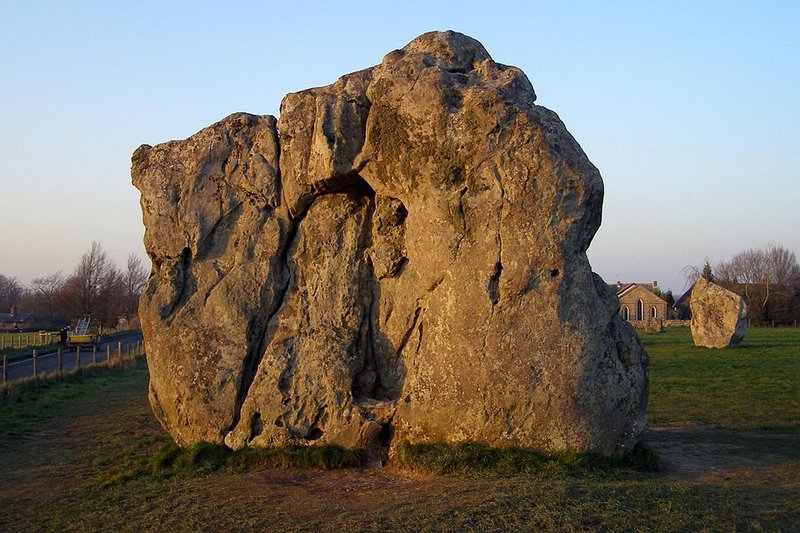
​The Devil's Chair, Avebury (Wiltshire)

devil
The Devil’s Chair
​See page for author, Public domain, via Wikimedia Commons

L​egend says that if you run around this megalithic stone at Avebury Henge one hundred times, the Devil will pop up for a chat.

​In an original ceremony devised by Philip Shallcrass of the British Druid Order in 1993, pagans assemble and divide into two groups, one the God party and the other the Goddess party. Those with the Goddess party go to the Devil's Chair, where a woman representing the spirit guardian of the site is a vessel for the voice of the Goddess.

Avebury in fiction:

​Children of the Stones (1977) - full series

The Devil’s Den (Avebury)

​A dolmen burial chamber, part of a Neolithic passage grave on Fyfield Down.

A local tradition says if water was poured into hollows on the capstone, Satan would come in the night and slurp it. Super.

The Devil's Arrows (North Yorkshire)

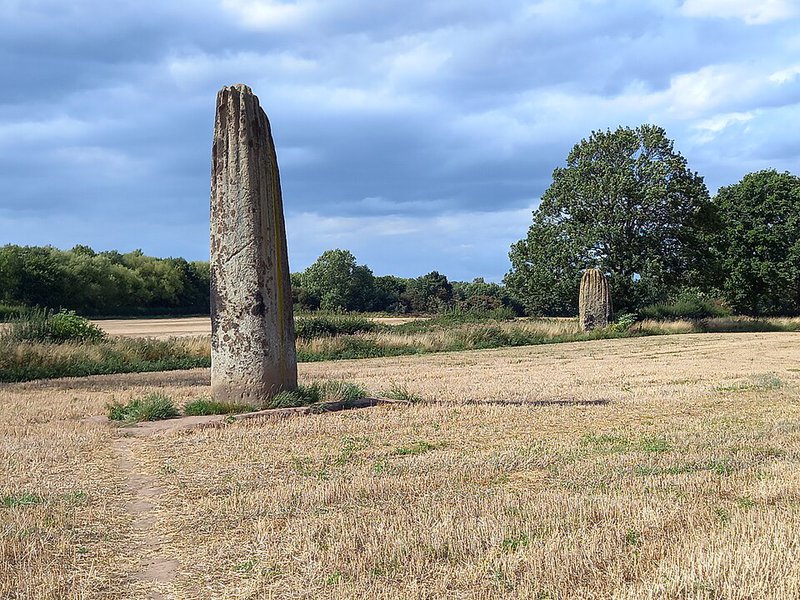
Two of the Devil's Arrows
​Two of the Devil's Arrows by Gordon Hatton, CC BY-SA 2.0, via Wikimedia Commons

​These millennia-old standing stones in North Yorkshire are the second tallest in the United Kingdom, after the Rudston Monolith.

The common Dark Age belief was that the Devil was shooting or throwing arrows from a neighbouring hill at the Christian settlement of Aldborough nearby, but he fell short of his target. Human sacrifices were supposedly conducted on the top of the stones, where the bodies were left to rot.

​​The Devil's Ring and Finger (Staffordshire)

​Some posit this Neolithic pile as a Druid’s altar within a sacred grove, the circular Ring Stone an altar piece for the Sun God, who represented the power of life, of good, of increase, and the Finger representing the Serpent God, which represented evil and death - in other words Satan, to later inhabitants. The Ring Stone’s porthole, is large enough for a person to climb through, or be passed through, to increase fertility. Or is it a portal to another dimension? Faerie perhaps?

The Devil's Quoits (Oxfordshire)

​The Devil's Quoits are located in Oxfordshire, Neolithic henge and stone circle near the village of Stanton Harcourt. Folklore says the Devil threw large stones from Wytham Hill, some 8 miles away, during a game of quoits with a beggar for his soul. The beggar lost.

In a different version, Satan was actually playing solo on a Sunday and was b*llocked by God for playing games on His Holy Day. Understandably, a frustrated Old Nick threw his huge stones down in a hissy fit at Stanton Harcourt.

Traditionally, the stones were thought to resist being moved; one story tells of a stone moved to make a bridge that would not stay in place. In fact, the henge has been disturbed many times in recent history. The stone circle originally featured 36 stones, some removed during the medieval period (used as building materials); during WWII, the site was levelled for an airfield. More recently, there have been efforts to restore the henge; the remaining stones being re-erected, missing stones replaced with modern blocks, and the earthworks surrounding the circle re-dug between 2002 and 2008. So a tad ersatz then.

The Devil's Stone (Shebbear, Devon)

The stone is rolled over every November 5th to "turn the Devil away" and prevent the next year's crops failing. Also, if the stone is NOT overturned, Satan will the appear. The Shebbear Yeomanry has yet to try leaving the stone unrolled as a test, local parish records show.

​​The Nine Stones, Winterbourne Abbas (Dorset)

These sarsen stones were erected in the Bronze Age; legend claims they were the Devil, his wife, and his children and cannot be counted; others say they had once been children who were turned to stone as punishment for playing ‘Five-Stones’ on a Sunday. A bit severe.

​In 2007, the Dolmen Grove Druids claimed they’ve had to confront individuals hurling abuse at them as they performed their rituals at the Nine Stones.

The Devil’s Toenail (Bedfordshire)

​This Neolithic stone (10,000 to 4,500 BC) marks the spot where the Devil joined some local kids who were defying the sabbath by enjoying a cheeky game of leapfrog. Satan merrily participated in their game, then opened a hole in the ground into which they were cast and never seen again.

20 minutes or so from my dwelling.

Roche Rock (Cornwall)

devil
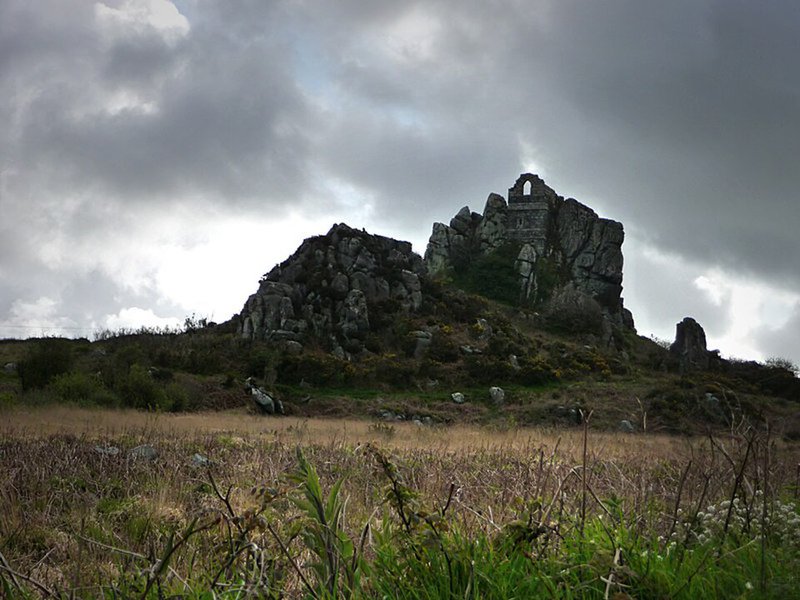
Roche Rock
​Roche Rock by Chris Gunns, CC BY-SA 2.0, via Wikimedia Commons

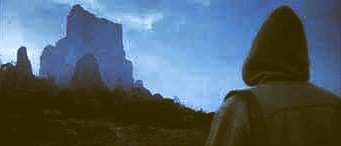
I’ve been to Cornwall’s chapel of St Michael at Roche Rock, mainly I admit from curiosity to see the location for one of the doomed killer monks attempts on Damien’s life in 1981’s Omen III: The Final Conflict than anything else.

The Chapel in Omen III: The Final Conflict (1981)

​Roche Rock features in Cornish myth; the ruined chapel that we see today was built more than 600 years ago in 1409 by the wealthy Tregarrick family. The last resident of Roche Rock is said to have been Sir John Tregarrick who hid himself there for many years after contracting leprosy. His only visitor was his daughter who brought him food and fresh water from a nearby well. 17th century magistrate Jan Tregeagle’s evil spirit was set to roam the wilds of Cornwall pursued by Satan’s demons. Tregeagle sought sanctuary in the chapel’s holy ground, but only managed to get his head stuck in the east window, with his body dangling outside to be welted by the Devil’s eager helpers. On a stormy night you can still hear the howls and tortured screams of cornered Tregeagle on the wind.

​In the time of King Arthur, it was said to have been the base of hermit/holy man Ogrin. Ogrin helped the famous star-crossed lovers Tristan and Isolde in their attempted escape from an enraged King Mark, hiding the couple with him on the rock.

Devil's Chimney (Gloucestershire)

The Devil, cheesed off by the many Christian chapels in the area, took to perching on Leckhampton Hill, mocking and hurling rocks at those who attended church on a Sunday. But the treacherous, turncoat rocks rebelled and drove Satan back beneath the ground, preventing him from harassing the pious villagers any further.

The mass of stones then formed a chimney to hell - as can be seen by tendrils of smoke that waft from the structure at night. Visitors still leave a coin among the stones, to protect them from the wrath of the Devil.

​The Devil's Lapstone (Durham)

The Devil himself offered to help build Durham Cathedral but with the wicked intention of constructing foundations of such crumbly rock, the building would soon collapse, killing anyone inside. Naughty Satan.

Lucifer would fly up and down the length of the River Dene, collecting stones for the cathedral, but one day, his leather apron snapped and the stone within plummeted to earth. The Devil snatched at it, trying to catch it again and again, leaving deep scratches and Satanic blood in the rock. If you ever see the Devil’s Lapstone, take a close look, as you can still see the rents and blood left by The Horned One in his fury.

LINKS:

​The Blood Stone at Luccombe: https://www.gothichorrorstories.com/journal/folk-horror-from-wiltshire-the-blood-stone-at-luccombe-spring-starving-out-the-vikings-at-bratton-camp-the-white-horse-of-westbury-and-the-nature-of-folklore/

​The Devil’s Boulder: https://www.shebbearvillage.co.uk/people/the-devils-stone/

​Soulbury Stone: https://www.bbc.co.uk/news/uk-england-beds-bucks-herts-36024009

​Sitting in The Devil’s Chair: https://marywoodenglandandireland2015.wordpress.com/2015/05/29/sitting-in-the-devils-chair-erasure-of-ancient-culture-and-fear-of-the-other/

​Devil's Toenail: Bedfordshire's frightening version of Stonehenge: https://www.bedfordshirelive.co.uk/news/history/devils-toenail-bedfordshires-frightening-version-5808785

​Ritual Protection Marks & Ritual Practices - The Devil’s Stone: https://ritualprotectionmarks.com/2022/10/31/a-chill-tale-for-halloween-the-legend-of-the-devils-stone/

​The Devil's Den and Fyfield Down: https://www.hiddenwiltshire.com/post/the-devil-s-den-and-fyfield-down

​The Devil in Westleton: The Westleton Witch’s Stone: https://withthefaeries.wordpress.com/2022/11/27/the-devil-in-westleton-the-westleton-witchs-stone/

The British Druid Order: https://web.archive.org/web/20120808075032/http://www.druidry.co.uk/bdocaerabiri.html

​The Devil’s Ring and Finger: https://thehistorydetective.org/2019/02/15/the-devils-ring-and-finger/

​The Devil's Quoits: https://www.darkoxfordshire.co.uk/explore/the-devils-quoits/

​Pagans suffer ritual abuse: https://www.dorsetecho.co.uk/news/1267293.Pagans_suffer_ritual_abuse/

​The Nine Stones of Winterbourne Abbas: https://shows.acast.com/dark-darzet/episodes/the-nine-stones-of-winterbourne-abbas

​Devil's Lapstone: https://www.atlasobscura.com/places/devils-lapstone

​Roche Rock: https://www.cornwalls.co.uk/st-austell/roche-rock

​A tale of rocks and rogues: https://www.boltholeretreats.co.uk/blog/a-tale-of-rocks-and-rogues/#

​Why not visit the enigma of the Devil's chimney: https://www.bbc.co.uk/gloucestershire/content/articles/2005/06/17/devils_chimney_feature.shtml

​A look at devil-lore in Gloucestershire and Oxfordshire: https://www.greatbritishlife.co.uk/magazines/cotswold/24329332.look-devil-lore-gloucestershire-oxfordshire/

STEPHEN ARNELL’S NOVEL THE GREAT ONE IS AVAILABLE ON AMAZON KINDLE NOW:

SAMPLE:

Monday, 28 February 2022

Better the Devil You Know

One of my favourite quotes of all time comes from the African shamanic culture: “Nature is magic and magic is natural.” I have believed in magic for as long as I can remember, and whiled away many happy childhood hours with my imaginary friends in Enid Blyton’s Magic Faraway Tree. When mum made me and my sister some fluffy angel wings to wear, we put our instant flying powers to the test by jumping off dad’s red ladder in the garden. As you do. Undeterred by consistent crash landings, Planet Earth felt like an exciting place to be for an inquisitive and imaginative child - St Peters, Adelaide, South Australia, to be precise.

As I grew older, life began to feel decidedly heavier, and the magic began to fade. The sudden death of my dad in 1980, just weeks after the equally devastating and untimely death of John Lennon, left me with some significant questions about God’s existence. A hefty burden for a 17 year old. By my early twenties, I began to quietly explore the esoteric realms, most of which were mocked, discouraged and demonized. Astrology was for weirdos, spiritualist churches were full of evil occultists and the concept of life after death was deemed nonsensical.

Like most people, I shuddered at the mere mention of the word occult because I equated it with the unpalatable work of the devil, even though I didn’t believe the devil existed. I enjoyed learning about astrology, numerology, runes and other sacred forms of divination but chose to disassociate them from the occult because I didn’t consider them to be evil. However, my idealistic, esoteric world began to transform in the mid-90s when I dipped my toes into the ancient shamanic world of healing and magic which dates back over a hundred thousand years. Even then, I skirted around the edges of the daemonic ‘underworld’, preferring to focus on the healing arts and how to harness the magic of nature. By the mid 2000’s, the universe conspired to connect me to a spiritual medium with whom I fell into a ten year relationship, an invaluable experience that provided deep and often rare insight into the delicate and deeply comforting art of authentic mediumship.

When it was time to part company with the medium and my entire life as I knew it, I also left the spiritual scene behind. With the rise of the internet, I watched the essence of esoteric authenticity and purity become overrun with well marketed wannabe ‘pop-up’ psychics and mediums. This left me feeling frustrated, disillusioned and concerned for vulnerable, grieving souls who were easy prey for the growing community of online shysters looking to make a few bucks from fortune telling and fake mediumship.

Just when I thought I was done with dabbling in the spirit world, along came Susan Filer, a kindred spirit from the UK who hosted an extraordinary spiritual sanctuary and private online group for people interested in learning more about authentic mediumship and all things related to spirit. We exchanged a few private messages about our concerns regarding the invasion of spiritual charlatans and she recommended that I contact Jock Brocas, a spiritual medium, author and educator who was on the same virtual page.

I must confess that my inner scaredy cat recoiled when I learned that Jock also specialized in education about the darker side of the occult and was nearing completion of his latest book Deadly Departed. Soon after that, I was drawn to a Shift Network course about the shamanic healing arts, magic and medicine under the guidance of a highly sought after Peruvian kamasqa curandero (healer), scholar and educator don Oscar Miro-Quesada. Between Brocas, Miro-Quesada and additional studies with author, attorney and leading authority on energy medicine, Deborah King, I safely delved into the daemonic realities of the ‘unseen’ realms and learned to replace fear and avoidance with confidence and understanding of how to navigate such dimensions if necessary.

The DeviI Has His Part To Play

Image: Jeff Shattuck, Pixabay
“The devil ain’t got no power over me. The devil comes, and I shake hands with the devil. The devil has his part to play. Devil’s a good friend, too… because when you don’t know him, that’s the time he can mosh you down.” — Bob Marley

In hindsight, I can now see the unfolding trail of spiritual teachers who helped me prepare for my unexpected journey into the deepest, darkest realms of mass deception in March 2020, when Corona officially landed in Australia. Whilst curating articles for ‘The Book of Comfort: Grief and Loss to Solace and Hope’, an Otherside Press project I had embarked on with Jock Brocas, I began to collaborate on a parallel book project with an inexperienced author whose raw, esoteric and often painful manuscript explored various themes ranging from ancestral healing, growing up in a cult family, recovering from child sex abuse and dealing with dark occult interferences. Most of her occult claims and experiences were completely new to me, and required extensive research to qualify.

As a result, I found myself on a fast tracked learning curve about the reality of generational satanic and Luciferian bloodline families where ritual child abuse, child sacrifice and cannibalism are common place; clandestine, harmful, black magick rituals that are repeatedly inflicted upon humankind by powerful, unelected creatures at the highest levels; the reality of psychopathic addictions to satanic ritual abuse and blood sacrifice of children; a US$150+ billion/year child trafficking, organ and adrenochrome harvesting racket. These hideous crimes were my most gruesome discoveries by far. Nonetheless, I helped the author develop and structure her manuscript into a readable form that an editor may consider working on and was really happy to move on from those darker realms. A job that I estimated would take about 3 months, took 9 months to complete and even then there was more work to do but that was the writer’s job.

Is the Occult Really Such a Dark and Dangerous Place?

Interesting to note that the mainstream online world will still have you believe that the occult is either a dark and dangerous place, dismissed as devilish nonsense or an elitist realm reserved for a select few such as secret societies including the Freemasons (that are not so secret anymore). Here are some examples of standard definitions I found on higher profile websites:

Cambridge Dictionary - (noun) relating to magical powers and activities such as witchcraft and astrology.

Merriam Webster- (noun) matters regarded as involving the action or influence of supernatural or supernormal powers or some secret knowledge of them.

Lexico - Oxford - (noun) Mystical, supernatural, or magical powers, practices, or phenomena.

Bible Study - Biblically, the occult is any practice that tries to gain supernatural power, abilities, or knowledge apart from the creator God. The Bible is clear regarding what the Eternal thinks about man's foolish attempts to circumvent Him.

Wikipedia: The occult, in the broadest sense, is a category of supernatural beliefs and practices which generally fall outside the scope of religion and science, encompassing such phenomena involving otherworldly agency as mysticism, spirituality, and magic. It can also refer to supernatural ideas like extra-sensory perception and parapsychology.

Online Etymology Dictionary - 1530s, “secret, not divulged,” from French occulte and directly from Latin occultus “hidden, concealed, secret,” past participle of occulere “cover over, conceal, from assimilated form of ob “over” + a verb related to celare “to hide” (from PIE root kel “to cover, conceal, save”). Meaning “not apprehended by the mind, beyond the range of understanding” is from 1530s. The association with the supernatural sciences (magic, alchemy, astrology, etc.) dates from 1630s.

When I broadened my search to some of the more obscure sites offering definitions of the occult, I discovered more resonant results. For example, Unimed Living’s Unimedpedia was a particularly spiritually nourishing find:

"The word ‘occult’ is one of the most sacred words that one can use and know. What it means, what it describes and what it reveals is that which God is; and from there, what forms God’s Science and thus the Science of God Himself." Serge Benhayon, An Open Letter to Humanity

I must confess that when I initially saw the word ‘God’, I flinched just a little and accepted that I had more work to do in relation to esoteric education and making peace within myself. But the more I read, the more I resonated:

"The true meaning of the word ‘occult’ is in complete contrast to the grossly erroneous conception, reference, inference and or direct claim that the word ‘occult’ is in any way associated with evil or witches, warlocks, ‘black magic’ or harm etc. The word ‘occult’ means the culture of God or the way of God. When the true meaning of the word occult is known to many more, and eventually by the majority, it will be found why it is so desirable to have it in its bastardised meaning by those who so desire it to the point of insisting that they are right and that there is no other meaning. For ‘them’, there is much to explain once the true meaning is more widely known … a meaning that unites all by one common truth." Serge Benhayon, Esoteric Teachings & Revelations

The following Unimedpedia passage also bears repeating, as it concisely weaves together the spiritual value of inviting the occult and esoteric into our lives:

“The occult is the entirety of the Whole and the esoteric is the many parts that make up the whole. If the occult is ‘all there is’ and we are separated from this, then by virtue of our withdrawal, we have created the very ‘parts’ that now need to be reconciled with the whole they are now existing a-part from. When one lives esoterically from the impulses of the Soul, the occult will reveal itself in full. It is up to each of us whether we choose to live this way or not and to what degree we will live it.” Unimedpedia

Armed with a new appreciation of why it really is better to know the devil than not, along with the benefits of ‘full spectrum’ occult awareness, I look forward to sharing more thought provoking revelations in a series of forthcoming articles for Paranormal Daily News.

“The greatest trick the devil ever pulled was to convince people he didn't exist. The disguises the devil used this time were simple and the people were easily fooled. A suit and tie plus a white lab coat were all that were needed.” Poul Larsen, ColdCast
Image Source: Poul Larsen, ColdCast