The ancient Roman world had not one, but two annual festivals that are analogous in some ways to Halloween.
These were the Parentalia, a nine-day festival in February to honour family ancestors, and the far more Halloween-like Lemuria/Lemuralia, held in May to appease malign supernatural entities. I’ll concentrate on Lemuria but if you’re especially interested in the Parentalia, there are links in the appendix at the end of this piece.
During the 3 days of the Lemuria (9th, 11th, and 13th of May), the ancient Romans performed rites to rid both evil and the merely restless dead from their homes. These baleful presences, known as lemures or larvae were placated with appropriate chants and by offerings of black beans.

Naples National Archaeological Museum, Public domain, via Wikimedia CommonsAccording to Ovid (43 BC – AD 17/18), the festival began with Romulus’ Remuria, which sought to pacify the bitter shade of twin Remus, who he murdered in an argument over Rome’s first city wall.
The lemures were apparently malicious due to being "kinless and neglected" when they died, with no commemorative rites; able to depart their dead bodies but unable to enter any underworld or afterlife. The larvae were nastier, wandering around a house with the lemures, causing more direct mischief; the name was also lent to a frightening kind of theatrical mask.

Carole Raddato from FRANKFURT, Germany, CC BY-SA 2.0, via Wikimedia CommonsThe Lemuria was supposed to help family members who had died "before their time" - in childhood or youth, via disease, battle, accident or assault and also where they were prevented being given proper funeral rites.
Ovid wrote that during Lemuria, the male householder (and possibly other members), walks barefoot through the house at midnight. After washing his hands in spring water, he takes his thumb between the fingers of his hand to ward off any ghosts, then spits out or throws black beans over his shoulder for the famished lemures to collect. He chants "I send these; with these beans I redeem me and mine" nine times and the rest of the household clashes bronze pots, repeating, "Ghosts of my fathers and ancestors, be gone!" The householder then washes his hands three times in spring-water.
When he turns to see the results of the offering, no lemures are to be seen. However, the larvae were believed to be utterly unforgiving, continuing to hound the living and even torturing wicked souls in Hades. So the solution would be to move house, I guess.
During the Lemuralia, all temples were closed and no marriages were allowed. Both the Lemuralia, and the Argei ceremony held in the same month (which itself was said to be a substitute for human sacrifice in days gone by), made May particularly ill-omened for marriages.
Pliny’s Three Ghost Tales
I am extremely desirous therefore to know whether you believe in the existence of ghosts, and that they have a real form, and are sorts of divinities, or only the visionary impressions of a terrified imagination. (Pliny the Younger, LXXXIII To Sura)
Gaius Plinius Caecilius Secundus, known to us as Pliny the Younger (AD 61 – 113) recounts three tales. The first is of a spectre that warned the senator, Curtius Rufus, of his rapid rise to power, and of his death in Africa. The second is of the Greek philosopher Athenodorus, who wanted to rent an apartment in Athens but was puzzled as to why it was so cheap. This was because the shade of an old man harassed any occupants of the flat, prompting Athenodorus to spend the night there to see what happened. The spectre appeared whilst the philosopher was working, insisting Athenodorus follow him to a spot nearby. The next day, Athenodorus asked that a hole be dug and found a chained, putrefied body. The remains were reburied with the proper rituals, and the ghost was never seen again.
Pliny’s third tale was of an experience in his own villa:
I have a freedman named Marcus, who is by no means illiterate. One night, as he and his younger brother were lying together, he fancied he saw somebody upon his bed, who took out a pair of scissors, and cut off the hair from the top part of his own head, and in the morning, it appeared his hair was actually cut, and the clippings lay scattered about the floor. A short time after this, an event of a similar nature contributed to give credit to the former story. A young lad of my family was sleeping in his apartment with the rest of his companions, when two persons clad in white came in, as he says, through the windows, cut off his hair as he lay, and then returned the same way they entered. The next morning it was found that this boy had been served just as the other, and there was the hair again, spread about the room. (Pliny the Younger, LXXXIII. To Sura)
Great Nero’s Ghost!
Time Tunnel - The Ghost of Nero
Nero, who was murdered in 68 BC, has supposedly been seen on the Via Nomentana, where he committed suicide at a servant’s villa. He was also seen to haunt the Piazza del Popolo, where his tomb was supposed to be. A ‘cursed tree’ grew up from his grave, where Nero’s ghost was believed to have lingered alongside various witches and demons. In 1099, Pope Pasquale II had the tree burnt down and a chapel built in its place, while Nero’s tomb was dug up and thrown into the Tiber.
Messalina’s Ghost
Messalina, the promiscuous wife of the Emperor Claudius was executed (after failing to kill herself) in the Gardens of Lucullus on Rome’s Pincian Hill; although strangely her spectre is said to haunt the area near the Colosseum, by the remains of the foundations of Temple of Emperor Claudius, built after her vengeful husband died in 54 AD.
The empress was rumoured to have engaged in a sex competition with Rome’s top prostitute, Scylla, as depicted in BBC2’s I Claudius (1976):
Vicus Sceleratus - the “Wicked Street”
Servius Tullius, the sixth and last ‘good’ King of Rome, was murdered by his son-in-law, Tarquinius Superbus (the seventh and final King of Rome) and his nasty daughter Tullia, who ran over her dad’s corpse with her chariot at the stretch of road later renamed the Vicus Sceleratus (Wicked Street) in memory of her horrific crime.
The location is also associated with the Scalinata dei Borgia, or Borgia Stairs, near the Basilica of San Pietro in Vincoli. Said to be the same area as the Vicus Sceleratus. The not-entirely wholesome Borgia family later built a palace over the ancient stairs, giving the location its current name.
The ghost of Caesar appears before Brutus (Julius Caesar, 1953).
Ancient Roman ghosts (mainly legionnaires) in England
And lastly, a few of the sites in England associated with the unquiet spirits of ancient Rome.
There are many sightings of Roman spectres in England, more it seems than Italy and the other provinces of the Empire. Why? Could England and the rest of the British Isles be more receptive to the spirit world than other countries? Do ley lines, prehistoric monuments and the like make England more porous to the paranormal?
The "Devil's Bridge" on the old Roman Road (aka "Spooky Lane") in Hertfordshire is associated with sightings of a Roman soldier guarding the road.
York - The Treasurer’s House
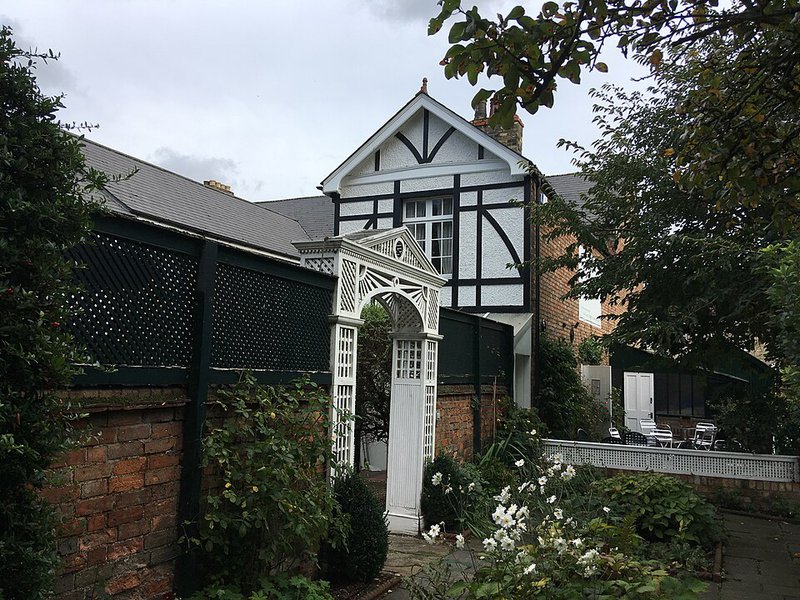
In 1953, trainee plumber Harry Martindale was working in the cellar of the old Treasurer’s House in York. He reported seeing a procession of downbeat, bearded Roman legionnaires wearing green tunics, carrying round shields, led by a mounted officer. The account is notable because later archaeological findings supported the details of his description, which differed from the common image of Roman soldiers - red cloaked, clean-shaven, square shields etc.
Thurston Clough, Greater Manchester
A letter received by the Oldham Evening Chronicle in 1973 claimed that Roman soldiers haunted Thurston Clough. The Romans had supposedly been seen before World War I (about 60 years earlier) by the letter writer’s grandfather. The legionnaires were led by a standard bearer carrying a wild boar’s head emblem. As they marched, they would sometimes appear to be walking above the ground and sometimes through it, explained by the terrain having changed over the last 2000 years. The sounds associated with metal and leather armour was said to accompany the apparitions.
Westmill Lane, Hertfordshire
At this point the old Roman Icknield Way running through Hertfordshire is called Westmill Lane. There are stories of the ghosts of Roman Soldiers marching here. The road also passes Gerry's Hole, where the ghost of Gerry (who fell into the pool and drowned on the way home from the pub one night) makes his presence known.
Reculver, Kent
It’s said that on stormy nights the mewling of young children could be heard emanating from Reculver’s ruined church and Roman fort. When the site was excavated in 1966, the skeletons of young babies were found under the foundations of the Roman barrack block. Were they part of some ghastly human sacrifice?
Bath - the Naked Ghost

Diego Delso, CC BY-SA 4.0, via Wikimedia CommonsThe figure of a naked Roman (which posits the question how can one tell if he’s nude?) has apparently been seen scampering around the town centre. On one occasion, a police officer gave chase to the streaking spectre, but the pursuit ended when the spook faded into the air.
The Chichester Inn, Chichester, West Sussex
West Street’s Chichester Inn stands close to Chichester’s ancient Roman walls, where the west gate of the town once stood. A Roman centurion’s phantom is said to haunt the pub as it continues to patrol the city wall on a seemingly endless patrol.
The Lookout Inn, Lawe Top, South Shields
The Lookout Inn stands opposite the partially reconstructed Arbeia Roman Fort which served as a maritime supply base for Hadrian’s Wall. The following account appeared on the Jarrow Life forum.
‘I used to work in the Lookout Inn at the top of Fort Street, South Shields, way back in 1966. One Friday day shift I was serving one of the regulars and from where I was positioned I saw a movement from the right of me, turned for a second and saw someone walking down the living quarter’s stairs, then when I heard them opening the snug door I fully turned to look and saw my boss’s son dressed in Roman armour with a sword held to his chest. I laughed and said ‘where you going?’ but he just ignored me and I just went ‘Ooooo’. He stopped, opened the hatch and went down the stairs into the cellar. About ten minutes later I heard his mam shouting for him so I shouted up that he was in the cellar. ‘No, I’m not. I’m in the bathroom’ was his reply from upstairs. I kicked the cellar hatch shut! Some of the regulars said that they often saw one, two or three Roman soldiers around the pub at different times.’
Oldbury Castle and Cherhill White Horse, Wiltshire
This hillfort atop the White Horse covers 22 acres and is said to be haunted by Roman soldiers. They have also been seen on a road near to the camp.
Bleaklow Head and moors, Derbyshire
According to Peak District legends, a patrol of Roman soldiers disappeared while crossing the moors in the area around Bleaklow. Apparently they either became lost and died of exposure, or were ambushed by the rebellious local hill tribes and thrown in the bogs. The area was frequented by the Romans - a fort stands at Castleshaw and their roads can be seen such as Doctors Gate which ran from Navio Fort in Hope Valley to Melandria Fort near Glossop.
Flowers Barrow, Dorset
An Iron Age hillfort above Dorset’s Lulworth Cove was taken over by the Romans after they invaded. The area is said to be haunted by phantom Roman soldiers seen several times over the years, traditionally appearing at times of national crisis.
In 1678, a phantom legionary army is said to have marched towards the town of Wareham from Flowers Barrow. The episode is recorded in the ‘History and Antiquities of the County of Dorset’ by the Revd John Hutchins. Around 100 people supposedly saw the spectral troops and their steeds. They looked so real that messengers were sent ahead to the next town to warn of the approaching army – which naturally never arrived.
In the 1930’s it was reported that a ghostly Roman army was seen on a foggy night, marching along nearby Binden Hill to their camp on King’s Hill, with the sounds of the marching men and their trotting horses heard.
Barrow Hill, Mersea, Essex
Mersea Island was used as an outpost garrison by the Romans. There is a causeway called the Strood, which connects Mersea Island to mainland Essex. At high tides, the Strood is underwater and in October, it’s said you can see the top half of a centurion marching the causeway; half because he’s patrolling the original Roman road. Many have reported seeing him, with motorists reporting the centurion suddenly appearing in their car’s headlights. Others say they have seen nothing but have heard footsteps following them; if the walkers stop, the footsteps stop; if they start walking again, so does the mysterious ghost.
On the island, half a mile south of the Strood, there stands a burial mound. It’s thought to be Roman from about 100 to 120 CE. Excavated in 1912 it was found to contain “a lead box with a wooden lid. The box contained an urn of green glass containing cremated remains” (Mersea Museum). The grave was of a high-status individual; some have suggested the centurion is in fact guarding the final resting place of this person.
Chester, Cheshire
A Roman trooper is said to pace between the ruins of Chester’s Roman Amphitheatre, located at Vicars Lane and the site of a Roman watch tower, near Newgate. The earliest known sightings date back to the late Tudor times; the spirit is said to be fading over time, with the first accounts describing the soldier as life-like, but more recent witnesses claim he is but a faint figure.
Another Roman ghost haunts Chester’s George and Dragon pub, which stands on what was a Roman road. Marching footsteps can be heard through the building, passing through the front and back walls of the pub; nothing has ever been seen of this ghost though, only the sound of his heavy hobnailed footsteps.
Many of these stories adhere to the ‘Stone Tape’ theory where past events imprint themselves on places, which can be summoned back by those sensitive to them, as depicted in Nigel Kneale’s chilling 1972 ghost story The Stone Tape:
Others suggest the appearances may be evidence of the ‘Timeslip’ hypothesis, explained in the introduction to ITV’s 1970 series appropriately titled Timeslip:
More Roman Stories
Stephen Arnell’s novel, THE GREAT ONE, is available on Amazon Kindle:
https://www.amazon.co.uk/Great-One-Secret-Memoirs-Pompey-ebook/dp/B0BNLTB2G7
Sample: