
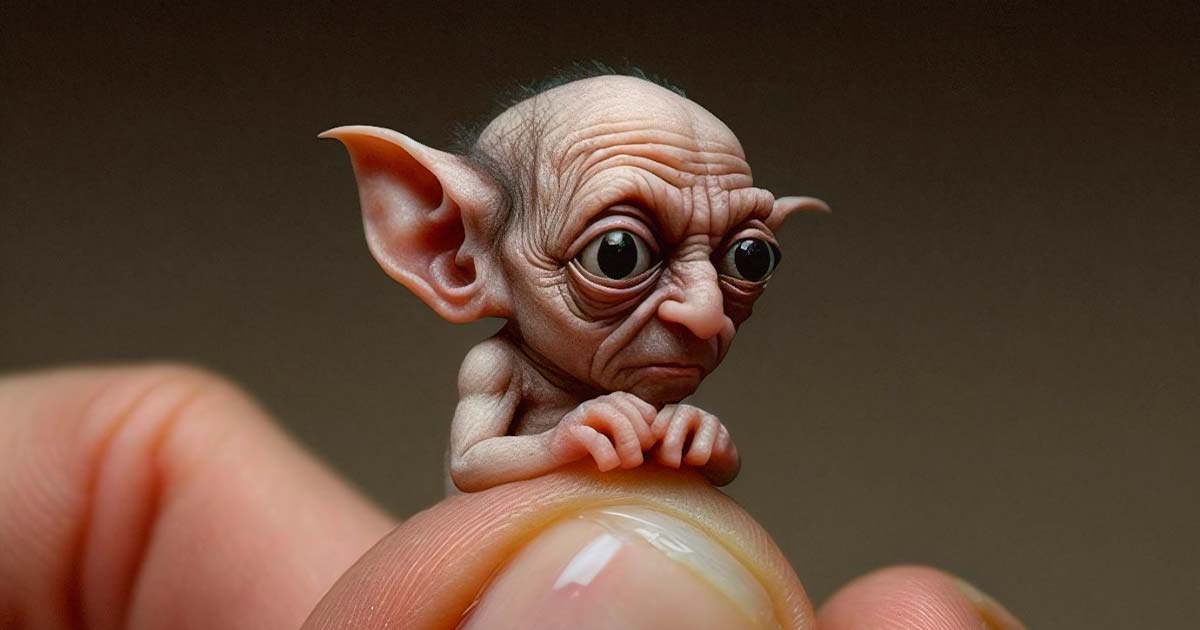
Mackenzie Crook's critically lauded BBC2 comedy-drama Small Prophets has sparked renewed interest in ‘Homunculi’ - the strange sperm, blood and horse manure created tiny artificial humans or human-like beings of legend...or reality?

In the show, DIY store worker Michael Small (Pearce Quigley) is inspired by his aged father Brian’s esoteric tales of National Service in Egypt to attempt to create his own prophesying creatures. Why?
To discover what happened to his girlfriend Clea, who disappeared without explanation seven years ago on Christmas Eve:
What are Homunculi - and what are their origins?
Psychiatrist, psychotherapist, and psychologist Carl Jung (1875-1961) believed that the concept of an (as yet unnamed as such) ‘Homunculus’ first appeared in the Visions of Zosimos, written in the third century AD. Zosimos was born in Panopolis in the south of Roman Egypt (a connection with Small Prophets) and wrote the oldest known books on alchemy, calling them "Cheirokmeta," for "things made by hand."
In the 1973 motion picture The Golden Voyage of Sinbad, evil sorcerer Koura creates a Homunculus to spy on Sinbad:
How can I create a Homonculus?
Swiss alchemist Paracelsus (1493–1541), in his De natura rerum (1537) outlines how to create Homunculi, not something to be taken lightly.
The sperm of a man be putrefied by itself in a sealed cucurbit for forty days with the highest degree of putrefaction in a horse's womb warmed by "venter equinus, warm, fermenting horse dung", or at least so long that it comes to life and moves itself, and stirs, which is easily observed. After this time, it will look somewhat like a man, but transparent, without a body. If, after this, it be fed wisely with the Arcanum of human blood, and be nourished for up to forty weeks, and be kept in the even heat of the horse's womb, a living human child grows therefrom, with all its members like another child, which is born of a woman, but much smaller.
The homunculus was a potentially powerful but also somewhat limited creature; only thriving for any time within its glass container and sustained only on a particular strain of blood known only to alchemists.
The homunculus acted as seer, protector and servant, not as a weapon; neither good nor evil, counted on only to follow the will of their master, be it for pure means or ill.
The Chymical Wedding of Christian Rosenkreutz (1616), concludes with the creation of a male and female Homunculi duo, suggesting the ultimate goal of alchemy is not transmutation of metal but the creation of artificial humans. In 1775, Count Johann Ferdinand von Kufstein, assisted by the cleric/mystic Abbé Geloni, created ten homunculi with the ability to foresee the future (see also Small Prophets), kept in glass containers at the Vienna’s Masonic lodge.
From The Strange Experiments of Count Kuefstein: The Man Who Made Ten Homunculi by Rade Kolbas (2024):
They worked on creating ten spirits, which they claimed to have successfully captured in glass jars. Each spirit was unique: there was a king, a queen, a knight, a monk, a seraph, a nun, a miner, an architect, and two other spirits, one blue and one red, that were only visible through specific rituals. The spirits were said to be small, initially just a few inches in size, and were captured in jars filled with a clear liquid, possibly holy water. The jars were sealed with a special ox bladder and a sigil, believed to prevent the spirits from escaping. Abbé Geloni assured Count Kuefstein that the spirits would grow, which they allegedly did, eventually reaching a length of over a foot. The captured spirits were then dressed and assigned certain roles, the king wore a crown, the knight carried a shield, and so on.
The captured spirits played a role in the Count’s interactions with other members of the Freemason and Rosicrucian orders. On several occasions, he invited prominent members of these secret societies to Greillenstein Castle to witness the spirits in action. These demonstrations were highly secretive, with only a select few allowed to attend. The spirits, according to witnesses, would move within their jars, change color, and even “speak” in a faint, barely audible voice. While some attendees were convinced of the spirits’ authenticity, others suspected that the Count and Geloni were using clever tricks to create the illusion of supernatural activity.
Not everything went smoothly during Count Kuefstein’s experiments. One notable incident involved the breaking of the jar containing the monk spirit. During an attempted ritual, Count Kuefstein accidentally knocked the jar over, causing it to shatter and the spirit to “die.” The Count’s attempts to replace the monk spirit with a new creation, an “admiral” spirit, ended in failure, as the new entity lacked the vitality of its predecessors. Another failed experiment involved an attempt to create a spirit that could provide more direct and accurate answers to questions posed by the Count. This spirit, which was supposed to be a “sage,” never fully formed, and the liquid in its jar remained cloudy and inert.
Dr. Emil Besetzny's 1873 Masonic handbook, Die Sphinx, devoted a chapter to the wahrsagenden Geister (scrying ghosts), apparently a form of Homunculi.

The Golem and Mandrakes
Homunculi have been compared to Jewish folklore’s protective Golem, a lofty animated anthropomorphic artificial being created from mud/clay.
The most well-known account of the golem is The Golem of Prague created by Judah Lowe ben Bezalel, in the 16th century.
The homunculus may have also been inspired by the German folk tradition of the mandragora (mandrake). Author Jean-Baptiste Pitois (1811-1877) likened the creation of a mandragora to that of a homunculus, writing:
“Would you like to make a Mandragora, as powerful as the homunculus so praised by Paracelsus? Then find a root of the plant called bryony. Take it out of the ground on a Monday (the day of the Moon), a little time after the vernal equinox. Cut off the ends of the root and bury it at night in some country churchyard in a dead man’s grave. For 30 days, water it with cow’s milk in which three bats have been drowned. When the 31st day arrives, take out the root in the middle of the night and dry it in an oven heated with branches of verbena; then wrap it in a piece of a dead man’s winding-sheet [burial shroud] and carry it with you everywhere.”

An Homunculus also featured in 2005’s The League of Gentlemen's Apocalypse, created by 17th-century sorcerer Dr. Erasmus Pea (played by David Warner):

"Scenes with Witches: Morning, Day, Evening and Night" by Salvator Rosa (1645 to 1649). A witch pours candle wax into her brew as it boils atop a fire, while another witch holds a book of spells. A demon (or, maybe even the Devil) looks on.

LINKS



Stephen Arnell’s novel THE GREAT ONE, is available on Amazon Kindle
SAMPLE:


No comments:
Post a Comment