
Black Annis ‘Kali’ - in Leicestershire?
Notwithstanding the large post WWII influx of immigration from the Indian subcontinent, Leicester is not the place that would boast a centuries-old legend of a witch described as possessing the blue features mirroring the Hindu Goddess Kali.
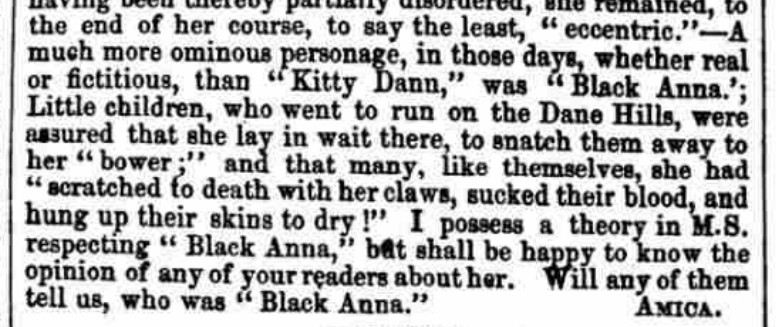
Black Annis (also called Black Anna or Cat Anna) was said to live in a cave in the now urbanized Dane Hills Housing Estate on the outskirts of Leicester.
The first official mention of Black Annis was in 1764, in legal documents referring to an area of land ‘known by the name of Black Anny’s Bower Close’, where she has used her iron claws to dig a cave out of the side of a sandstone cliff.
By the mouth of the cave grew a pollarded oak in which the witch hid to pounce on local kids. After capture, she sucked them dry of blood and ate their flesh, before draping their flayed skins out to dry on the oak's branches. The old oak tree is also recorded as having stood over the entrance, as was noted by local historian, William Kelly, quoted in The Leicester Mercury back in 1999:
“On my last visit to the Bower Close, now several years ago, the trunk of the old tree was then standing, but I know not if it still remains," he said. “At that time, and long previously, the mouth of the cave was closed, but in my school-boy days it was open, and, with two or three companions, I recollect on one occasion snatching a fearful joy, by crawling on our hands and knees into the interior, which was some seven or eight feet long by about four or five feet wide, and having a ledge of rock, for a seat, running along each side.”
“Watch out or Annis'll get you”
Black Annis wore skirts sewn from these skins and also preyed on animals to such an extent, local shepherds blamed any lost sheep on the hag. Generations of Leicester's boys and girls, if either naughty or out after dark, were told, “watch out or Annis'll get you”.
Tales will tell you that when when Black Annis ground her sharp fangs, local people could hear her, giving them just enough time to bolt their doors and to keep away from the window. Cottages in Leicestershire were purposely built with tiny windows so that the witch could only get one withered blue arm inside. According to folklore, when Black Annis screeched, she could be heard from up to 5 miles away. On hearing her howl, villagers would fasten animal skins across the windows and place protective herbs above the sills.
Today, the cave is thought to be in a back garden of a home in Dane Hills, filled in with earth and turfed over - although the deeds to the house reportedly mention the land is named “Black Anna’s Bower Close”.
An ancient account of Annis was supposedly told by a WWII evacuee to folklorist Ruth Tongue in 1941: Three children were sent out by their wicked step-mother to collect fire-wood. As night descended they feared to see Black Annis who only came out after dark for, it was said, 'daylight would turn her to stone'. They heard a snuffling and, through a hole in their witch-stone, saw Black Annis. Unable to escape her whilst carrying the faggots, they dropped them and ran. Annis bloodied her legs on the bundles and, mumbling and cursing to herself, went to her bower to rub her legs with salve. Then she came back for the children and caught-up with them at their cottage door. Their dad came out with an axe and hit Annis full in the face. She began to run for her cave shouting 'Blood! Blood!' but just then the Christmas bells began to peal and she fell down dead.
Leicestershire poet, John Heyrick Jnr wrote of Black Annis in the 18th century:
“Vast talons, foul with human flesh, there grew In place of hands, and features livid blue Glar'd in her visage; while the obscene waist Warm skins of human victims close embraced.”
Black Annis apparently confronted King Richard III on his way to the nearby Battle of Bosworth in 1485 When the King’s spurs struck a stone pillar on Leicester’s Bow Bridge, the crone declared his uncrowned head would hit the post on the way back.
After Richard lost the battle to usurper Henry Tudor, the late king’s bare-assed body was thrown across the saddle of a horse and his head, hanging down as low as the stirrups, hit the very same stone.
A tablet was put on the re-rebuilt bridge in the nineteenth century saying “his head was dashed and broken as a wise-woman had foretold, who before Richard’s going to battle being asked of his success said that where his spur struck his head would be broken”. If it indeed existed, the tablet is no longer there.

Black Annis featured in a Victorian Melodrama called ‘Black Anna’s Bower, or The Maniac of the Dane Hills’ about the murder of the landlady of ‘The Blue Boar’ pub.

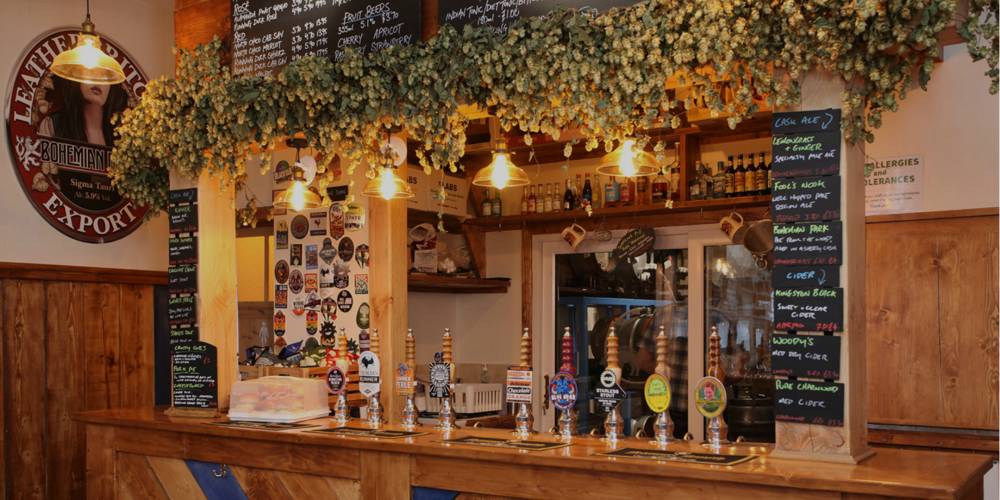
Leicester has had a Boar Inn since the Middle Ages; its latest incarnation is a micropub selling craft ales situated down a side street. The original White Boar was a much grander establishment and played host to Richard III as he made his way to Bosworth Field, possibly chosen because the castle was in a ramshackle state and, importantly, the White Boar was also Richard’s personal symbol, or sigil, as called in Game of Thrones.
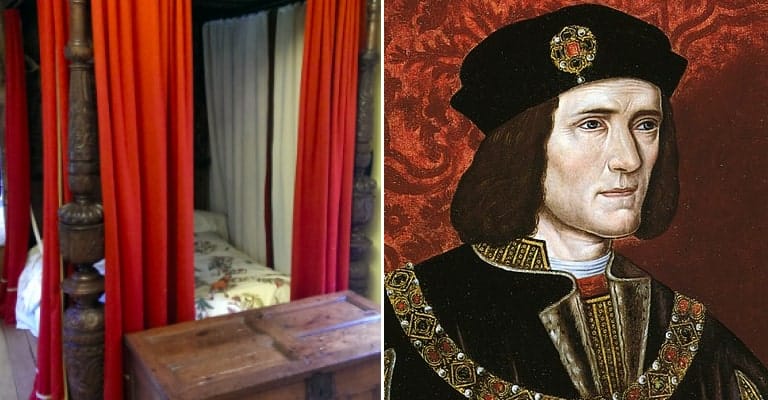
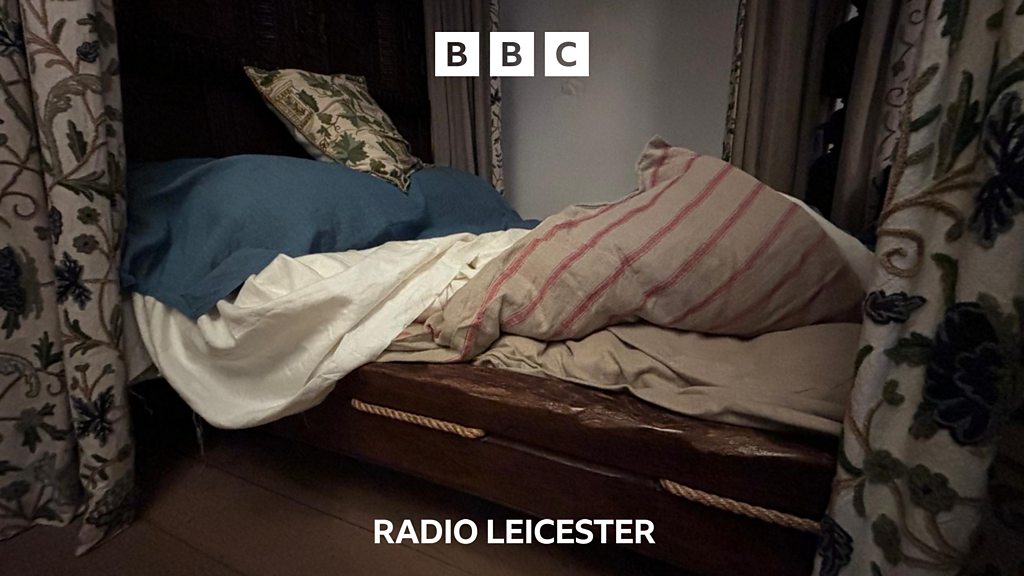
The King would not sleep in strange beds and so brought his own, and had it set up in the White Boar. When Richard left Leicester, his bed remained, ready for his expected return. This, of course, never happened. After his death, the bed stayed at the re-named Blue Boar, passing from tenant to tenant until it was eventually acquired by Leicestershire Museums Service, where it is today on display at Donington Le Heath Manor House.

In 1604, the tavern’s owner, Mayor’s widow Mrs Clarke was strangled to death because of a hoard of gold coins found hidden in the bed, which had partially funded her late husband’s mayoral campaign. The criminals, Thomas Harrison and Edward Bradshaw, aided by Mrs Clark’s servant, Alice Grimbold, were quickly apprehended and Bradshaw was hanged for his crime in 1605, whilst Alice – found to be an accomplice in the robbery and murder of her mistress – was burnt at the stake for ‘petty treason’. After the murder, the bed became notorious and in 1611, ‘King Richard’s bed-sted I’ Leyster’ was on the list of English sights and exhibitions to be seen for a penny.
In 1604, the The thieves 1604 haul was worth between £300-£500. Today, it would have been valued at between $98,853.68- $164,756.14 or £76,000-£126,000.
Shortly after Agnes Clarke’s death, the new owners and the locals noticed a white, misty apparition that resembled a woman manifesting about the Inn, presumed to be the restless spirit of Agnes Clarke. Agnes’s ghost remained peacefully enough in the Blue Boar until in 1836, when Leicester’s authorities decided the old timber medieval building was out of place in the vibrant new Leicester and demolished it.

Another Blue Board Inn was built a few streets away down Southgate Street, an ordinary, everyday tavern that became very popular with the locals. However, the ghost of Agnes Clarke appeared to be haunting the new Blue Boar Inn, becoming a fixture of the pub, that is until 1958 when landlord Fred Mason took over. Mason didn’t believe in ghosts and pooh-poohed the stories, chalking up various accidents he experienced to bad luck and clumsiness.
But when he woke one night to the sight of an eerie white figure moving towards the foot of his bed, Fred Mason instantly became a firm believer in the supernatural. Agnes was apparently happy that the new landlord had acknowledged her and never bothered him again.
By the 1960’s, a post-war desire to modernize Leicester saw much of Southgate Street designated for demolition/redevelopment. By 1965, the Blue Boar was abandoned and boarded up, but Agnes’s ghost remained there in the shell of the pub.
A patrolling policeman paused outside the inn but was suddenly attacked by a volley of stones from the empty building. Doesn’t really sound like Agnes though; more likely to be local yobs. Her spirit never relocated to the other Leicester pubs that have taken up the name of the Blue Boar Inn, but the misty figure of a woman continues to be seen in Leicester’s Southgate.

At the Dane Hills, Easter Monday was also known as Black Monday, an occasion when Leicester’s Mayor and the dignitaries set off for a ‘mock-hare hunt’ at noon. The hare was in fact a dead cat, soaked in aniseed (hence the cat annis?), and tied to the tail of a horse, which dragged it from Bower Bridge, through the town streets to the Mayor’s residence. Charming.
In later years, the hunt gave way to an annual event known as the Dane Hills Fair, which lasted until the 1920s.
Black Annis is still believed to haunt the area of the Church of St. Mary de Castro and Leicester Castle, specifically Prince Rupert’s Gate, where she sleeps in the castle cellars, reached from a tunnel in her cave.

Black Annis could be related related to pre-Christian winter goddesses, faces blue with cold, who heralded cold, dissolution and death. She may be a less appealing side to Mother Goddess Anu/Danu worshipped in the cave she supposedly dwelt. Others posit her being an aspect of Brighid or Brigantia, who took the souls of human children into her care. The Dane Hills [possibly from Danu] being the nexus of her cult.
Black Annis may then represent the crone goddess who brings on winter; the dark lady holds the souls of the dead in her cold embrace.
Or
One fifteenth century woman might just be the origin of Black Annis. The Dominican nun Agnes Scott was a religious recluse described as a 'hermit of the forest'. Nearby Swithland village church boasts a brass plaque in her memory and a three foot veiled statue of her. Agnes is surmised to have lived in a cave near the Dane Hills, running a leper colony. The connection between her and Black Annis was made by Robert Graves (1895-1985), writer of I Claudius.




Stephen Arnell’s novel THE GREAT ONE, is available on Amazon Kindle:
Sample:


No comments:
Post a Comment