Showing posts with label ghost. Show all posts

Sunday, 5 April 2026

THE HAG GODDESS AND HER DAUGHTER

In Celtic cultures, the goddess of winter is the Cailleach, the old hag. The Cailleach is a wrinkled old woman with blue skin, rust colored teeth, and one immense eye in the center of her forehead. Her hair is long and wild and bone white. The goddess of winter appears at Samhain (Halloween) and rules until Beltane (May Day), when she is superseded by her daughter, Bride, the goddess of the spring.

Cailleach
By Internet Archive Book Images - https://www.flickr.com/photos/internetarchivebookimages/14566397697/Source book page: https://archive.org/stream/wondertalesfroms00mack/wondertalesfroms00mack#page/n28/mode/1up, No restrictions, https://commons.wikimedia.org/w/index.php?curid=43940524

As Patricia Monaghan writes in The Goddess Companion, quoting a Scottish song about the Cailleach:

“Her face had the blue-black shine of coal.
Her one bony tooth was red like rust.
Her hair was thick and dense and gray
like brushwood in a dying forest.
In her head was one eye like a pool,
swifter than a star in the winter sky.
That one stone eye in the hag’s head
moved quicker than mackerel after a lure.”

The Cailleach is more than a weather witch. She is a Neolithic Scottish creation goddess, a sort of giantess with amazing size and strength. The hag fashioned the Scottish mountains with her hammer. The goddess made the islands by dropping chunks of peat and rock from a basket on her back. Hikers see her hand print or footprint on rock formations.

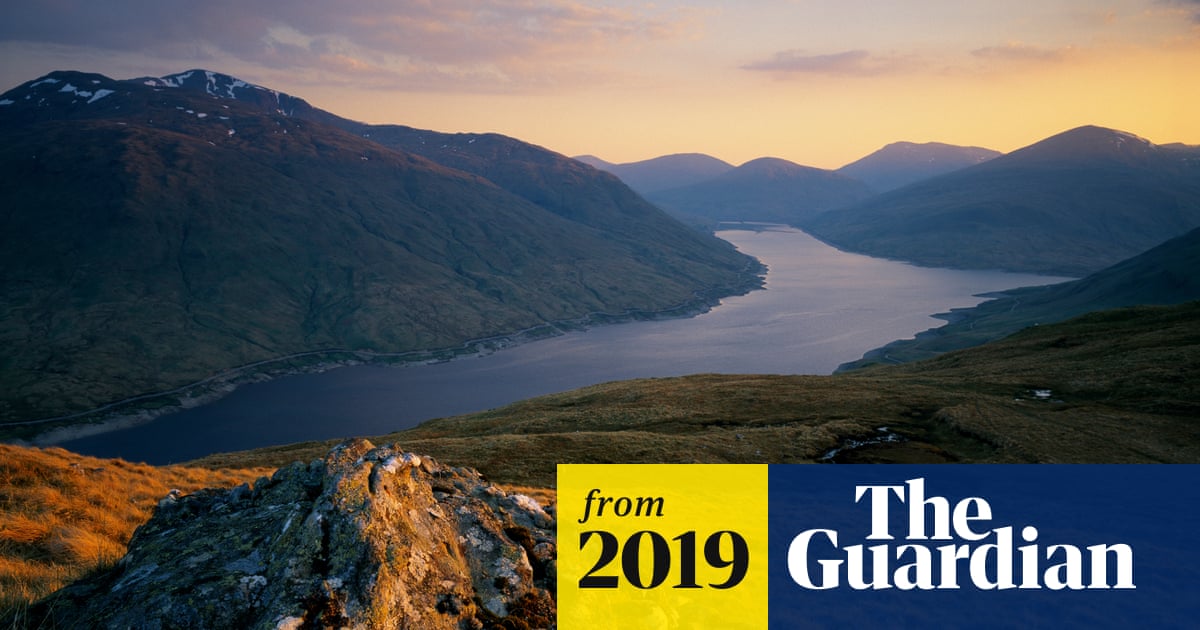
Along with deliberate landscape fashioning, the winter goddess sometimes created land features by mistake. For example, after a long day of milking her deer herds, she lifted a rock on the side of Ben Cruachan to reveal a spring of fresh water to drink and bathe in. She was so tired, and the water was so refreshing, that she fell asleep without replacing the rock cap. When she awoke, the waters had rushed down the side of Ben Cruachan to form Lake Awe, the largest fresh water lake in Scotland.

The Cailleach, also known as the “Veiled One,” functions in many roles, including as a kind of wise old grandmother goddess. The hag crone gently encourages those whose earthly time is ended to cross to the spirit world while she stretches her veil across the winter landscape. Her association with Bride, however, indicates the promise of rebirth. She is a guardian and midwife of spring, for she protects the seeds so that they may sprout when her daughter comes to power.

The hag goddess of winter rides a wolf and has a particular affinity for black cats. She is also a fierce protector of all animals, especially horned animals such as wild cattle, goats, and deer. When her singing is heard in the forest, Scottish hunters give up their quest, knowing there will be no meal to catch.

Cailleach

Once, a desperate man with a large family to feed kept on searching until night fell, though not a deer was to be found. Eventually he built a fire, and inspired by the Calliach’s tune ringing through the forest, he sang a song about her clever ways. When he looked across the fire, the old hag was there with a twinkle in her eye. She explained that her herd was growing too large and she could use a brave hunter to cull it. If he would follow her song the next day, she would lead to him a deer he could shoot. From that time forth, he was always a successful hunter, thanks to the Cailleach’s respect for his cleverness in calling on her by singing her praises.

As the goddess of winter, the hag brings the wind, snow and ice. She plunges her staff into the ground to freeze it. Her magic can thicken lakes into icy slabs by dropping her plaid into the water. The Cailleach is also the goddess of the harvest, urging folk to gather in the crops when her gusts turn cold and the morning fields are rimmed with frost. In some places, a farmer’s wife makes a corn dolly, tossing it onto the field of a neighbor who has not finished his harvest. That neighbor, in turn, finishes and tosses it to another. Farmers are in fierce competition to not be the last to have the corn dolly, for then they will have to keep it throughout the winter, meaning they have to feed and house the winter hag all season as well.

As a goddess, the Cailleach has many complicated qualities that can be called upon by the worshipper. She has fierce strength, the power to both destroy and build, the power the protect life, whether of the animals or of the seeds, the power to grant the rejuvenation of deep sleep.

Deep in Glen Lyon, inaccessible by car, lies the tiny Glen Cailleach where an ancient indigenous shrine to the Cailleach can be found.

Cailleach
Tigh nan Cailleach, near Glen Lyon in Perthshire, Scotland By Richard Bisset - Own work, CC BY 3.0, https://commons.wikimedia.org/w/index.php?curid=10530829

Legend has it that if the small stone statues of the Cailleach and her husband and children are placed carefully inside this small turf roofed stone hut at Samhain (Halloween), the land will prosper. These same statures are brought out into the meadow in front of the hut at Beltane (May Day) to protect the land during the spring and summer months. The local people re-roof her hut at this time in a ceremony of gratitude to the Goddess. Researchers think this ritual has been performed at this site for thousands of years, and it is still performed today.
The Cailleach has a famous daughter, the beautiful spring goddess Bride (known as Brigid in Ireland). The Cailleach is threatened by her daughter’s beauty, for it is so great that she is able to make ice melt and flowers grow merely by her glance. The Cailleach’s fear forces her to keep Bride imprisoned on the top of Ben Nevis, Scotland’s tallest mountain. Every day the hag forces Bride to do impossible tasks, and then punishes her when she fails.

One day, while Bride is trying unsuccessfully to wash the Cailleach’s plaid in the lake, a kindly old man appears. He is sympathetic to her plight and hands her a bouquet of snowdrops, suggesting that she show them to the Cailleach. The girl, determining she has nothing to lose, does so. The Cailleach, who knows that the flowers mean her power is beginning to wane, is furious. She rides to every corner of Scotland, shaking her staff and burying the land in snow, ice and frost.

Scotland
Ben Cruachan, highest point in Argyll and Bute, home of the Cailleach nan Cruachan, By Graham Lewis - Ben Cruachan, CC BY 2.0, https://commons.wikimedia.org/w/index.php?curid=26172267

The kind old man turns out to be Angus, the prince of summer, in disguise. He rescues Bride from the imprisonment of the Cailleach and flies with her to the Isle of Summer. They dwell there happily, but the goddess Bride misses Scotland, so the couple returns to visit again and again. Each time, the sun shines brighter, the earth warms more, the trees bud and leaf, and the flowers grow more plentiful. The winter goddess throws wind and cold at them with less and less success, until finally the Cailleach gives up in exhaustion on Beltane (May Day), going to sleep again until Samhain.

https://www.youtube.com/watch?v=joKYWzzjuro

Bride, the Celtic goddess of spring, is welcomed across Scotland and Ireland on Imbolc (February 1) because Angus first rescues her then, and also because it is when ewes first give milk. Bride is not only the goddess of spring, but also of fire, of the forge, of light itself, of dawn, of fertility, of healing, of water (she has many holy wells and rivers associated with her), and of inspiration, especially for writing poetry. She is also associated with serpents, because they shed their skins and are thus symbols of regeneration.

Bride is a liminal goddess, meaning that she reigns over the in-between. Spring is a slow and subtle time between winter and summer. Dawn is a subtle time between night and day. Bride, according to legend, was born in a doorsill, thus neither inside nor outside.This goddess governs becoming, emerging, forming. She governs the forge, in which metal is formed, and poetry, in which meaning and image are formed. She governs water, which is the original womb of all life on earth.

One of her most ancient names was Breo-saighead, the fiery arrow, the goddess who brings light from darkness. The season of Imbolc does not bring the bright sun of summer, but rather the subtle shift of the angle of the sun’s rays slowly marches toward the equinox and eventually the summer solstice. Once again, she is a subtle goddess, the slow birther.

Cailleach
Labbacallee wedge tomb or "The Hag's Bed", near Glanworth, County Cork, By VisionsofthePast - Own work, CC BY-SA 4.0, https://commons.wikimedia.org/w/index.php?curid=35693041

As a goddess associated with light, Bride is involved with spiritual wisdom, truth, healing, prophecy, and divination. These arts grow slowly to fruition, though their ultimate flowering may appear as a sudden burst. This is also true of the plant and animal kingdoms, where the slow period of gestation ends with the sudden birthing of a baby animal or a flowering tree. She is thus associated with healthy livestock and crops.

Fire, of course, melts snow and warms things. The Druids, who worshipped Bride, are said to have kept a perpetual fire alive in her honor. Such fires may have been burned for her up to the fifteenth century, by which time she had been conflated with Saint Brigid of Kildare and had found favor with nuns. The Druids also associated the goddess with their important bardic traditions, which preserved history through the recitation of poetry.

Today in Scotland, it is common to leave a strip of cloth or a piece of clothing outside on the eve of Imbolc so that it collects dew overnight. Bride bestows this dew as a blessing for the health and well-being of the family. People fashion special “Bride’s crosses” (AKA “Brigid’s Crosses”) from reeds or straw and hang them on the door for protection. Traditionalists eat special bannocks (Scottish quick bread), and may drink the milk of ewes if it is available. They cleanse the hearth of old ashes and lay a new fire for Bride. In homes lacking a hearth, people light candles in her honor. Young girls make Bride dolls of straw or reeds and carry them from home to home to bring blessings.

The weather on Imbolc determines the length of remaining winter. If the weather is sunny, the Cailleach is gathering a large amount of firewood and winter will be long. If the weather is foul, she gathers less and spring will come sooner. This Scottish tradition is the precursor to the American tradition of Groundhog Day. In this small way, the goddesses of Scotland still influence those of us in the “New World.”

Thursday, 12 March 2026

When Someone Appears: The Mystery of Crisis Apparitions

A quiet presence in an ordinary room, the kind many crisis apparition experiences begin with. People sometimes describe a moment that only feels strange afterwards. Nothing dramatic at the time. A sense someone is nearby. A quick impression. Occasionally a voice, or the feeling of being watched.

Then life carries on.

The phone rings later. News arrives. A death. An accident. Something serious.

Only then does the earlier moment return and feel different.

Accounts like this turn up everywhere. Different cultures, different periods, very similar descriptions.

What are crisis apparitions?

Researchers eventually began using the phrase "crisis apparitions" for experiences reported around moments of danger, trauma, or death. The definition is simple, but the timing is what draws attention.

Most reports are spontaneous. People are not trying to contact anyone. They are going about their ordinary routines when something interrupts them. Often the person involved is emotionally close. The experience tends to feel unusually clear compared to daydreaming or memory.

Not everyone interprets these moments the same way. Some treat them as coincidence. Others see them as psychological responses. Parapsychology tends to step back and look at the pattern rather than the explanation.

Early Psychical Research

crisis apparitions and parapsychology
Early psychical researchers began collecting firsthand accounts in an attempt to understand these experiences rather than dismiss them.

​By the late nineteenth century, people had started writing these experiences down more deliberately. Instead of passing them along as stories, they were being collected, compared, and discussed.

The Society for Psychical Research, established in 1882, became one place where this happened.

The aim was cautious. Members were less interested in proving survival after death than in asking a simpler question. Did these reports appear often enough to take seriously?

One ‘but project’, later known as the Census of Hallucinations, asked large numbers of ordinary people whether they had ever experienced a vivid impression of someone who was not physically present, particularly around important events.

Some investigators felt a pattern might exist around moments of crisis. That suggestion has never been fully settled, but the material itself continued to be referenced.

The Admiral Tryon Case

A distant ship fading into mist, echoing the sudden loss at the heart of many crisis apparition reports.

​One example often mentioned in this context is the death of Vice Admiral Sir George Tryon in 1893. Tryon led the British Mediterranean Fleet. During naval maneuvers off the Syrian coast, a command resulted in a collision between HMS Victoria and HMS Camperdown.

The ship sank quickly.

In the period afterwards, a number of people connected to Tryon reflected on impressions they had experienced around that time. The accounts themselves were understated. What drew interest was when those impressions were said to have occurred.

Researchers approached the case carefully. It was not treated as evidence on its own, but as a reminder of how these accounts tend to surface and how difficult they are to separate from memory, coincidence, and grief.

Patterns Across Reports

Across many reports, certain tendencies appear. Emotional closeness shows up repeatedly. Experiences involving strangers do occur, but far less often.

Timing is harder to assess. Many accounts are described after the person learns about the crisis. Memory shifts in those moments. Meaning settles in quickly. Researchers have always acknowledged that problem.

Closeness appears again and again in these reports. Experiences involving strangers do occur, but far less often.

The repetition is not dramatic. It is simply persistent, which is part of why researchers keep returning to the subject.

Psychological Explanations

Psychology tends to begin from connection. People remain mentally oriented toward those who matter to them. Worry, expectation, coincidence, and memory can overlap in ways that feel striking afterwards.

Another factor is reinterpretation. Moments that seemed ordinary at the time may be reconsidered once new information arrives. Memory adjusts quickly in those circumstances.

Experiences of presence after loss are widely reported and do not necessarily indicate anything unusual in a clinical sense. For many people they are part of ordinary grieving. Crisis apparitions may represent an earlier point along that same spectrum.

Parapsychological Perspectives

Parapsychology approaches the question from a different angle. Rather than dismissing the experiences outright, it asks whether extreme situations might coincide with unusual forms of information transfer.

Some researchers describe this in terms of spontaneous telepathy or emotional signaling. The idea remains tentative. If anomalous communication exists, moments of crisis would be the most likely place to look.

That position does not resolve the question, but it keeps inquiry open.

Modern Research and Experience Studies

Modern research methods often rely on experience surveys rather than individual case investigation. Large collections allow researchers to look for recurring features even when verification is difficult.

Online reporting has changed the landscape. People share experiences quickly, sometimes before timelines are clear. That creates both opportunity and complication.

Crisis apparitions now sit alongside research into bereavement experiences, deathbed visions, and anomalous perception more broadly. The boundaries overlap but the timing element remains distinctive.

Why the Topic Persists

Reflecting on experiences that resist simple explanation is where crisis apparition research often returns.

These experiences sit in an awkward space. They appear too often to dismiss entirely, yet not with enough consistency to explain comfortably.

For many people, the meaning comes first. Explanation follows later, if it comes at all. Even those who lean toward psychological accounts often note how distinct the experience feels.

Researchers, meanwhile, focus on recurrence. Patterns raise questions even when answers remain uncertain.

A Quiet Mystery

Crisis apparition reports are rarely dramatic in presentation. They are brief interruptions. A sense of presence. A glance. A moment that only becomes significant later.

The Tryon case shows how these reports enter discussion. It is not unusual in structure, which is precisely why it is referenced. The details matter less than the pattern it reflects.

What keeps the subject alive is not spectacle. It is repetition. People continue to describe moments in which someone seems to appear at exactly the point something changes.

The explanation remains unsettled. The pattern does not disappear.

Further Reading

Phantasms of the Living — Edmund Gurney, F. W. H. Myers, Frank Podmore (1886)

Census of Hallucinations report — Society for Psychical Research (1894)

Apparitions — G. N. M. Tyrrell (1943)

New Frontiers of the Mind — J. B. Rhine (1937)

The Founders of Psychical Research — Alan Gauld (1968)

Parapsychology: A Handbook for the 21st Century — edited by Etzel CardeƱa, John Palmer, David Marcusson-Clavertz (2015)

Thursday, 29 June 2023

Two new paranormal TV shows are changing the landscape of ghost-hunting shows

A few months ago, I joined a team of paranormal investigators, visiting haunted locations for the first season of a brand-new indie ghost-hunting show called Inhuman Beings. This month, we launched a Kickstarter to finish Inhuman Beings and a paranormal documentary series called New Blood. The two shows aim to present a new outlook on the supernatural, showcasing the esteemed specialist in the occult, Michelle Belanger. Her expertise has been previously displayed on several publications such as Paranormal State, Portals to Hell, Conjuring Kesha, among others. Locations have been chosen for the first season of a brand-new indie ghost-hunting show called Inhuman Beings. This month, we launched a Kickstarter to finish Inhuman Beings and a paranormal documentary series called New Blood.

paranormal tv shows

Inhuman Beings

Each episode of Inhuman Beings features a different location with a reputation for high strangeness. Rather than trying to banish ghosts or uncover demons, we approach the unknown with a sense of curiosity, keeping an open mind and looking into ghosts, UFOs, cryptids, the fae, and more.

We use some traditional paranormal investigation techniques, experimenting with REM pods, spirit boxes, a Kinect SLS camera, and an Ovilus. But we also get weird, trying out remote viewing experiments, using dream sigils to communicate with entities, and following our curiosity as far down the rabbit hole as we can go.

That led us to some strange places. During production, we found ourselves crossing a remote river to visit land ruled by the fae, exploring a strange castle with a mysterious past, and investigating the most haunted building in a small town.

As the team’s paranormal researcher, I dug into the locations before filming and was floored by how many anomalies had been reported in each spot.

In one episode, we venture to the area of the original Loveland frogman sightings, along the banks of Ohio’s Little Miami River. While doing preliminary research, I couldn’t believe how much lore was concentrated in one small area and how interconnected the different paranormal phenomena were there.

I had heard the famous 1950s story about a man encountering strange, frog-like humanoids—one of whom carried a wand emitting sparks—but the more research I did, the more reports I found about local sightings of UFOs, cryptids, aliens, and ghosts.

That was my first hint that things were going to get a lot stranger than I had expected. However, I was not fully prepared for the firsthand experiences we had when we arrived at the site and engaged in conversations with the locals, conducted our own experiments, and gained a true understanding of what the place was truly like.

New Blood

Much of the cast and crew of Inhuman Beings are also in New Blood, a longform docu-series about modern-day vampires.

In New Blood, a series of synchronicities leads witch and host of paranormal podcast Follow the Woo Fen Alankus (she/they) to move from LA to the spooky Midwest. There, she conjures an investigative film crew to document a secret society of vampires.

They delve into the mysterious world of vampires while staying in a haunted Airbnb. The experience, which involves visiting sacred vampire ritual spaces, braving the creepy woods of Ohio, and performing out-of-the-box psychical experiments and spells, changes all of them. Season one was a wild ride, and the next phases of initiation have already begun for the team.

The Kickstarter and team

paranormal tv shows

Michelle Belanger (he/she/they) and Fen Alankus (she/they) have gathered a top-notch crew of film professionals and paranormal investigators. That includes historian and medium Stephanie Bingham (she/her), who has been featured on the CW’s Mysteries Decoded, Destination America’s Paranormal Lockdown and SyFy Channel’s School Spirits; tarot/oracle reader Tigresse Bleu (they/she); filmmaker, forager, and hedgewitch Aubrey P. Archer (they/them); and photographer and skeptic-turned-believer Taylor Brown (she/they), and me.

More than 100 hours of footage have already been shot for these shows, and both shows are slated for release in Fall/Winter 2023.

With the Kickstarter funding, the team will finish up the first seasons of both shows, start pre-production on the next seasons, and more. Backers get rewards like magically imbued Ouija planchettes, Bigfoot and Pride Demon T-shirts, subtle-body portrait readings, bonus and behind-the-scenes content, executive producer credit, guest spots on their shows, and more. Spread the word and help bring this fresh paranormal project into the world!

Sunday, 27 February 2022

"A Murky Path Down Archer Avenue" Short Documentary

Few things make me happier than figuring out how to construct documentary projects through research and shooting plans.  Everything is safely practical during those planning stages but, once the production actually begins, it's an entirely new reality of headaches, revisions, and inevitable screw-ups.

haunted archer avenue

I have an independent horror film coming up later this year.  It involves an updated camera hard drive and constant editing learning curves.  Doing documentary projects can be relaxing experiences in the best scenarios so, I figured, what a better way to try out some new horror-centric content than to do a documentary revolving around real, creepy, pre-existing scenes?  I didn't want this documentary to be too easy since it's a sort of drill for that bigger shoot.  A few years back, I had done a short doc about the spirits of Detroit--it's literally called "The Spirits of Detroit"--and I wanted to do something in a similar vein in my usual home city (I was born and raised in the metropolitan Detroit area and I now live in Chicago).

haunted archer avenue

Chicago has too many ghosts.  Doing a documentary about the spirits of Chicago would encompass too much so I decided to stick to one general area.  Archer Avenue isn't one spot, per se; it's a far-reaching street that begins in the South Loop district and stretches beyond the city limits into the southwestern suburbs.  Slicing through hundreds of years worth of multi-layered, unpleasant history, the road serves as a microcosmic sample of what this American region represents.  A well-worn Native American route collided with European immigrants and the psychospiritual baggage that they dragged along with them.  The result is a very long, appropriated, and renamed boulevard lined with myth-drenched cemeteries and woodlands.  The Archer Avenue area is absolutely beautiful and you can feel the history surrounding you.  

This sinister little project was designed to be speedy so I did the best that I could to rush viewers through a Mr. Toad's Wild Ride-inspired jaunt mixing the archived past with a large helping of urban myths and local pop culture.  Whatever's going on with Archer Avenue has staying power.  These are old tales passed down through generations, constantly being remixed and updated.  

haunted archer avenue

Are there actually haunted places on Archer Avenue?  People swear that there are.  The energy in these places, speaking through firsthand experience, seems to back this up.  Did a couple of weird things happen?  Yes.  But I made this documentary to reflect Archer Avenue's potent mesh of history and paranormal rumors, not to present some kind of video diary.  It's an old-fashioned approach: location cinematography and actors in costumes used as live-action illustrations, fleshing out stories.  The supposed scenarios revolving around Archer Avenue and its various locations read like fragmented scripts from B movie horror films.....so why not offer a glimpse at these scenarios utilizing some custom-made B movie horror film fragments?  It makes perfect sense.  Research, narrative compression, and a little bit of technical exercise for me and a thoroughly unnerving, quick, paranormal history adventure for viewers.  If you enjoy the possibility of running into monsters, dead monks, and cursed damsels, there's a few places in Chicago that you may want to visit.  All that you have to do is take a trip down a specific street.

haunted archer avenue

"A Murky Path Down Archer Avenue" is a short documentary by Derek Quint via Addovolt Productions.  This project is narrated by Michael Marius Massett and features music by Andre Almaraz and Michael Marius Massett.