Jock Brocas is a spiritual author and teacher with books published internationally. Jock is also the president of the charity organization assmpi and works tirelessly to he others develop spiritually and live a more rewarding life. Join Jock Brocas on a spiritual journey.
http://jockbrocas.us
In my front garden stands a typically fast-growing Ash tree, one whose roots are perilously close to destroying the garage.
Which got me thinking about the Ash tree in folklore and in the paranormal world; my cultural touchstone being M.R. James’ disturbing tale The Ash Tree (1904); links to two BBC2 versions are linked below.
The Ash (or Fraxinus) is generally regarded as a positive member of a genus of plants in the olive and lilac family, or Oleaceae. Indeed,in Norse mythology, the World Tree Yggdrasil is held to be a sacred Ash tree and was regarded across Northern Europe as a symbol of cosmic connection, healing, and strength.
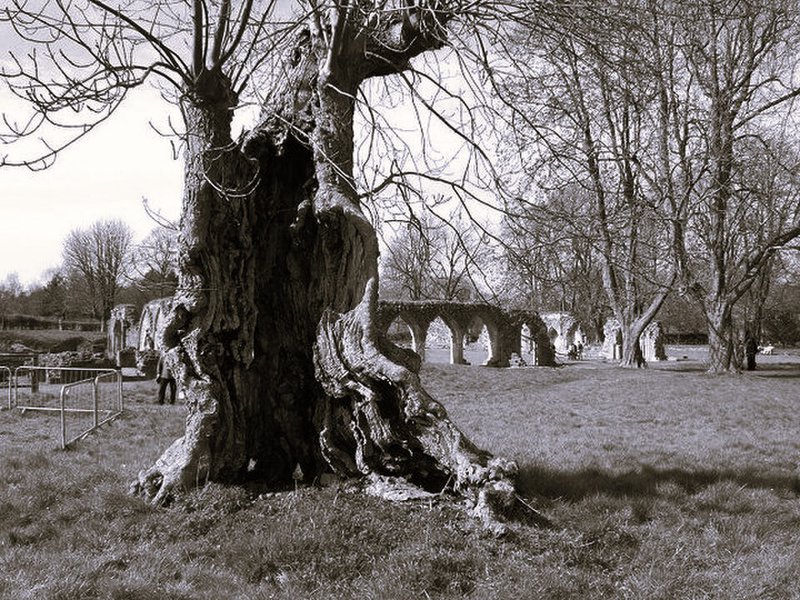
The Old Ash Tree
Symon Parsley / Old Ash Tree
In popular culture, the World Tree recently featured in season 2 of Marvel’s LOKI (2023).
For the Vikings, the first man, Askr, was formed from an Ash, whilst the first woman Embla was made from an elm. In the Norse poem Hávamál, Odin described hanging himself from a "wind-swept (Ash) tree" for nine nights, wounded by a spear, in a self-sacrifice to himself to gain wisdom and learn the secrets of the runes.
In Celtic and British folklore, the Ash is one of the three sacred trees, along with Oak and Thorn; a healing tree, particularly used in rituals to cure poorly children.
For the ancient Greeks, the Meliae were nymphs associated with the Ash tree, born from the blood of Uranus falling onto Gaia.
The Askafroa (wife of the Ash tree), or in Danish ‘Askefrue’ is the guardian of the Ash tree, a malicious creature. To appease her, it was necessary to make a sacrifice every Ash Wednesday by pouring water on her roots and declaring: "I am offering to you so that you do us no harm".
Ash Wednesday, while nowadays of course, a Christian observance marking the start of Lent, has roots in pagan customs of purification, mourning, and the return of spring, including using ash for protection, fertility, and renewal. Ashes were used to mark the forehead for Odin’s protection often done on "Odin's Day" (Wednesday). In Celtic tradition, ashes were used to bless livestock and ensure fertility during the transition from winter to spring, frequently associated with Imbolc celebrations.
There are fictional takes on less than benevolent Ash trees, including in the 1990 3-part BBC television adaptation of Kingsley Amis’s novel, The Green Man (1969), where it puts in a truly terrifying appearance at the beginning of the first episode:
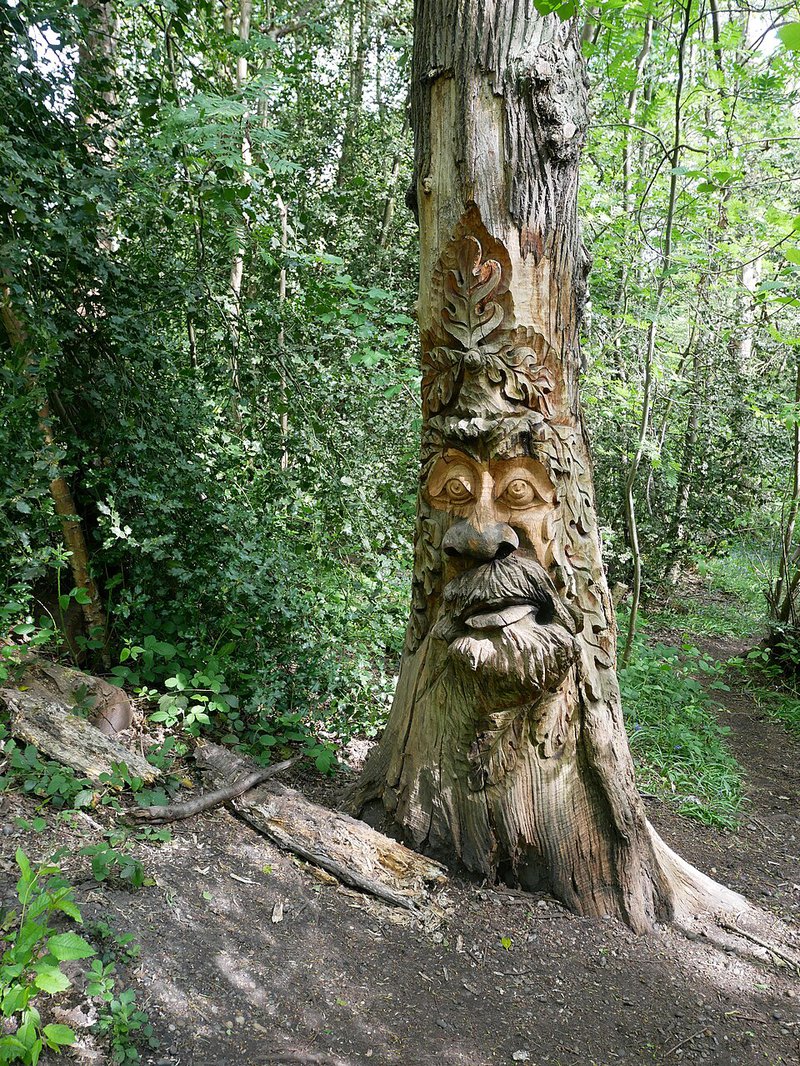
Note: Green Man sculptures are often created from fallen Ash trees.
The Green Man in Lesnes Abbey Woods, London Borough of Bexley.
Ethan Doyle White, CC BY-SA 4.0 , via Wikimedia Commons
The UK - in ‘real’ life?
1869’s Haunted Ash of Lampits (Scotland), part of The Ghosts of Carnwath series of supernatural reportage
An account in Scotland’s Hamilton Advertiser of 28th August 1869 detailed a melancholy apparition and haunted Ash tree near Lampits Farm, to the east of Carstairs Junction in South Lanarkshire:
“There long stood a solitary, melancholy-looking ash tree in a field on the Lampits Farm, in the vicinity of Cockysyetts, which was cut down to make way for the Queen’s branch of the Caledonian Railway, and which was still more melancholy, in my imagination, from its dismal associations; for here, on one of the branches of this dowie-looking tree, a poor heart-broken girl of Cockysyetts closed her earthly sorrows and her earthly pilgrimage. No mavis or blackbird was ever seen to nestle in it scanty foliage, no merry note of music was ever heard from its dull half-blasted branches; the raven might croak and the pyot chatter there by day, and the owl scream by night, but no other merriment, dear tree, was thine. Ghosts love the darkness and the shade, and the ghost of poor Jessie was often seen gliding at midnight among the shadows of the fearsome neuk.”
Today, few trees grow on the flat windswept carseland around Lampits. There remains, however, a solitary ancient ash tree that commands a view across the flat fields towards the Caledonian Railway. Many of its upper branches have been lost to past storms, and disease ravages others, however new growth continues to sprout from a gnarled and weathered old trunk.
With scanty foliage and half-blasted branches it has an uncanny resemblance to the melancholy old ash tree described in the newspaper article over 150 years ago. Ash trees can live for up to three hundred years, therefore it’s possible that the surviving tree could have witnessed Jessie’s melancholy end, early in the 19th century. It might even have sprung from a seed of the haunted ash.
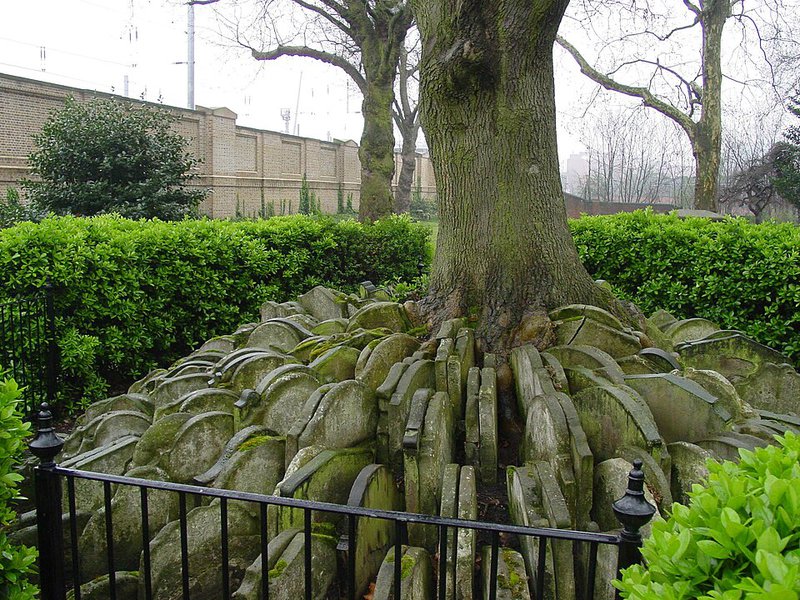
The Hardy Tree (St Pancras Old Church, London)
David Edgar, CC BY-SA 3.0 , via Wikimedia Commons
The Hardy tree was an Ash tree located in the very ancient, possibly Roman St Pancras Old Church's churchyard in London. Notable for the stacked gravestones embedded at its base in around 1860, when graves were moved by writer-then-architect Thomas Hardy to make way for the Midland Railway to run through the churchyard.
In 2014, the tree was infected with fungus, and with storms further weakening it, the tree fell in December 2022.
The Hell Tree
From: The Mysterious Hardy Tree | Graves that Circle a Tree….(2021)
It’s thought that during his time here, Hardy actually uncovered the body of a two-headed man during the excavations. Thomas never documented anything regarding and this and more recent photographs of the tree has encouraged speculation if he ever had anything to do creating the design at all. He did write a poem namedLevell’d Churchyard. Thomas’s poem suggests that he didn’t have fond memories of the work he did here but its hardly surprising given the job he was expected to do.
In letters that were written by the St Pancras Old Church vicar John Tweed in 1859 to his wife Charlotte, he appeared to have witnessed a supernatural manifestation. The vicar detailed how his churchyard was home to a mass gathering of apparitions and how tombstones seem to appear at the Ash tree and that he had even seen them moving towards this tree by a unseen force.
In December 1859 he wrote to Charlotte: ”More missing headstones. Increasingly certain of connection with my guests. Today I traced strange lines of disturbed earth across the graveyard. Each lead to the Ash Tree. Are they being dragged there? And then where? The ash tree itself is looking increasingly unhealthy, possibly diseased. I don’t like to get too close to it.”
And then: “If I hadn’t seen such as I have seen these past months I may not have trusted my eyes, but trust them I must. I shall record it in as plain a manner as I know how: By the light of the moon last night I saw a gravestone, moving with some speed, and quite of its own accord, across the graveyard. It hurtled towards the ash tree, at the base of which it disappeared, as if plunging in to the very bowels of the tree.” Finally: “Good God. Hundreds of them, of all shapes, just pouring into the tree.” He later refers to the tree being a gateway and it’s believed by some that he felt it could have possibly been a hell gate.
“Dearest Charlotte, I do so love hearing your news from the vale, it pains me to have to recount the horrors of my life here… At night I am plagued by nightmares so vivid and dreadful that I am afraid to sleep at all. I have been nailed to the cursed iron frontage of a flame-licked and hell-bound locomotive. I have walked through the dark miasma and fetid slime of a London choked by death. I have seen the flagstones of the church floor thrust violently upwards by a sudden eruption of uncertain origin. And these are only the visions I have the constitution to retell… I begin to suspect that it is not just the lost ones that are being dragged down to that place. For how to account for the sheer number I watch descend every night? Where will it end? Must every dead soul in the parish, every dead soul in London be reclaimed for damnation?! No Charlotte, I shall not see it happen.”
Allegedly John Tweed closed the hell gate in 1860 by burying a Bible under the tree, and scans of the Ash tree show a large book buried within the roots… but nobody has ever been allowed to dig the area. No reports were made from Tweed after 1860, when he lost the ability to record his findings; his writing hand apparently useless.
And...this from Exit Strategy for the Restless Dead: The Hell Tree of St Pancras (2017)
He wrote to Charlotte: “Every thief, vagabond and ne’er-do-well in London seems to have wound up buried at St P. Which would be all well and good, except that the digging up of late seems to have unearthed more than just bones. Judging by the number of lost souls drifting about the place in one spirit form or another, I would offer that many of my guests are far from welcome in Heaven. I can only assume that having been buried in consecrated ground further precludes them from the other place, which leaves them, it is my horror to say, stuck in the churchyard with me”.
Tweed was not entirely without sympathy for his ghostly companions, going on to tell his wife that they were: “Sad seeming things. I feel quite sorry for them. I don’t suppose I should mind at all if only they kept their mournful meanderings to the night-time hours. Last Sunday I was midway through service when a wraith came down the aisle – an infernal thing, it stalked among the shadows between the shafts of morning light, wailing and moaning like a baleful cat. There were already murmurings amongst the parishioners about the foul stench from the digging up. Dearest Charlotte, I am not sure how much longer I can pacify them.”
The Beatles at Old St Pancras (1968)
Although St Pancras Old Church is in central London, minutes away from the great Victorian Gothic pile of a station, the area can be quite a haunting, lonely place, perched on a hill overlooking the railway junctions of St Pancras and King’s Cross. I remember visiting in the snows and blizzards of Winter 2015, when the church grounds felt like something from one of Grimm’s tales.
The Lively Arts: Thomas Hardy - A Haunted Man (1978)
The Ash Tree - Vampire/Zombie Killer
In folklore, an ash stake is traditionally used to kill vampires, especially in Slavic, Russian, and Baltic traditions. Ash wood represents protective, "life" energy in Norse mythology, where it can help destroy the Draugr (Undead), or at least weaken their supernatural powers. The Viking version of vampires/zombies are described as bloated “death-blue/black” revenants who ferociously protect their treasure, with the ability to grow to giant sizes and shapeshift.
Note: other words for the Undead or Vampires in Norse legend include:
Aptrgangr (Again-walker): One who walks again.
Haugbúi (Barrow-dweller): One that dwells within its burial mound (howe).
In Bram Stoker’s Dracula (1897), Abraham Van Helsing utilizes wooden stakes associated with specific woods like ash or white oak to impale vampires by piercing their Undead hearts.
Three BBC adaptations of The Ash Tree by M.R James
The Ash-Tree (1986)
And a later telling from 2000; my idea but ripped off by a then senior BBC colleague:
A Ghost Story for Christmas: The Ash Tree (1975) - The big reveal...
The Essex seaside town of Clacton-on-Sea is a peculiar place; a faded former holiday resort for London’s Cockney underclass, now best known for being the constituency of former (and maybe again, if he is re-elected on August 13th) Reform MP/leader, one Nigel Farage. Two of my articles on Mr Farage are linked below in Additional Reading.
I knew the area fairly well, as both my widowed grandmothers live in the village of Little Clacton, just outside the town. I used to stay with both for a week during the summer holidays as a kid. One of my grandmothers later married a faith healer, who held free surgeries in his consulting room at her bungalow. A decent old cove, he however did say I possessed ‘The Sight’, which was slightly disturbing for an imaginative youngster to hear, but there you go.
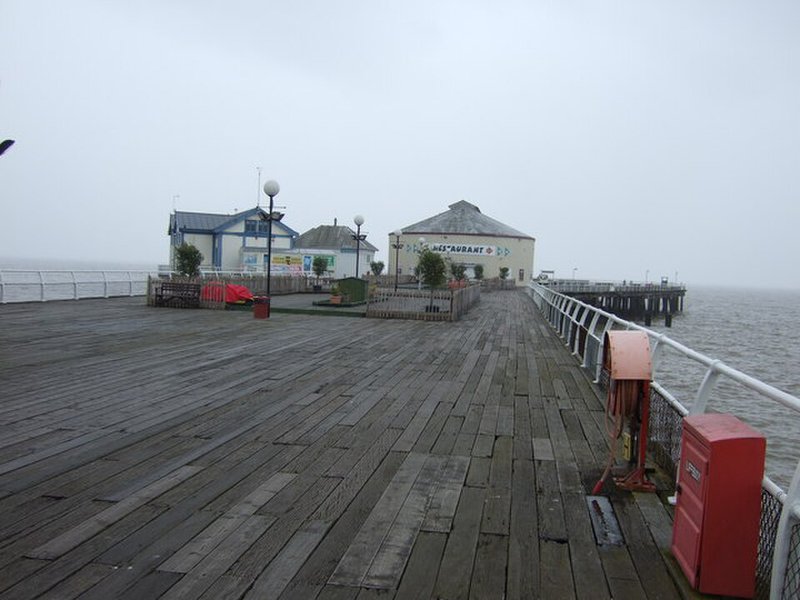
Clacton Pier
On Clacton Pier by JThomas, CC BY-SA 2.0 , via Wikimedia Commons
Anyway, the area has an interesting history. I was told of smuggling tunnels linking the nearby church of Saint James to the ancient cellars of local pubs The Blacksmith’s Arms, The Ship Inn and The Queen’s Head, presumably as part of a ‘Dr Syn’-style contraband operation organised by the local vicar(s). Other tunnels were rumoured to link the manor house, Giddy Hall, to the coast (unlikely, as it’s around 2.5m away), so the Clacton gentry were also presumably involved in the racket.
From Hidden East Anglia:
From a genuine event has arisen an odd little legend. In 1806 the Cameron Highlanders were stationed in barracks at nearby Weeley. At the St. James’ Day Fair (on July 26th) a fight broke out outside the Blacksmiths Arms between villagers and some of the soldiers, with some of the latter being chased along the street. A soldier named Alexander McDonald had hurt his foot, and was caught, struck and slain. On the spot where his head hit the road, it was said that a hole appeared which could not be filled, no matter how hard people tried. His gravestone can still be seen in Weeley churchyard, with the inscription “late soldier in the First Battalion 79th Regt who in the prime of life was inhumanly murdered near Little Clacton”.
Little Clacton’s St James Church itself hasa macabre history:
Prudence Lambert (1582): Prudence remarried two months after her first husband died in mysterious circumstances. Consumed by guilt, she hanged herself the morning after the wedding. As suicide was considered a grave sin, she was buried in unsanctified ground at the furthest edge of the churchyard. Legend holds this specific corner of the grounds is haunted by her restless spirit.
The Witch Trial Executions (1645): During the notorious Essex Witch Trials, local rector Henry Waite’s wife was executed for witchcraft, despite being said to be extremely pious.
Additionally, other Little Clacton women were accused of using "imps" to carry out their designs, causing long-lasting dark folklore to imprint the parish.
Nearby St Osyth's Priory is steeped in paranormal lore, most famously haunted by the ghost of its namesake, the Saxon Princess Osyth. She wanders the ancient grounds carrying her severed head after being decapitated by Viking raiders in AD 653.
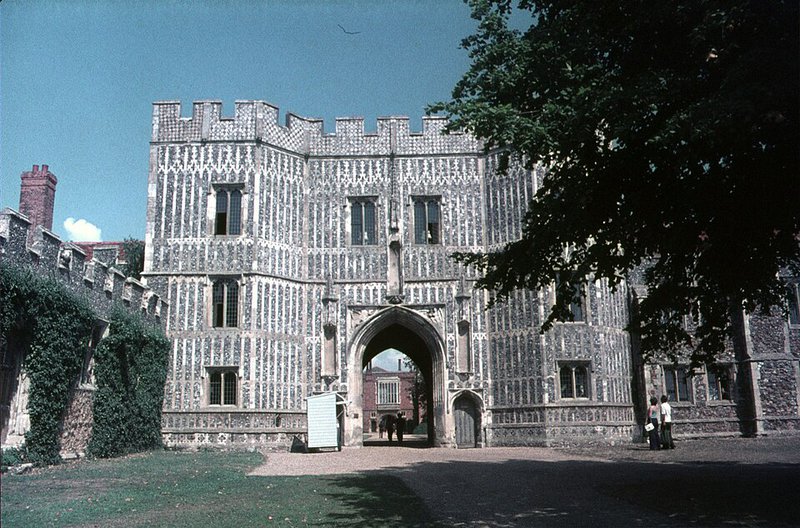
St Osyth’Priory Gatehouse
St Osyth's Priory Gatehouse by Marathon, CC BY-SA 2.0 , via Wikimedia Commons
Other paranormal sightings at the priory include a hooded white monk and a phantom nun who peers into local windows.
A short distance from the Priory sits a 16th-century cottage known as ‘The Cage’, which once acted as the local prison for accused witches. In 1582, Ursula Kempe and others were detained there before being tried for witchcraft. The Cage has gained modern notoriety as one of the most haunted houses in Britain. Investigations have cited both poltergeist activity (former owners reported being pushed, and CCTV has recorded slamming doors and disembodied voices) and apparitions of shadowy figures and sudden temperature drops.
Clacton itself boasts as variety of supernatural phenomena that continue to defy explanation, including the following:
West Cliff Theatre Tower Road: Both Staff and performers at West Cliff Theatre have spoken of unexplained eerie noises backstage, footfall in empty parts of the building and the feeling that they are not alone after audiences have gone home.
Wilson House, Leas Road (no longer standing): In the late-twentieth century, a ghostly white lady was said to have been seen by several schoolgirls when this building was a dorm. Sounds of heavy footsteps could also be heard walking along the corridors late at night.
The Kingscliff Hotel: A woman in old-fashioned clothes has reportedly been seen walking through the corridors then disappearing without trace. Unexplained footsteps, doors opening by themselves and an uneasy feeling when parts of the hotel are empty have also been reported.
The old ballroom at former Butlin’s holiday camp: Butlin's Clacton was used as a training base when the Second World War broke out. A soldier was supposedly stabbed and killed in a fight which occurred at the ballroom and took to haunting the area. The camp was demolished and the area redeveloped in the mid-1980s; the ghost left at the same time. There are no official police or historical records of a stabbing in the Butlin's ballroom in Clacton during the 1940s.
St Johns Road: Phantom monks seen drifting along the roads in this area of Clacton.
Clacton Pier: Spooky figures have been seen on Clacton Pier after dark, vanishing as people get closer. Workers have claimed to hear footsteps and unexplained voices when the pier is usually deserted. Probably drunk.
Old Kinema: Local history accounts say a fire was started by a projectionist who perished in the building in a suspected suicide in the 1940s. His damned shade disturbed cinemagoers and staff. The cinema was closed and demolished in early 1962.
Thornbury Road private house: In 2003, after a period of experiencing disembodied footsteps, doors opening and closing and electrical items working independently, the occupier saw the manifestation of a young girl. The occupiers were then dragged across the floor by their ankles and creeped out by the appearance of an evil old crone in the box room bed. I couldn’t find much, if any, supporting evidence.
Jaywick Martello Tower: Visitors to this defensive tower, constructed to combat Napoleon, have reported hearing footsteps echoing through the empty fort, along with strange voices, and the feeling that someone is watching them. Sudden cold spots have also been reported.
Old Lifeboat House: During the late twentieth century, a shopkeeper who hired a room to store surplus stock reported that items would rearrange themselves overnight.
Private house along St Osyth Road: From 1975 until the building was exorcised in 1978, the family living at the house reported spectral singing, ghostly footsteps, and a wee girl, who all could hear but only their four year old son could see. No online supporting material aside from The Paranormal Database.
St John's Church: Ghostly figures have reportedly been seen strolling through the churchyard, whilst whispers and footsteps are heard when nobody else is nearby. The church dates back to the twelfth century and has inspired local ghost stories for generations. Smugglers apparently used the locale, adding to its unsavoury reputation.
Ghosts of monks, the victims of a homicidal innkeeper, a cavalier, a highwayman, and a man torn apart by a mob have all been reported at what are now the environs of the quaint Treasure Holt Garden Centre.
What Happened To Clacton-On-Sea? A Town Stuck in Time
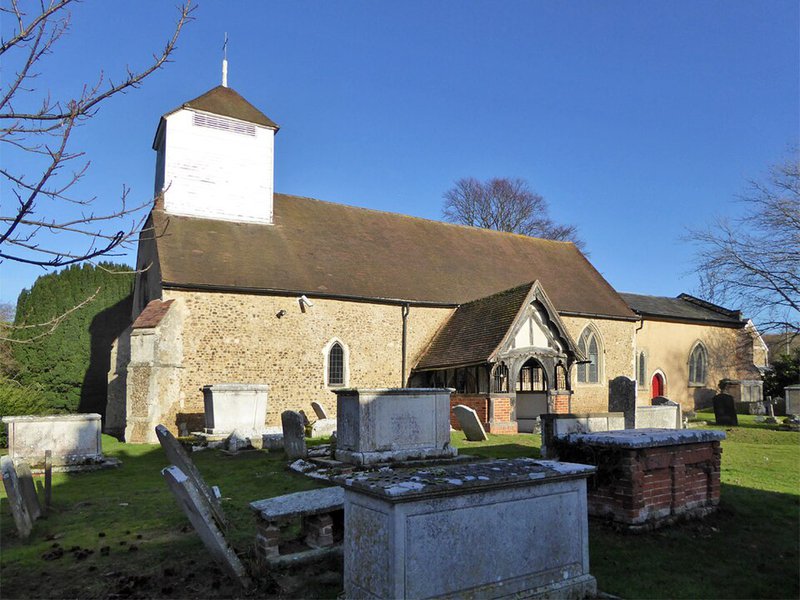
The Parish Church of Saint James, Little Clacton
Little Clacton church by Robin Webster, CC BY-SA 2.0 , via Wikimedia Commons
Fun Fact: The "Clacton Spear", a Neanderthal yew spear found near Clacton-on-Sea in 1911 is the world's oldest known wooden spear at approximately 420,00-450,000 years of age.
Every year, some science journalists proudly announce in their headlines that they are “debunking” ghosts. Their recycled, repeatedly cloned articles—usually appearing in summer or around Halloween—follow the same predictable pattern.
When the Media Keep Recycling the Same “Scientific Explanations” Supposed to Debunk “Ghosts”
When it’s not about cognitive biases, irrationality, fraud, or misinterpretations, the past two decades have seen a wave of cliché articles and videos claiming to explain ghosts through poorly understood environmental factors barely perceptible to our senses: black mold, infrasound, magnetic fields, and so on. More importantly, these explanations are often presented as “major scientific discoveries,” even “revolutionary,” when in reality they rely on shaky interpretations, overextended extrapolations, or studies taken out of context.
A critical review reveals the same recurring pattern: an initial article engages in cherry‑picking and offers ready‑made explanations. It is then reproduced internationally without verification; consequently, it spreads like wildfire, amplified by sensationalist headlines, and is ultimately presented as an uncontested scientific truth.
The method I propose—and encourage others to adopt—to counter this recycling of ignorance consists in presenting contradictory data and sources while, at the same time, analyzing the limits of these simplistic explanations within a structured, evidence‑based counter‑expertise.
A Few “Classics” of the Genre
Here are some typical examples of debunking ghosts:
Seeing ghosts may just be a result of breathing a toxic mold! — Mental Floss, 2015
Black mould in your home can cause terrifying hallucinations of demons and ghosts — The Mirror, 2019
Neuroscientists awaken the ghosts hidden in our cortex — EPFL News, 2014
Scientific explanations for ghosts — Mental Floss, 2015
BBC Earth Lab – The Science of Ghosts, 2015
This list is only a tiny sample of what circulates online.
What concerns me most in these highly biased pieces is that their rhetoric almost never engages with the serious indexed empirical literature that contradicts their assumptions.
This issue becomes even more troubling when certain institutions presenting themselves as authorities on “critical thinking” also promote explanations that would benefit from being re‑evaluated in light of contradictory data. The Committee for Skeptical Inquiry (CSI), for instance, adopts a form of militant skepticism toward psi and so‑called paranormal phenomena that diverges from scientific skepticism itself. Most of its advocates produce no empirical data on anomalies (Clément, 2026). Only a small handful of researchers affiliated with orthodox anomalistic psychology—such as Wiseman, French, or Braithwaite—have published a few isolated experimental studies on hauntings, which are regularly—and often over‑interpreted—by the press without any in‑depth examination of the results.
Epistemic Tension Trying To Explain Ghosts
As researcher Chris Roe (2024) points out, this situation creates a genuine epistemic tension that deserves far more attention. Indeed, the objections raised by opponents of psi are often so vague and so poorly operationalized that they themselves escape any test of falsifiability. Consequently, this absence of explicit, testable, and potentially refutable counter‑hypotheses paradoxically places part of the anti‑psi discourse in a position of irrefutability—precisely what they accuse parapsychologists and other heterodox researchers of doing. Moreover, their flagship magazine, Skeptical Inquirer, which is more opinion‑driven than research‑driven, is not indexed in any academic database.
Despite this very limited scientific output relative to the epistemic authority it claims, CSI (and its international branches) regularly mobilizes media personalities to reinforce its position. This is notably the case with Neil deGrasse Tyson, often presented as an essential reference on anomalies (psi, ghosts, UAPs…). This is not a personal criticism—I have great respect for his science communication work in his field of expertise. But the example below illustrates a structural problem.
In this video: Insider Tech — Neil deGrasse Tyson explains why some people see ghosts
Tyson offers psychological explanations for ghosts, but:
He cites no specialized empirical studies that could challenge his claims.
He does not examine the limits of his explanations.
His argument relies primarily on media authority rather than expertise grounded in empirical research on anomalies.
What I highlight here is not a moral issue but a critical thinking issue about how knowledge is constructed, one that deserves serious attention. The argument from authority replaces analysis, and the “skeptic” posture overshadows substantive research. This pattern is not limited to Tyson: it also appears among other public figures such as Bill Nye, Brian Cox, or Sean Carroll, whose opinions on the paranormal never engage with the empirical data that challenge their normative assumptions.
France Is Not Immune to This Media Recycling
The same pattern appears in the French‑speaking press and on YouTube: these explanations are often repeated without context, without perspective, and without any systematic comparison with specialized research. Most of these reprises come from more‑or‑less self‑appointed science communicators who are unfamiliar with the literature on hauntings, or from podcasts hosted by psi‑antagonists whose goal is debunking—driven more by ideology than by empirical inquiry. It is a form of critique that judges and disqualifies rather than explores, tests, and confronts evidence.
A few examples to illustrate the point:
Milgram, G. — Les expériences de télépathie sur C8… et ailleurs ! (YouTube)
Info ou Mytho — La télépathie, ça marche ? ; Les maisons hantées : révélations ! (YouTube)
Le Pharmachien — Chasse aux fantômes et phénomènes paranormaux (YouTube, 2022)
S&V TV — La science du paranormal (2016). This episode notably shows Jérôme Bonaldi interviewing François Lasagne, who makes several claims about “ghosts” that clearly distort the data.
Futura‑Sciences — Hallucination : les infrasons vous font voir des fantômes (2021)
Futura‑Sciences — Fantômes et maisons hantées : ce que la science vient de trouver, invisible mais bien réel (2026)
Even some popular magazines and books contribute to spreading these simplified ideas:
DK (2024) — A History of Ghosts, Spirits and the Supernatural, p. 275
Benoit, M. (2021) — In TENEBRIS, pp. 98–102, 131–132, 136–142
Epsilon (2023) — Ce que le paranormal dit de notre cerveau, n°26
This analysis of debunking practices is part of a broader epistemological reflection that, in my view, deserves serious attention from experts in scientific demarcation.
Debunking Ghosts Counter Analysis
Before moving on to the counter‑analysis that motivates this article, one essential point must be recalled: environmental factors only produce effects when our senses are already placed in highly ambiguous conditions (Houran & Lange, 1996). Put simply, the more our senses are exposed to ambiguity, the more the brain tries to make sense of weak stimuli, thereby increasing the risk of confusing the normal with the paranormal. Thus, this occurs in situations of poor visibility, total darkness, sensory deprivation, or during paranormal investigations conducted deliberately in pitch‑black conditions—combined with strong expectations. Even suggestion, however, must be nuanced in light of recent research (Dagnall et al., 2015).
Important note: the “sensory deprivation” mentioned here has nothing to do with Ganzfeld protocols, which use sensory reduction to facilitate the emergence of potential psi‑mediated perceptions. In environmental models, sensory deprivation acts instead as a source of perceptual ambiguity likely to induce misinterpretations.
In other words, these models are only relevant when the environment prevents or reduces normal perception—conditions that differ significantly from many documented haunting reports. By contrast, these typically occur in good observational conditions (daylight or artificial lighting), in ordinary settings, and describe structured multisensory experiences.
Curiously, Wikipedia and many media outlets continue to cite Houran & Lange (1996) as a key reference, even though nearly thirty years of incremental research have passed. Houran himself now adopts a far more measured position, both in his recent publications and in his public statements (Houran, 2022).
It is also crucial to recall that empirical literature on apparitions and hauntings highlights two characteristics that cannot be ignored—both incompatible with the weak, unstable effects produced by environmental factors:
Intersubjective verification: several witnesses perceive the same phenomenon simultaneously under good observational conditions.
Serial verification: the same phenomenon is observed successively by different witnesses.
These two dimensions—intersubjective and serial—therefore constitute phenomenological consistency criteria that go far beyond explanations based on individual perceptual illusions or environmental factors producing weak, non‑reproducible, idiosyncratic effects.
Likewise, they contradict hallucinatory hypotheses, which by definition rely on private, unshared, unsynchronized experiences that are not independently repeated by multiple witnesses.
A common attempt to salvage a “shared hallucination” objection is to invoke clinical entities such as folie à deux (shared psychotic disorder) or related “shared belief” syndromes. However, these constructs do not map well onto the typical phenomenology of hauntings, poltergeist cases, or ADC reports: they primarily concern the transmission of a delusional interpretation within a close dyad or family system, usually in the context of marked vulnerability, dependency, isolation, and broader psychopathology. By contrast, many haunting/ADC reports involve ordinary contexts, multiple witnesses with varying degrees of involvement, and recurring perceptual patterns that are not reducible to one dominant individual’s fixed delusional framework. In short, pointing to shared-delusion syndromes does not constitute an explanation of the empirical patterns at issue; it mostly highlights the need to keep diagnostic clinical categories distinct from field reports of anomalous experiences.
These elements are recurrent in ADC and poltergeist cases, and contemporary research confirms this phenomenological coherence (Woollacott, Roe, Cooper, Lorimer & Elsaesser, 2022; Elsaesser, Roe, Cooper, Morrison & Lorimer, 2025; Sweeney, Ryan, Leahy & Deering, 2026; Dullin, 2024).
My article follows the same line of reasoning as a chapter of my book Phénoménologie des hantises (Clément, 2025), in which I dismantle a considerable number of fragile scientific claims that attempt to explain ghostly experiences through errors, hallucinations, or perceptual biases.
In my approach to psi and anomalies—particularly hauntings, my area of expertise—I pay close attention to historical depth, verifiable sources, and the provisional nature of knowledge. Scientific skepticism should logically involve corrective reflexes based on current data, not rigid adherence to outdated assumptions.
Reading a scientific study does not mean suspending critical thinking.
To illustrate this issue:
James Felton relays the claims of Dr. Rodney Schmaltz, an active member of the Center for Inquiry and co‑author of the latest infrasound study I critique. Yet, after reviewing his Academia and ResearchGate profiles, it appears that Dr. Schmaltz has conducted no substantive research on psi, hauntings, or ADCs. His publications focus almost exclusively on belief psychology, critical thinking, and the critique of pseudoscience. In other words, he specializes in cognitive mechanisms associated with paranormal beliefs—not in anomalies themselves.
This distinction is essential.
And yet, here is what he claims:
“As someone who studies pseudoscience and misinformation, what stands out to me is that infrasound produces real, measurable reactions without any visible or audible source. So, the next time something feels inexplicably off in a basement or old building, consider that the cause might be vibrating pipes rather than restless spirits.”
Striking, isn’t it? And these examples are far from isolated.
Back to the Origins of the Infrasound‑Explains‑Hauntings Narrative
In 1998, engineer Vic Tandy proposed the idea that 19 Hz infrasound—produced in his case by an unbalanced industrial fan—had triggered a “ghostly vision” and other strange sensations. Yet a closer look at his account shows that Tandy described only a vague, peripheral blur, nothing remotely comparable to the structured characteristics of documented apparitions.
Despite this, his anecdote became the starting point for a disproportionate media narrative.
By 2003, Wiseman and O’Keeffe had published a study in the British Journal of Psychology suggesting that infrasound might be involved. But the data did not show hallucinations.
Although 46.5% of participants reported at least one “strange experience,” two‑thirds of these involved temperature changes. The remaining third, moreover, consisted of other atypical sensations (dizziness, headaches, discomfort, breathlessness, foul smells, a sense of presence, intense emotions). When the experiment was repeated in a more intimate setting, most participants were not convinced they had encountered an entity, despite some reports of unusual sensations. Ultimately, only 3% attributed their feelings to a ghost.
Yet the press presented this experiment as “the first major scientific investigation of ghosts”—historically false, since the first major study dates back to Phantasms of the Living (Gurney, Myers & Podmore, 1886).
This distortion prompted a reaction at the time from Pascale Catala, IMI researcher and France’s leading specialist on hauntings.
Chris French revived the same demystifying logic in 2009 with his Haunt Project, aiming to recreate a “haunted room” in the lab. But the results were again far removed from actual haunting phenomena: participants mainly reported vague, subjective sensations—about 80% dizziness, 50% spinning sensations, 23% depersonalization, 23% sense of presence, 8% terror, and 5% sexual arousal (French et al.).
From Early Media Amplification to Laboratory Simulation
Nothing resembling the structured, intersubjective perceptual richness found in phenomenological accounts of apparitions.
A crucial detail is that participants knew they were expected to feel “strange sensations.” As a result, this alone introduces a classic demand characteristics bias, well documented in experimental psychology (Orne, 1962; Coles, Wyatt & Frank, 2025): when subjects perceive the experimenter’s expectations, they tend to produce the responses they believe are desired.
Despite this, the study received disproportionate media coverage.
Later Refutations and the 2026 Resurgence
A technical refutation of the infrasound hypothesis followed in 2012, when Steve Parsons argued that while infrasound can produce odd effects in some individuals, it does not generate elaborate visual hallucinations attributable to entities (Parsons, 2012).
That same year, MythBusters, in collaboration with Meyer Sound Laboratory, tested a 19 Hz infrasound signal in several cabins—only one of which received the signal. Participants, unaware of the condition, showed no significant reaction: only 2 out of 10 found the infrasound cabin more unsettling, far too weak to establish any link between infrasound and haunting sensations.
France’s ANSES then published a report in 2016 on infrasound from wind turbines and found no evidence of hallucinogenic potential.
In 2020, Dagnall et al. concluded that environmental models based on air, temperature, infrasound, light, or electromagnetic fields are insufficient to explain hauntings or anomalous experiences (Dagnall et al., 2020).
In 2022, Houran, Laythe and Ventola emphasized that the psychophysiological effects attributed to these variables are weak, inconsistent, or nonexistent, and that no solid empirical basis supports them as a general explanation (Houran et al., 2022).
In 2026, the study amplified by The Guardian — Infrasound exposure is linked to aversive responding, negative appraisal, and elevated salivary cortisol in humans (Scatterty, VonStein, Prichard, Franczak, Hamilton & Schmaltz, 2026) presents, in my analysis, several major issues:
Sampling bias (36 volunteers)
No reference to the work of French, Wiseman, or Dagnall
Results show only a small to moderate increase in cortisol under infrasound exposure
Again: what does this have to do with the phenomenology of hauntings and apparitions as documented in exceptional‑experience research?
The results show only a slight rise in cortisol (a stress hormone), increased irritability, and altered emotional appraisal of music; accordingly, none of this constitutes hallucinations or anything comparable to haunting reports.
Even less so when compared to the empirical literature on ADCs, which consistently shows comfort and psychological benefit (Evrard et al., 2021; Penberthy et al., 2023).
What About Other Environmental Factors Such as Magnetic Fields, Toxic Spores, and CO₂?
Neuroscientific and environmental explanations of hauntings rely heavily on overextended interpretations drawn from artificial laboratory experiments. The EPFL study (Blanke et al., 2014), widely promoted as proof that ghosts are merely brain‑generated illusions, in fact produced only feelings of presence in some volunteers—no visual hallucinations. No apparition was induced, and the protocol bears no resemblance to the complexity of documented haunting cases.
Explanations involving toxic mold, CO₂, or other environmental agents follow the same fragile interpretive pattern. Here again, the often‑cited case of Shane Rogers is particularly revealing: his hypothesis linking toxic spores to hallucinations has never been published in a robust peer‑reviewed scientific journal, and the available medical literature contradicts the idea that household molds can produce structured, apparition‑like hallucinations. At best, such exposures are associated with general symptoms (fatigue, irritation, mild cognitive issues), which, in turn, have nothing in common with the phenomenology of hauntings.
To paraphrase investigator CJ‑Romer, many of these “pop‑science” explanations are methodologically unfounded:
“…all these pop science articles on ‘Science explains ghosts’ are generally absolute claptrap. Science will one day explain the ghost experience; but that begins with a detailed study of that experience, and we have 150 years of neglected peer‑reviewed research on this issue now!”
— Christian Jensen Romer, 2023
The case of magnetic fields illustrates this drift even more clearly. Since Persinger’s “God Helmet,” the idea that electromagnetic fields could induce ghostly visions has been widely publicized (Persinger, 1983–1990s). However, these results have failed replication (Granqvist et al., 2004). Later studies show, at best, weak, inconsistent, or nonexistent effects (Braithwaite, 2011; Maij et al., 2018; Caltech, 2019; Schumacher et al., 2023). Even when the brain shows some sensitivity to magnetic fields, moreover, no elaborate hallucinations are produced.
Conclusion
Apparitions have never waited for electronic devices or faulty boilers to make themselves known. The phenomenon long predates Pliny the Younger’s accounts: the earliest known descriptions go back to at least 3400 before Jesus Christ, as shown by Finkel (2021).
In the face of the increasingly troubling instrumentalization of science as a form of branding—an image of authority rather than a means of producing knowledge—I call on researchers and practitioners, amateurs and professionals alike, to structure their disagreements according to Graham’s hierarchy: prioritize reasoned refutation, methodological critique, and source‑based argumentation over posturing. This is essential if we want to restore a public sphere capable of debating intelligibly and responsibly.
It is becoming urgent, in both scientific and media spheres, to move beyond the simplistic rhetoric that claims to “debunk” the paranormal. In fact, the real scientific approach—rigorous, cumulative, and transparent—already exists and has been developing for nearly 160 years: field investigations, explicit protocols, confrontation of contradictory data, peer‑reviewed publications. Yet one must be willing to read and engage with them.
These are the practices that need visibility—not media saturation that pretends to explain anomalies without ever engaging with the data.
In short, we need to disseminate reliable information, something mainstream magazines paradoxically almost never do when discussing the paranormal.
As for the “revolutionary explanations” that resurface every year—infrasound, mold, CO₂, ocular vibrations, and perhaps next year the hallucinogenic wingbeats of flies or wood‑boring insects—see you in 2027 for the next “definitive” explanation the media will present as the rational key to irrational beliefs, yet once again disconnected from empirical data.
Sources :
ANSES. (2013). Assessment of the health effects of low‑frequency sound and infrasound from wind farms. https://www.anses.fr/fr/system/files/AP2013SA0115Ra.pdf
BBC Earth Lab. (2015). The science of ghosts [Vidéo]. YouTube. https://www.youtube.com/watch?v=FuFZf89Rp-A
Benoit, M. (2021). In Tenebris : Poltergeist, revenants, démons… Les fantômes à l’épreuve de la science (pp. 136–137). Payot.
Big Think. (2016). Hé Bill Nye, crois‑tu aux fantômes et à l’au‑delà ?
Blanke, O., et al. (2014). Neurological and robot-controlled induction of an apparition. Current Biology. https://www.cell.com/current-biology/fulltext/S0960-9822(14)01212-3
Braithwaite, J., & Townsend, M. (2006). Sleeping with the entity: A quantitative magnetic investigation of an English castle’s reputedly ‘haunted’ bedroom. European Journal of Parapsychology, 21(2), 198–215.
Braithwaite, J. (2011). Magnetic fields, anomalous experiences: A sceptical critique of the current evidence. The Skeptic, 22(4) / 23(1). https://www.academia.edu/1009539/
Brouet, A.-M. (2014). Les neuroscientifiques réveillent les fantômes… cachés dans notre cortex. EPFL News. https://actu.epfl.ch/news/neuroscientists-awaken-ghosts-hidden-in-our-cortex/
Caltech. (2019). Human magnetoreception laboratory. https://maglab.caltech.edu/human-magnetic-reception-laboratory/
Catala, P. (s.d.). Quelques remarques sur le documentaire : « Aux frontières du surnaturel : les fantômes ». Institut Métapsychique International. https://www.metapsychique.org/quelques-remarques-sur-le-documentaire-aux-frontieres-du-surnaturel-les-fantomes
Clément, M. (2025). Phenomenology of hauntings: Apparition and poltergeist (Published in French). JMG Édition.
Clément, M. (2026). Between rhetoric and research: A critical analysis of media skeptics’ scientific claims on paranormal phenomena. Parawize Journal, 1(1). https://doi.org/10.66589/j26m9k19
Coles, N. A., Wyatt, M., & Frank, M. C. (2025). A meta-analysis of the impact and heterogeneity of explicit demand characteristics. Collabra: Psychology. https://doi.org/10.1525/collabra.143005
Dagnall, N & al. (2015). Suggestion, Belief in the Paranormal, Proneness to Reality testing deficits & Perception of an Allegedly Haunted Building. Journal of Parapsychology 79(1):87-104.
Dagnall, N., et al. (2020). Things that go bump in the literature: An environmental appraisal of “haunted houses”. Frontiers in Psychology, 11, Article 1328. https://doi.org/10.3389/fpsyg.2020.01328
DK. (2024). A history of ghosts, spirits and the supernatural (p. 275). Dorling Kindersley Libri.
Doyon, J. (2023). Un scientifique félicité après avoir dit à son auditoire qu’il n’y a pas de vie après la mort. Ipnoze.
Dullin, E. (2024). A detailed phenomenology of poltergeist events. Journal of Scientific Exploration, 38(4), 431–432. https://doi.org/10.31275/20243263
Elsaesser, E., Roe, C. A., Cooper, C. E., Morrison, S., & Lorimer, D. (2025). What the deceased communicate… Journal of Anomalistics, 25(2), 242–281. https://doi.org/10.23793/zfa.2025.242
Epsilon. (2023). Ce que le paranormal dit de notre cerveau. Epsilon, (26).
Evrard, R., Dollander, M., Elsaesser, E., Cooper, C., Lorimer, D., & Roe, C. (2021). Exceptional necrophanic experiences and paradoxical grief: Studies of the phenomenology and aftereffects of distressing experiences of contact with the deceased. L’Évolution Psychiatrique, 86(4), 799–824. https://doi.org/10.1016/j.evopsy.2021.09.001
Ferro, S. (2015). Scientific explanations for ghosts. Mental Floss.
Finkel, I. (2021). The First Ghosts. Hodder et Stoughton
French, C. C., Haque, S., Bunton‑Stasyshyn, R., & Davis, R. (2009). The “Haunt” project… Cortex, 45(5), 619–629. https://doi.org/10.1016/j.cortex.2007.10.011
Gurney, M., Myers, F. W. H., & Podmore, F. (1886). Phantasms of the living (Vols. I & II). Society for Psychical Research; Trübner & Co.
Hollen, E. (2021). Hallucination : les infrasons vous font voir des fantômes. Futura Sciences. https://www.futura-sciences.com/sante/actualites/corps-humain-hallucination-infrasons-vous-font-voir-fantomes-91056/
Houran, J., Laythe, B., & Ventola, A. (2022). A next‑gen study of ghostly episodes [Vidéo]. Public Parapsychology. https://www.youtube.com/watch?v=U5skFwguCVc
Houran, J., & Lange, R. (1996). Diary of events in a thoroughly unhaunted house. Perceptual and Motor Skills, 82, PubMed.https://doi.org/10.2466/pms.1996.83.2.4
Houran, J. (2022). “Haunted houses” remain scientific mysteries. Public Parapsychology. https://www.publicparapsychology.org/
Info ou Mytho. (s.d.). La télépathie, ça marche ? YouTube. https://www.youtube.com/watch?v=P-D3FG5tY1A
Info ou Mytho. (s.d.). Les maisons hantées : révélations ! Très étrange. YouTube. https://www.youtube.com/watch?v=rDPJSByqWOw
Khamsi, R. (2004). Electrical brainstorms busted as source of ghosts. Nature News. https://www.nature.com/news/2004/041011/full/news041011-10.html
Lavender, J. (2019, October 29). Black mould in your home can cause terrifying hallucinations of demons and ghosts. The Mirror. https://www.mirror.co.uk/news/weird-news/black-mould-your-home-could-6736985
Le Pharmachien. (2022). Chasse aux fantômes et phénomènes paranormaux [Vidéo]. YouTube. https://www.youtube.com/watch?v=hyQbROr5utQ
Milgram, G. (s.d.). Les expériences de télépathie sur C8… et ailleurs ! [Vidéo]. YouTube. https://www.youtube.com/watch?v=S1rnfgxoMvU
Mythbusters. (2012). Fright Night [Épisode 193]. Discovery Channel.
Nathalie Mayer. (2026). Fantômes et maisons hantées : ce que la science vient de trouver est invisible… mais bien réel. Futura Sciences.
Orne, M. T. (1962). On the social psychology of the psychological experiment: With particular reference to demand characteristics and their implications. American Psychologist, 17(11), 776–783.
Parsons, S. (2012). Infrasound and the paranormal. Journal of the Society for Psychical Research, 76(3), 152–168.
Penberthy, J. K., St Germain‑Sehr, N. R., Grams, G., Burns, M., Lorimer, D., Cooper, C. E., Roe, C. A., Morrison, S., & Elsaesser, E. (2023). Description and impact of encounters with deceased partners or spouses. OMEGA—Journal of Death and Dying. https://doi.org/10.1177/00302228231207900
Perry, F. (2016). Large Hadron Collider disproves the existence of ghosts, British professor claims. Big Think.
Persinger, M. A., Koren, S. A., & O’Connor, R. P. (2001). Geophysical variables and behavior… Perceptual and Motor Skills, 92(3 Pt 1), 673–674. https://doi.org/10.2466/pms.2001.92.3.673
Persinger, M. A., Tiller, S. G., & Koren, S. A. (2000). Experimental simulation of a haunt experience… Perceptual and Motor Skills, 90(2), 659–674. https://doi.org/10.2466/pms.2000.90.2.659
Roe, C. A., French, C., & Taylor, S. (2024). Will the debate about ‘psi’ ever be settled? The Psychologist. British Psychological Society.
Romer, C. J. (2023). Beware sciencey nonsense! The Association for the Scientific Study of Anomalous Phenomena. https://www.assap.ac.uk/articles/detail/beware-sciencey-nonsense
Schumacher, D., et al. (2023). Electromagnetic Field (EMF) profile and baselines at a non‑haunted control location. Journal of Scientific Exploration, 37(1), 114–123.
DOI:10.31275/20232725
ScienceAlert. (2021). The “God Helmet” effect is probably just a placebo, study finds. https://www.sciencealert.com/god-helmet-placebo-mystical-experiences-spirituality
S&V TV. (2016). La science du paranormal – Les chroniques de la science. YouTube. https://www.youtube.com/watch?v=QjMKmQo6l_0
Scatterty, K. R., VonStein, D., Prichard, L. B., Franczak, B. C., Hamilton, T. J., & Schmaltz, R. M. (2026). Infrasound exposure is linked to aversive responding… Frontiers in Behavioral Neuroscience, 20, 1729876. https://doi.org/10.3389/fnbeh.2026.1729876
Sweeney, S., Ryan, P., Leahy, D., & Deering, H. (2026). The impact of after‑death communications on grief… Death Studies, 1–18. https://doi.org/10.1080/07481187.2026.2626550
Rogers, S. (n.d.). Shane Rogers – Research profile. ResearchGate.https://www.researchgate.net/profile/Shane-Rogers
Wiseman, R., Watt, C., Greening, E., Stevens, P., & O’Keeffe, C. (2003). An investigation into alleged ‘hauntings’. British Journal of Psychology, 94(2), 195–211. https://doi.org/10.1348/000712603321661886
Woollacott, M., Roe, C. A., Cooper, C. E., Lorimer, D., & Elsaesser, E. (2022). Perceptual phenomena associated with spontaneous after‑death communication. Explore (NY). https://doi.org/10.1016/j.explore.2021.02.006
You, J. (2014). Robot makes people feel like a ghost is nearby. Science. https://www.science.org/content/article/robot-makes-people-feel-ghost-nearby
Editorial Illustration Notice
Some images contained within this article may have been generated using artificial intelligence (AI) as editorial illustrations. These images are artistic interpretations designed to support storytelling, discussion, and reader engagement. They are not presented as evidential, documentary, or historical records unless specifically identified as such within the article.
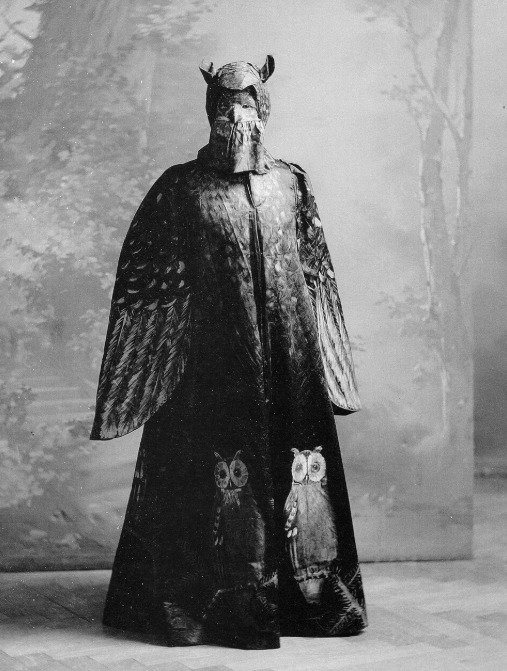
Cornish folklore tells of the cryptid Owlman (Kowanden in Kernowek), an owl-like humanoid creature first seen in 1926 in the quaint, but somehow forbidding, coastal village of Mawnan Smith, located in the south of the peninsula.
Johannes_Meiner_Eulenkost
Johannes Meiner, Public domain, via Wikimedia Commons
The Cornish ‘Mothman’ if you will.
The most famous appearance of The Owlman was in 1976
Surrealist artist, magician and writer Tony "Doc" Shiels (1938-2024), had a reputation as something of a trickster/hoaxer, and was already associated with a series of Cornish ‘monster-raising’ tall-tales in 1976 (sometimes aided by his coven of nude ‘witches’).
In the Spring of that year, he claimed to have investigated the curious story of two young girls on holiday who apparently witnessed a large, red-eyed, winged humanoid creature hovering above the tower of St Mawnan and St Stephen's Church on April 17th 1976.
St Mawnan and St Stephen's Church, Mawnan
Simon Burchell, CC BY-SA 4.0, via Wikimedia Commons
The girls - June (12) and Vicky Melling (9), were so rattled by the "feathered bird-man" their dad immediately cut their family holiday short and took them all home. Shiels said one of girls gave him her drawing of the beast, which he called "Owlman". The events were recounted in Anthony Mawnan-Peller’s (Mawnan?) pamphlet Morgawr: The Monster of Falmouth Bay, circulated throughout Cornwall the same year.
Sheils claimed "Owlman" was reported again a few months later on July 31st by two 14-year-old girls Sally Chapman and Barbara Perry, who had heard of the supposed creature. The pair were camping when they encountered "a big owl with pointed ears, as big as a man" boasting glowing red eyes and black, pincer-like claws, reminiscent of Spring-Heeled Jack, subject of a previous investigation of mine.
Irregular sightings of the beast in the vicinity of the church were shared in 1978, 1979, 1989, and 1995. According to local hearsay, a "loud, owl-like sound" was heard at night in the church yard during the year 2000.
The 1995 incident was witnessed by an American tourist, who sent a letter to the then night editor of the Western Morning News, Simon Parker:
Dear Sir,
I am a student of marine biology at the Field Museum, Chicago on the last day of a summer vacation in England. Last Sunday evening I had a most unique and frightening experience in the wooded area near the Old Church at Mawnan, Cornwall. I experienced what I can only describe as a ‘vision from hell’. The time was 15 minutes after 9, more or less. And I was walking along a narrow track through the trees. I was halted in my tracks when about 30m ahead I saw a monstrous ‘Birdman’ thing. It was the size of a man with a ghastly face, a wide mouth, glowing eyes and pointed ears. It had huge clawed wings and was covered in feathers of silver grey colour. The thing had long bird legs which terminated in large black claws. It saw me and rose, floating towards me. I just screamed then turn and ran for my life. The whole experience was totally irrational and dreamlike. Friends tell me that there is a tradition of a Phantom Owlman in that District. Now I know why. I have seen the phantom myself. Please don’t publish my real name and address. This could adversely affect my career. Now I have to rethink my ‘worldview’ entirely.
Yours very sincerely scared Eyewitness.
The creature was quiet for a few years but there were other strange occurrences recorded in Mawnan. In 1996 a woman reported a ball of light floating above the church. In 2003, two teenage girls (again) were listening to music in the church car park late at night (possibly indulging in some herbal recreation):
They too saw a glowing, pulsating globe of light hovering over the church. The girls said that they watched it for a while until it just vanished. The most recent sighting (that I know of ) was in September of 2009. It was reported that a 12 year old girl named Jessica Wilkins (or Wilkinson) saw the Owlman of Mawnan for the first time this century. Why all these strange happenings have occurred in the vicinity of Mawnan church is a mystery. There is some suggestion that the sightings are due to an escaped Great Grey Owl which can have a wing span of nearly 2m, has huge talons and can stand around 4.5ft tall. The only problem with this theory is the length of time over which the Owlman has been seen. Another theory is that the stories have something to do with the church standing in the centre of an ancient earthworks. Or perhaps because some researchers have detected a ley line (earth energy line) passing through the site? Other writers have said that sensitive and perceptive visitors have also described Mawnan Woods as being ‘alive’ with energy. Could that natural Earth energy be connected to the reports of the Owlman? (The Cornish Bird: Cornwall’s Hidden History Blog)
Tony Shiels - from Magonia Archive
Shiels seems to be an admirer of John Keel, the British edition of whose classic The Mothman Prophecies appeared in 1976. As if in affectionate imitation there then came report of a Cornish counterpart, Owlman. This entity showed himself only to adolescent girls on holiday, who afterwards would chance to meet Doc Shiels, tell him their stories, and never be seen again. Three of the girls produced drawings of what they had seen, though there is some doubt about one variously described as "by June Melling", or "based on the sketch by June Melling", which is not the same thing. If it is her original, then like the other two, she had remarkably excellent draughtsmanship for a pre-teenager; in fact one might have guessed all of the pictures to have been the work of a professional artist (e.g. Doc Shiels).
Barbara Perry and Sally Chapman both wrote a brief description of the 'monster' underneath their drawings. Their handwriting is of interest. Graphologists know that there are some writing habits that can be consciously altered, for instance whether the letters are joined up or not, whereas others are very difficult to disguise. Chapman's and Perry's hands are very different in their alterable habits; Perry joins up some of her letters but Chapman does not but are remarkably similar in their unalterable ones. The ways they wrote "monster" are virtually identical, and they share several other habits, both putting the dot over the i to the right of the letter and beginning the crossbar of the t at the upright stroke. One could almost conclude they were one person pretending to be two.
Years later Jonathan Downes, the portly Devonshire cryptozoologist, did his own investigation of Owlman and located a man who said he had seen it when a boy; though his sketch of it looks like an imitation of the originals rather than an independent drawing from life. The same is true of a letter sent by an American student who had seen it while on holiday. Though she gave an address in Chicago and stated herself to be a student of marine biology, when Downes tried to contact her she was not registered as living there, and no department chief he spoke to on the telephone had heard of her. Downes' best known contribution was to star in the Owlman video, which also featured the director's wife as a naked lesbian Witch, while a professional sceptic was depicted as a maniac gay Nazi.
But... back to 1926
From Sarah Coomer’s 100 Ghosts: The Owlman of Mawnan (May 2021)
There had been reports of a very large angry bird type thing in the churchyard as far back as the 1920s, whose reputation was enough to attract the attention of loved up Surrealists Leonora Carrington and Max Ernst who allegedly performed rituals to try to summon the beast in 1937. But the most famous sighting of the Owlman occurred in 1976 - whilst holidaying in Cornwall, two (probably v bored) young girls caught sight of what they described as a very large bird with glowing red eyes and claws like blacksmith’s pincers hovering over the church, as reported to monster investigator, storyteller, magician and all round character Tony ‘Doc’ Shiels. A number of other sightings were sporadically recorded but dismissed as having been engineered by Shiels, who had a bit of a reputation as a hoaxer. It’s all so obviously utter nonsense, and easily explained away (er, it’s a big owl) but there’s something about it which has captured the imagination of fans of the unexplained / Surrealist painters for decades. The idea itself is terrifying, the environs evocative and a bit spooky and the name of the place is a gift, like something out of Lord of the Rings.
And this from The Cornish Bird: The Cornish Hidden History Blog
In 1926 the Cornish Echo newspaper reported that two boys had been chased by what was described as a very large and ferocious bird. The terrified boys managed to escape and took cover behind a large steel grating. This first sighting attracted the attention of surrealist painters Max Ernst and Leonora Carrington. The couple visited Mawnan in 1937. There they are said to have performed rituals to try and summon up the half man half bird they called a ‘therianthorpes’. The Owlman featured heavily in both their artworks for the remainder of their lives.
Lord Of Tears (2013) - In the film, the Owlman represents Canaanite god Moloch, who particularly savoured child sacrifice. Moloch has been connected to Bohemian Grove, a sinister ‘gentlemen’s club’ for wealthy elites who gather in the San Francisco woods and stand each summer before a giant moss-covered 40ft wooden owl statue erected there.
The Owl Service
The Owl Service Episode One - transmitted Sunday, 21 December 1969, based on the Welsh legend of Blodeuwedd, turned into an owl for betraying her husband to death (all episodes available on YouTube)