Sunday, 27 September 2026

How Long Might a Ghost Haunt a House?

Editors note: We missed publishing this on National Ghost day, and published this a little late, but the article stands alone on its own merit.

A Practical Consideration for Ghost Hunters & Paranormal Enthusiasts
how long might a ghost haunt a house?

​​When in active search of spirits, many ghost hunters and paranormal enthusiasts will seek to visit a reputedly haunted house in the thought that since ghosts have been seen there by other people in the past, then there’s a chance that they might (eventually) be seen there again. But how long might a ghost haunt a house? While being somewhat rhetorical, this question may be a rather important one to ponder over, even for just a moment, when trying to decide whether our chances of encountering a ghost at a particular site with a haunted reputation may even be modestly slim or not.

One of the difficulties we face in pondering this question is that there tends to be relatively little data to go on: Not very many places with haunted reputations seem to continually keep records of all the times that their spectral inhabitants have been sighted. And even when they do, they may not be too detailed. But some partial records are known to exist in some cases, and even these might be useful in lending a bit of insight on the matter.

Revisiting the Case of the Cheltenham Ghost

haunted house

One such case that can be found in the early psychical research literature is the classic Cheltenham (aka. “Morton Ghost”) case of the late 19th century, which was partly chronicled by 19-year-old medical student Rosina Despard, under the pseudonym “Miss R. C. Morton” [1-2]. From 1882 to 1889, Rosina and several members of her family reported seeing the spectral figure of a lady in a dusky-colored widow’s dress that would wander through their rented home in Cheltenham, England. The path taken by this spectral widow tended to be repetitive and semi-regular in pattern, being rather akin to the kind of repeated, unwavering actions that are often said to be exhibited by ghosts in residual hauntings.

In her documentation of the case, Rosina noted down several of the occasions in which she and/or her family had sighted the spectral widow over the course of their occupancy of the Cheltenham house, and some of the descriptions she provided were detailed enough to roughly infer the approximate time on the calendar in which they took place. Then nearly a century later, psychical researcher Andrew MacKenzie interviewed a few additional witnesses who reported having haunt-related experiences in the vicinity of the Cheltenham house [3]. Some question might be raised about these later experiences, considering that some of them took place at night, and that there was already wide public awareness of the Chelteham haunting in the local area by that time (which could’ve shaped the witnesses’ perceptions). But if we momentarily assume, for the sake of the present argument, that at least some of them do represent genuinely anomalous experiences, then at least two were seemingly in line with a sighting of the same spectral widow figure (based upon their closest matching descriptive details).

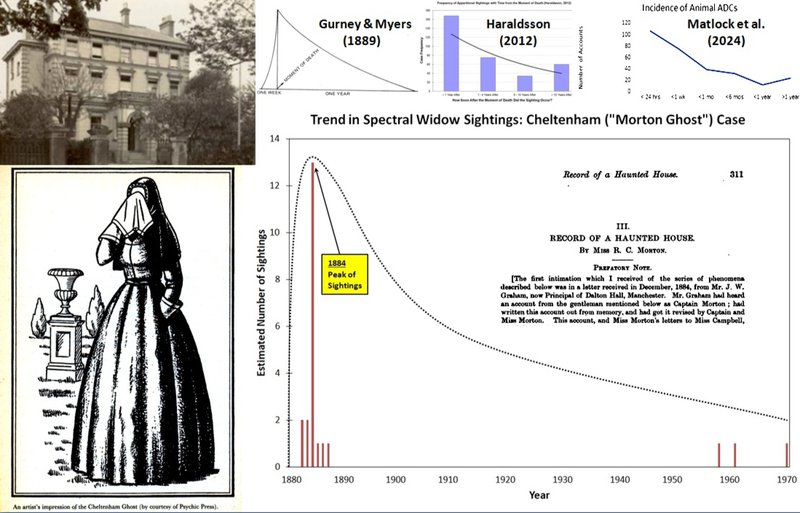
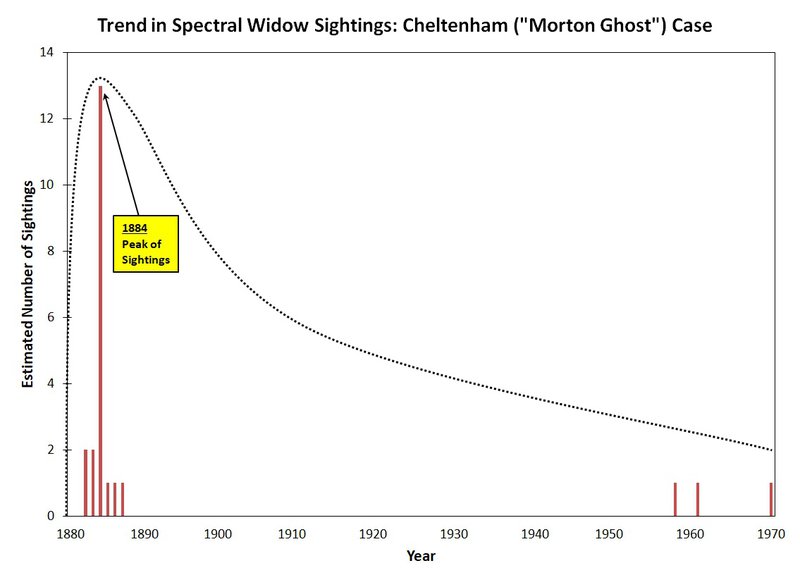
This made it possible to roughly approximate the yearly chronology for 23 sightings of the spectral widow (which is likely to be only a relatively small fraction of all the sightings that ever occurred). When plotted on a graph, the chronology looks something like what is shown in Figure 1.
spectral sightings
Figure 1. Approximate yearly chronology of a small subset of 23 sightings of the spectral widow figure in the Cheltenham (“Morton Ghost”) case, as reported by Rosina Despard and Andrew MacKenzie. The dotted line roughly represents the estimated trend in sightings over time.

​While remaining mindful of the caveat that there’s only a relatively small amount of data involved, the estimated trend (dotted line in Figure 1) would seem to suggest that a cluster of spectral widow sightings took place throughout most of the 1880s, with a peak period in sightings during the summer (particularly August) of 1884. After that period, the sightings began to decline over time, which would be consistent with Rosina’s own observation that: “The figure became much less substantial on its later appearances,” and was seen less and less as time went on [1, p. 321].

A Similar Pattern Among Ghost Sightings?

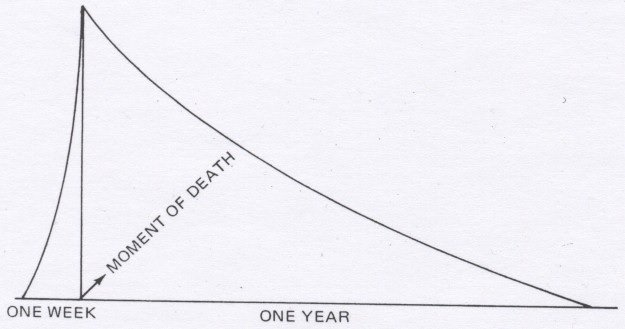
If the estimated trend seen in Figure 1 happens to be anywhere close to reflecting the actual pattern of ghost sightings, then it bears a notable degree of similarity to another kind of pattern seen in survey studies of reported apparition cases. This other kind of pattern was also first noticed in the 19th century by early psychical researchers Edmund Gurney and Frederic Myers [4] when they were looking at the number of spontaneous spectral sightings being reported before, at the moment of, and after the time of death. As can be seen in the graph reproduced in Figure 2, they found that the spectral sightings initially “...increase very rapidly for the few hours which precede death,” and then “...decrease rapidly in the few days after death, then more slowly; and after about a year’s time, they become so sporadic that we can no longer include them in a steadily decreasing line” [4, pp. 426 - 427].
ghost haunt a house graph
Figure 2. Pattern initially observed by Edmund Gurney and Frederic Myers in the number of 19th century ghost sightings reported before, at the moment of, and after death. [Source: Reference 4, p. 327]

​A somewhat similar kind of pattern seems to hold for more modern reports of ghost sightings, as well: Back in 2012, Icelandic researcher Erlendur Haraldsson reported a survey of 449 cases that he’d collected of spontaneous sightings of apparitions of the dead [5]. When I’d graphically plotted his case reports over the long term (Figure 3), they seemed to indicate that the number of reported sightings gets progressively smaller as the years pass from the time of death (with a slight upswing in reports occurring more than ten years after) [6].
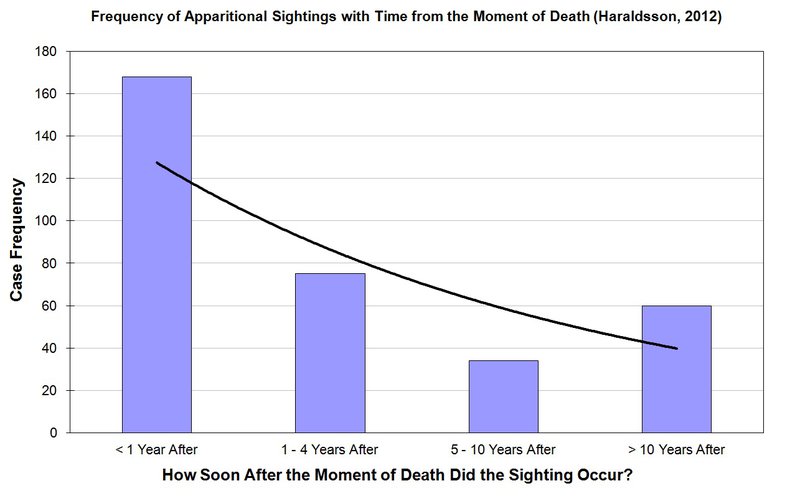
Figure 3. Long-term pattern observed by Erlendur Haraldsson of a decrease in apparitional sightings as time (in years) passes from the moment of death. [Source: References 5-6]

​And as observed by researchers James Matlock, Beth Hilton, and their colleagues, this kind of pattern even holds for reported sightings made of animal apparitions (Figure 4).
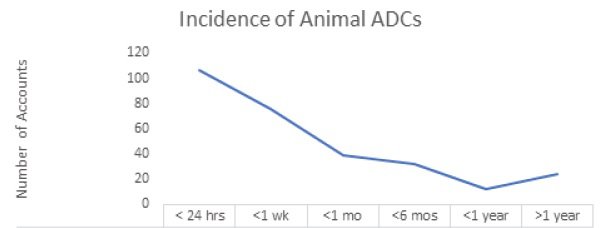
Figure 4. Long-term pattern observed by Matlock et al. of a decrease in animal apparition sightings as time (in years) passes from the moment of animal death. [Source: Reference 7, p. 64]

​A Possible Practical Take-Away Tip

When considered altogether, these findings seem to suggest that the number of reported spectral sightings tends to get less frequent as more time continues to pass. And if this happens to extend more widely to a number of haunting cases, then it may further suggest that while hauntings tend to last a long time, they don’t go on forever.

That would seem to further reinforce a practical consideration suggested earlier to ghost hunters and paranormal enthusiasts [6]: Be mindful of a location’s history of haunting, in order to see whether a visit might be worthwhile or not. Try to check up on the latest witness reports beforehand in order to determine how long ago phenomena were last reported there, and what was experienced. Has anyone seen the ghost there lately? If the location is a publicly accessible one, then there might be some time-stamped reviews and vlogs available on the Internet from other visitors who have been there, which can give hints about what has occurred (if anything) and how recently.

In doing this, it’s also good to be mindful that some publicly accessible locations may hype their reputed haunt as a tourist attraction. This means there’s a possibility that even though the haunting may have stopped, these locations could be aiming to keep the legend of haunting going, for the purpose of keeping up interest and drawing in more visitors - after all, who wants to visit a place that may no longer be haunted? When faced with such a potential situation, it may be good to further look into the quality of the witness reports coming from the location lately: Are the witnesses describing phenomena that come anywhere close to matching the kinds of phenomena that were experienced there in the more distant past? Or do the phenomena being reported lately seem relatively mundane? Weighing thoughts of this may be useful in deciding whether to make visit to the location or not.

​For more details on this and other practical take-away tips that may be useful to consider on future ghost hunts, check out this article in the pages of PDN’s new Parawize Journal.

​References

[1] Morton, R. C. [Despard, R. C.] (1892). Record of a haunted house. Proceedings of the Society for Psychical Research, 8, 311 - 332.

[2] Collins, B. A. (1948). The Cheltenham Ghost. Psychic Press Ltd.

[3] MacKenzie, A. (1988). Continuation of the “Record of a Haunted House.” Journal of the Society for Psychical Research, 55, 25 - 32.

[4] Gurney, E., & Myers, F. W. H. (1889). On apparitions occurring soon after death. Proceedings of the Society for Psychical Research, 5, 403 - 485.

[5] Haraldsson, E. (2012). The Departed Among the Living: An Investigative Study of Afterlife Encounters. White Crow Books.

[6] Williams, B. J. (2026). Seeking spectral insight: Some possible practical lessons for ghost hunting from parapsychological research. Parawize Journal, 1, 1 - 23. https://dx.doi.org/10.66589/rnc13b29

[7] Matlock, J. G., Hilton, B., Sheldrake, R., Smart, P., & Nahm, M. (2024). After-death communications (ADCs) from non-human animals: Parallels with human ADCs. Journal of Scientific Exploration, 38, 61 - 78. https://dx.doi.org/10.31275/20243087

Monday, 21 September 2026

The Mystery of Edward Mordake and his ‘Devil-Twin’

​Watching 2011’s American Horror Story: Freak Show the other evening, my attention was drawn to the peculiar character of Edward Mordake, played by Wes Bentley.

​Edward Mordake or Mordrake* was said to have been born sometime in the latter half of the 19th century, the heir to a wealthy English peerage with a life of ease and/or adventure in front of him. However, he was afflicted with a ‘devilish’ female face at the back of his head, which would whisper, simper, giggle or weep, contrary to Mordake’s own prevailing moods. Mordake pleaded with physicians to remove the face, claiming it whispered bad things to him at night. Mordake died by suicide at the age of 23. Can’t really blame him, to be absolutely honest.

* Mordrake is pop culture spelling

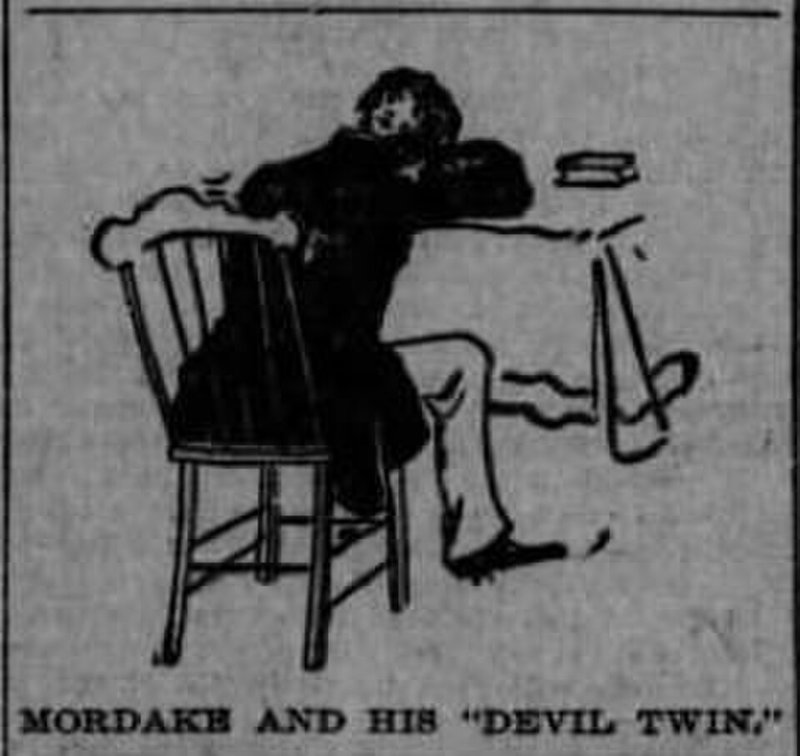
edward mordake
Illustrazione di Edward Mordake sul Boston Sunday Post, 1889
​[[File:Edward Mordake (illustrazione).jpg|Edward Mordake (illustrazione)]]

​George Gould and Walter Pyle wrote about Mordake in their 1896 book Anomalies and Curiosities of Medicine. Contained within is the story of Edward Mordake, supposedly taken from lay sources:

“One of the weirdest as well as most melancholy stories of human deformity is that of Edward Mordake, said to have been heir to one of the noblest peerages in England. He never claimed the title, however, and committed suicide in his twenty-third year. He lived in complete seclusion, refusing the visits even of the members of his own family. He was a young man of fine attainments, a profound scholar, and a musician of rare ability. His figure was remarkable for its grace, and his face—that is to say, his natural face—was that of an Antinous (the lover of the Roman Emperor Hadrian).

But upon the back of his head was another face, that of a beautiful girl, ‘lovely as a dream, hideous as a devil.’ The female face was a mere mask, ‘occupying only a small portion of the posterior part of the skull, yet exhibiting every sign of intelligence, of a malignant sort, however.’ It would be seen to smile and sneer while Mordake was weeping. The eyes would follow the movements of the spectator, and the lips would ‘gibber without ceasing.’ No voice was audible, but Mordake avers that he was kept from his rest at night by the hateful whispers of his ‘devil twin,’ as he called it, ‘which never sleeps, but talks to me forever of such things as they only speak of in hell. No imagination can conceive the dreadful temptations it sets before me. For some unforgiven wickedness of my forefathers I am knit to this fiend—for a fiend it surely is. I beg and beseech you to crush it out of human semblance, even if I die for it.’

Such were the words of the hapless Mordake to Manvers and Treadwell, his physicians. In spite of careful watching he managed to procure poison, whereof he died, leaving a letter requesting that the ‘demon face’ might be destroyed before his burial, ‘lest it continues its dreadful whisperings in my grave.’ At his own request he was interred in a waste place, without stone or legend to mark his grave.”

Edward Mordake

​However, the story of Mordake actually first appeared in an 1895 article by fiction writer Charles Lotin Hildreth, which was published in the Boston Sunday Post. Hildreth created references to a non-existent ‘Royal Scientific Society’ to make his fictional horror story appear real.​ Gould and Pyle were either in on the hoax, or were suckered by Hildreth, who didn't live to see the success of his creation. He died in August 1896, at the age of 39, just before the publication of Gould and Pyle's Anomalies and Curiosities of Medicine.

Many were introduced to the story of Mordake by an old photograph that circulated online for many years. It's in reality a photo of a wax replica created by an artist to demonstrate what Mordake could have looked like.

​Besides American Horror Story: Freak Show, Mordake has also appeared in contemporary popular culture as the subject of the song, “Chained Together For Life” aka “Poor Edward” by Tom Waits and the opera Mordake by Erling Wold.

​Tom Waits - Chained Together For Life

​Mordake by Erling Wold

Medically, it’s not impossible, as the phenomenon of Craniopagus Parasiticus, happens when "a parasitic twin head with an undeveloped body is attached to the head of a developed twin." Mordake if he existed could also possibly have been a case of Diprosopus, known as craniofacial duplication, resulting from abnormal protein activity. In 2008, Lali Singh, a female child with two faces, was born in India and survived for six weeks (see Sources for further details),

Anyway, with regard to Mordake, cases of craniopagus parasiticus always involve monozygotic (or identical) twins, which means the pair are always of the same sex. Mordake could not have had the face of a female on the back of his head.

​American Horror Story Freakshow - Edward Mordrake's Backstory

Other instances of Edward Mordake’s condition include Ashley Barrett’s “Second Face” from The Boys (2019-26)

And further back:

​How to Get Ahead in Advertising (1989) - an advertising executive has a nervous breakdown and grows a talking boil on his shoulder, a manifestation of the cynical and unscrupulous side of his personality.

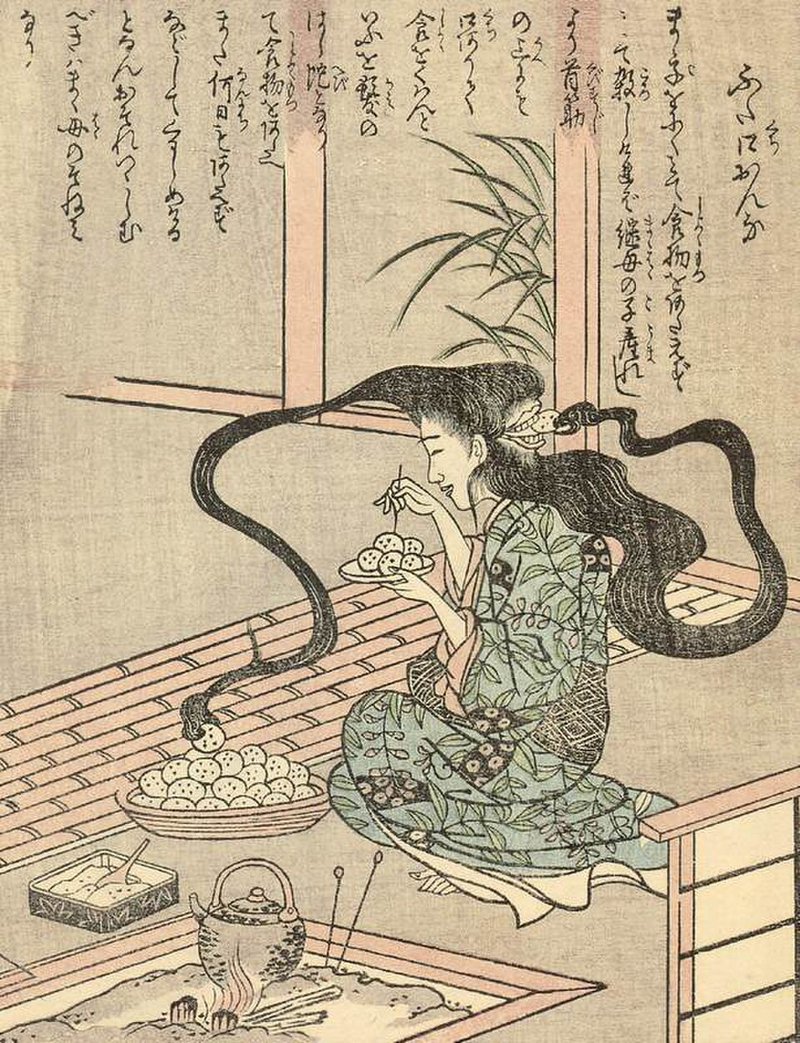
​Futakuchi-onna

edward mordake
Futakuchi-onna (二口女) from the Ehon Hyaku Monogatari (絵本百物語)
​Takehara Shunsen (竹原春泉, Japanese, *?, †?), Public domain, via Wikimedia Commons

In many Japanese stories, the soon-to-be futakuchi-onna (two-mouthed woman) is the spouse of a miser and rarely eats. A second mouth mysteriously appears on the back of the woman's head. This often mumbles spiteful and threatening things to the woman and demands food. If not fed, it screeches obscenities and causes tremendous physical pain. After a while, the woman's hair begins to move like a pair of serpents, allowing the maw to help itself to the woman's meals. While no food passes through her normal lips, the mouth in the back of her head consumes twice what the other one normally would.

In another story, the extra piehole is formed when a stingy woman is ‘accidentally’ hit in the head by her husband's axe whilst chopping wood, and the wound never heals and becomes a extra orifice. Some stories cast the woman as a mother who has let her stepchild die of hunger while keeping her own daughter nourished. The spirit of the waif possesses the stepmother or the surviving child to exact revenge.

​In the folk tales of Japan’s eastern regions, futakuchi onna are most often thought to be shape-changed yama uba (supernatural creatures) posing as young women. In the west of the country they are frequently shape-changed kumo - magical spider monsters. In the other tales they are the result of curses brought about by wicked deeds, a punishment upon a greedy man or woman for evil and extreme parsimony.

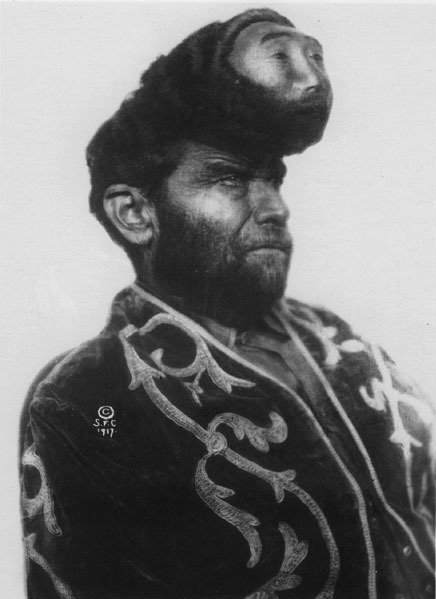
​Pasqual Piñón

Pasqual Pinon, 17 August 1917
​See page for author, Public domain, via Wikimedia Commons

​Pasqual Piñón (1889–1929), popularly known as Pedro The Two-Headed Mexican, was discovered by a sideshow huckster for the Sells-Floto Circus in the early 1900s, his attention caught by a large benign cyst or tumor at the top of the chap’s noggin. A phony wax face placed on the growth, demonstrating Piñón really had two heads.

​When the circus arrived in Gardner, Massachusetts, Dr. James Waters was called to check on Mr. Pinon, who was unable to leave his bunk on the circus train due to severe headaches. Dr. Waters attended to Piñón, then ordered him to the Henry Heywood Memorial Hospital, where it was decided the tumor had to be severed in order to save the man’s life. During the operation, Piñón remained conscious, numbed by Novocain. He didn’t suffer brain damage, as separate from the tumor. But he did lose his career. After regaining his health, ​Pasqual Piñón returned home to Mexico and retired from the circus.

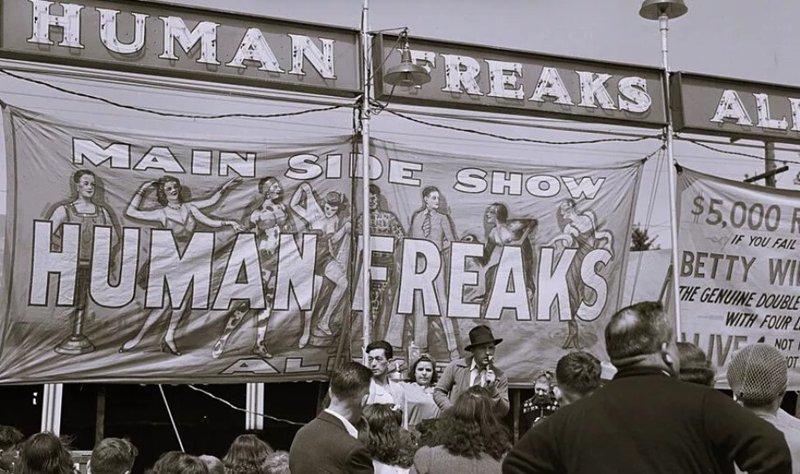
Rutland Freak Show (1941)
​Jack Delano, Public domain, via Wikimedia Commons

SOURCES

An English noble with two faces, a literary creation: https://eu.usatoday.com/story/news/factcheck/2021/07/22/fact-check-two-faced-edward-mordake-literary-creation/7985429002/

A Mystery Solved: https://hoaxes.org/weblog/comments/edward_mordake

​An apocryphal case of craniopagus parasiticus: https://link.springer.com/article/10.1007/s00381-014-2581-6

The Man Who Allegedly Had One Head And Two Faces:https://allthatsinteresting.com/edward-mordrake

​The True But False Story of Edward Mordrake: https://www.weirdhistorian.com/edward-mordrake/

​Edward Mordrake, the Two-Faced Hoax: https://www.ripleys.com/stories/edward-mordrake-hoax

​Futakuchi onna: https://yokai.com/futakuchionna/?srsltid=AfmBOor1CBXA_uI-yEbbWGB_fO59t8W6ICSFYpEnlMnqZbZmqA5MKWiq

​PASQUAL PINON – The Two Headed Mexican: https://web.archive.org/web/20130805140701/http://thehumanmarvels.com/39/pasqual-pinon-the-two-headed-mexican/fake-freaks

​Girl with two faces just fine as she is, say parents: https://www.theguardian.com/world/2008/apr/07/india

​'Miracle baby' is feted in India: http://news.bbc.co.uk/1/hi/world/south_asia/7340091.stm

STEPHEN ARNELL’S NOVEL THE GREAT ONE IS AVAILABLE NOW ON AMAZON KINDLE

SAMPLE:

​Cube - Two Heads Are Better Than One

Sunday, 20 September 2026

What Waits Around the Corner

At the Black Swan Inn in San Antonio, my guide stopped outside the barn and told me what other visitors had reported there: unexplained pulls, scratches and pinches. He also pointed to faded marks on the walls and ceiling. I listened, stepped away from the light, and went in alone.

Nothing scratched me. Nothing pinched me. Yet in the darkness, every creak seemed to ask the question that had followed me across America: What might be around the next corner?

That question carried me to 20 locations from a Reader's Digest list of haunted places and five more I added myself. It took nearly forty years, countless side roads and a final 10,800-mile solo journey to complete the search. I did not come home with proof of ghosts. I returned with a clearer understanding of how history, suggestion, grief and storytelling can occupy the same room.

A Boy and a Watchful Portrait

My search began in 1986 at Our House Tavern in Gallipolis, Ohio, an early nineteenth-century inn overlooking the Ohio River. During a tour, I heard stories about figures in the garden and portraits whose eyes seemed to follow visitors across the room. I was frightened, but I also wanted to know more. That combination of fear and curiosity became familiar.

Growing up in West Virginia, I heard local ghost stories and read Ruth Ann Musick's The Telltale Lilac Bush, a collection rooted in the state's oral traditions. Later, Stephen King's fiction showed me that fear does not always wait in a dark room. It can grow from loneliness, grief, guilt and the decisions people make.

The Shining stayed with me most. Beginning in 2022, I sought places connected to the novel and Stanley Kubrick's film: Timberline Lodge in Oregon, used for exterior images of the Overlook Hotel; Yosemite's Ahwahnee, whose interior design has often been compared with the film's sets; and Glacier National Park's Going-to-the-Sun Road, seen in the opening sequence. Then I reached the Stanley Hotel in Estes Park, Colorado, where King's 1974 stay helped inspire his novel.[1]

The Stanley was the first place that truly unsettled me. Guides discussed hotel founder F. O. Stanley, Room 217 and experiences reported by employees and guests. Late one night, I walked through dark service tunnels beneath the hotel. I did not see an apparition, but I felt the isolation that makes The Shining so powerful. The darkness supplied little information, and my mind supplied the rest.

The Search Changes the Place

Finding a supposedly haunted location can feel like a treasure hunt. I read old stories, compare maps, follow coordinates and sometimes arrive only to discover that access is restricted. At Forest Park Cemetery near Brunswick, New York, a police officer pulled alongside me before I could enter. I explained why I was there and asked permission to take photographs.

At West Virginia's Lake Shawnee Abandoned Amusement Park, fencing and vegetation separated me from the rusting rides until I received permission to walk the property. On Clinton Road in New Jersey, darkness and the absence of streetlights gave every sound more weight. Stories associated with the road include a drowned boy, phantom vehicles and strange creatures. I could not verify those claims. What I could observe was how quickly anticipation changed an ordinary walk.

The limits matter. The Amityville house remains a private residence, and its appearance and address have been altered over time. I photographed it only from a public roadway. The Conjuring House in Rhode Island has also existed in tension between public fascination and the rights of owners and neighbors. A haunted reputation is not permission to trespass, peer through windows or turn another person's home into a stage.

Those experiences changed my approach. Curiosity should not outrank safety, privacy or respect. The most responsible visit begins with permission and with a willingness to leave some corners unexplored.

When Recorded History Is Frightening Enough

haunted
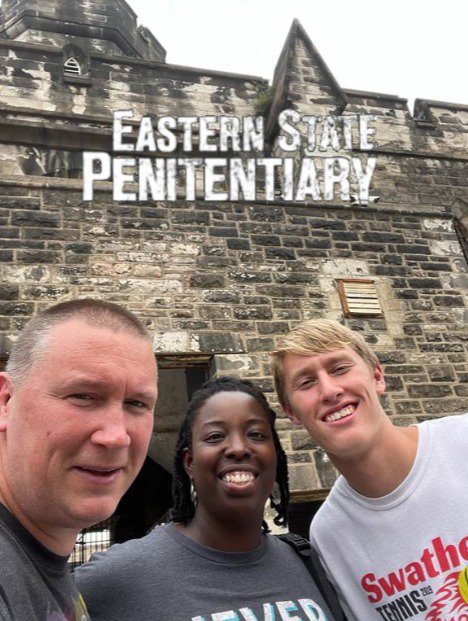
Brian Bollinger, Marlana Bollinger, and son Benjamin Bollinger outside Eastern State Penitentiary in Philadelphia, Pennsylvania. (Photo supplied by Brian Bollinger)

The places that affected me most were not necessarily those with the strongest ghost stories. They were the ones connected to documented suffering.

In Wisconsin, I used coordinates to locate the former site of Ed Gein's farmhouse. His crimes later influenced novels and films, while repeated vandalism led officials to remove his gravestone from Plainfield Cemetery. Standing near the place where the marker had been, I thought less about the fictional monsters he inspired than about the real victims too often reduced to background in retellings.

At the Trans-Allegheny Lunatic Asylum in Weston, West Virginia, the historical record overshadowed the paranormal accounts. The hospital was designed for about 250 patients but held more than 2,000 during its most crowded years. Its history includes severe overcrowding and treatments now recognized as deeply troubling.[2] Visitors hear reports of footsteps, voices and apparitions, but the documented lives of patients demanded more attention from me than any claim I could not confirm.

Eastern State Penitentiary in Philadelphia produced a similar reaction. Opened in 1829, it became famous for a system of separation intended to inspire penitence through isolation.[3] Walking its long cellblocks, I heard the familiar lore of whispers and shadowy figures. What stayed with me was the human cost of confinement: how time, silence and isolation might distort a person's sense of the world.

At the Crescent Hotel in Eureka Springs, Arkansas, the building's most disturbing chapter involved Norman Baker. In 1937, Baker converted the hotel into a hospital and advertised a supposed cancer treatment despite having no medical training. He was later convicted of mail fraud connected to the enterprise.[4] Current ghost stories often focus on former patients and the building's basement. Whether those reports have a paranormal explanation is unresolved. The exploitation of desperately ill people is not.

The Lizzie Borden House in Fall River, Massachusetts, offered another lesson in presentation. Our guide placed historical photographs in the rooms associated with the 1892 killings. The images did not prove any haunting, but they restored names, faces and physical context to a story often treated as entertainment. Good interpretation makes the past more specific, not merely more frightening.

Two Dolls and the Power of Expectation

haunted
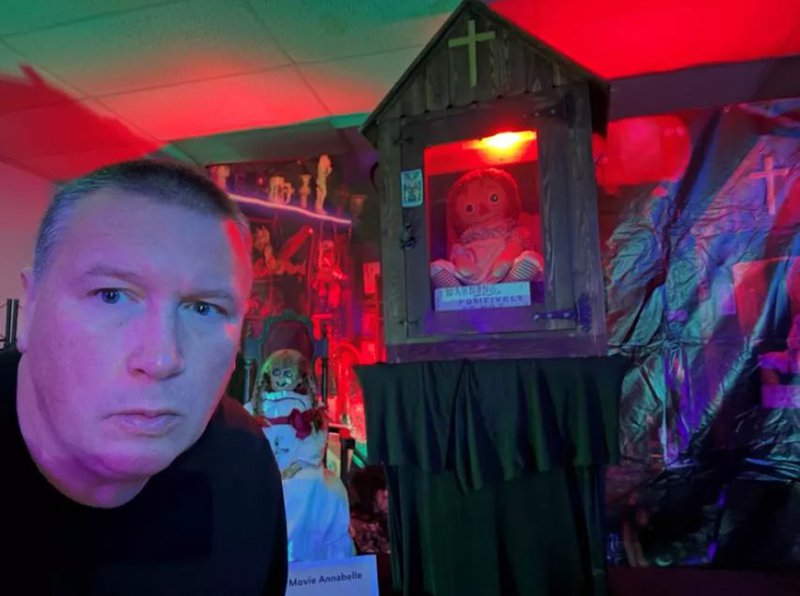
Brian Bollinger with the Raggedy Ann doll presented as Annabelle, alongside the film version of the character, at a 2025 horror convention in Rock Island, Illinois. (Photo supplied by Brian Bollinger)

Few parts of my search drew more interest than Robert the Doll and Annabelle. Their reputations arrived before I did.

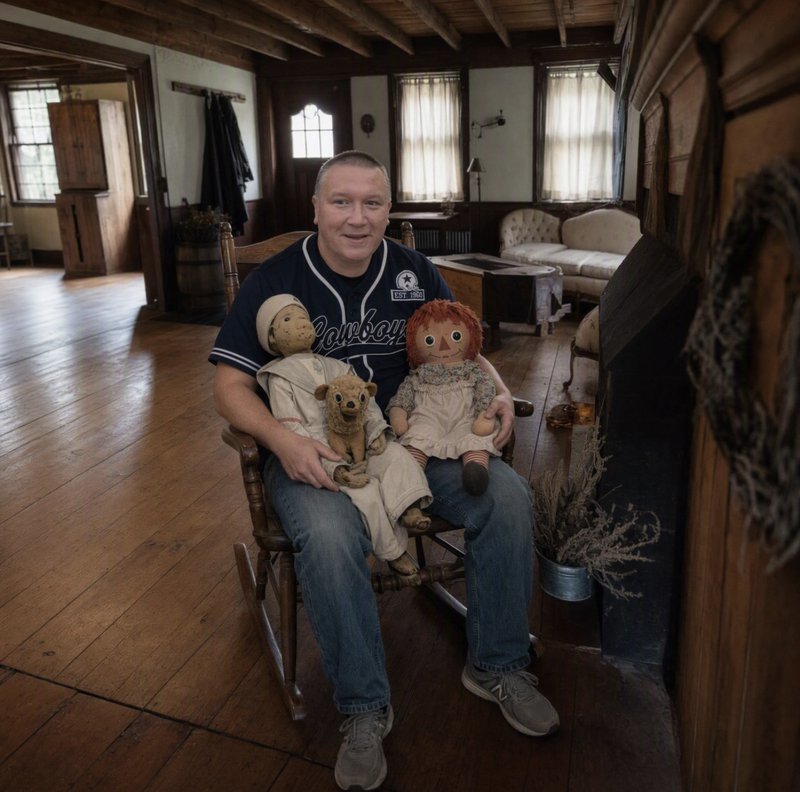
At Fort East Martello in Key West, our guide explained the custom of asking Robert's permission before taking a photograph and saying goodbye before leaving.[7] I was eager and began taking pictures without following the ritual. My camera recorded a doll behind glass. Around me, other visitors carefully observed the rules. The ritual created a shared expectation: everyone knew what might happen if Robert was offended, even though no one could test that warning under controlled conditions.

I encountered Annabelle in 2025 at a horror convention in Rock Island, Illinois. The doll associated with Ed and Lorraine Warren's accounts is a Raggedy Ann, unlike the porcelain figure created for the films. She sat behind glass as people approached slowly, spoke quietly and lifted their phones. I photographed her and watched the crowd.

The object itself looked ordinary. The atmosphere around it did not. Books, testimony, warnings, films and social media had taught everyone in the room how to react. That did not establish that the doll was dangerous. It demonstrated how a story can shape an encounter before the encounter begins.

Skepticism did not make the moment meaningless. It changed the question. Instead of asking only whether the doll was haunted, I began asking what fear reveals about the people sharing it. Believers, skeptics and the undecided were all standing before the same glass case, but each person had brought a different story into the room.

Screenshot
Author with Robert the Doll, Key West Floriday (Photo supplied by Brian Bollinger)

The Last Three Stops

In 2026, my final three haunted destinations were the Conjuring House, the Winchester Mystery House and the Queen Mary. Each showed a different way that history becomes legend.

At the Winchester Mystery House in San Jose, I moved through stairs, doors and rooms made famous by decades of stories about Sarah Winchester. The house is real, as are Winchester's losses and years of construction. The common claim that she built continuously to confuse or appease spirits is disputed by historians, and surviving evidence does not settle every motive.[5] The uncertainty is part of the attraction. Visitors encounter a remarkable building and a legend that has become difficult to separate from it.

I ended the journey with an overnight stay aboard the Queen Mary in Long Beach. The ship's documented service includes its years as a luxury liner and its military role during World War II.[6] Its corridors also carry generations of reported encounters. At night, machinery hummed behind the walls and metal shifted with changes in temperature and movement. Ordinary sounds became difficult to place. Once again, the setting and the stories worked together.

As I walked a corridor, I wondered whether someone else was nearby. I found no evidence that required a paranormal explanation. Still, I understood why the ship continues to generate stories. It is enormous, layered with history and filled with spaces most visitors cannot see. The Queen Mary did not need to produce a ghost to make me feel the presence of the past.

Back in the Barn

haunted
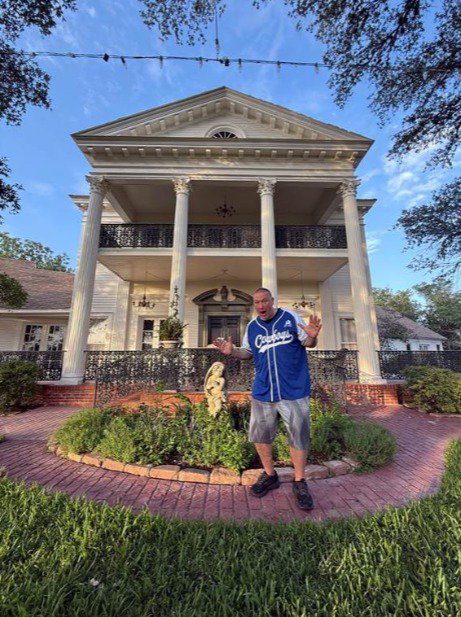
Brian Bollinger outside Victoria's Black Swan Inn in San Antonio, Texas (Photo supplied by Brian Bollinger)

The Black Swan Inn remains my favorite stop because I had time to explore without being rushed toward a promised scare. My guide invited me to sit before a mirror and consider whether I might glimpse a younger or older version of myself. Later, alone in the barn, I waited for the pull or scratch others had described.

It never came. But the absence of an unexplained event did not make the visit a failure. It gave me room to recognize what had been happening throughout the journey. A guide's account had focused my attention. Darkness had removed visual certainty. The history of the property and my own expectations had filled the gaps.

Other places raised the same problem. At the Sallie House in Atchison, Kansas, I wondered how the reported story of a young girl dying during surgery had hardened into accepted local history even though key details remain difficult to document. In Tennessee, the Bell Witch legend has shaped the identity of a community for generations. Repetition can preserve a story, but it can also make a claim feel more certain than its evidence allows.

After forty years and 25 haunted locations, I remain interested in what might wait around the next corner. I am simply more careful about naming it. A sound can be real without being supernatural. A legend can be meaningful without being historically exact. Skepticism and wonder do not have to cancel each other.

I left these places without proof of ghosts, but with greater respect for the lives behind the legends: patients, prisoners, victims, workers, owners, storytellers and visitors. A room can gather history, rumor, commerce and belief until one becomes difficult to distinguish from another. Perhaps that is why haunted places endure. They do not merely ask whether the dead remain. They reveal what the living refuse to forget.

The next time I step into the darkness, I will listen for the next sound. I will also ask what I already carried into the room with me.

​Sources

1. The Stanley Hotel History and Stephen King connection https://www.stanleyhotel.com/

2. National Park Service Weston State Hospital National Historic Landmark documentation https://npgallery.nps.gov/AssetDetail/NRIS/78002805

3. Eastern State Penitentiary Historic Site History of the Pennsylvania system https://www.easternstate.org/research/history-eastern-state

4. Encyclopedia of Arkansas Norman Baker https://encyclopediaofarkansas.net/entries/norman-g-baker-4885/

5. Winchester Mystery House Estate history https://winchestermysteryhouse.com/

6. The Queen Mary Ship history https://www.queenmary.com/history/

7. Fort East Martello Museum Robert the Doll https://www.kwahs.org/museums/fort-east-martello/robert-the-doll

Article header image of the Black Swan Inn front door attribution:

​Nicolas Henderson from Coppell, Texas, CC BY 2.0, via Wikimedia Commons

Wednesday, 9 September 2026

Ghost Sightings at Work

When it comes to a certain locale where one might possibly encounter a ghost, a haunted house may tend to readily come to mind for most people, and not too many of them may readily think of their own workplace in this regard. Yet there have been a fair number of reported instances in which people say they’ve spontaneously experienced ghost sightings in their own work environment - figures which often seemed to resemble a past (or even present) co-worker of theirs. Here are three examples which seem fitting to share on the occasion of the Labor Day holiday:

Store Specter

Many people strive to not be late for work, and that was the aim of a woman in Canada, for as she put it:

​I had been reprimanded for taking off too much time and I didn’t want to be late. But that morning, after a sleepless night, I was still in bed at 8:30, the time I was supposed to report for work. My guilty knowledge that the store was short-staffed would not let me stay in bed for long, but when I finally reported to [the store] at eleven, I went virtually unnoticed even when taking my place as clerk-cashier on the second floor. Soon, however, the manager came up to me. He had seen me come in at 8:30, but then he had been unable to find me. “But I just came in a few minutes ago,” I explained. He looked at me as if I needed psychiatric attention and stalked away. At lunch time I joked about Mr. Keeler’s strange delusion with two friends. To my utter amazement, both Jessie and Trudy corroborated his statement and reported seeing me come in. Rose, the downstairs cashier, too, insisted that I had entered at 8:30, and that she had greeted me as I came in, “dressed as you usually are.” But my daughter-in-law confirmed that she had seen me in bed at 8:30. [1, pp. 127 - 128]

​Some PDN readers might recall an article by Cat Ward in which she introduced a kind of spectral encounter known in Scandinavia as vardøgr, which refers to a premonitory phantom noise or vision that precedes someone’s arrival at certain place (for this reason, they are also sometimes simply called “arrival apparitions”). The preceding account represents another such instance of vardøgr, as the woman’s spectral figure seemed to represent a premonitory vision of her actual arrival at the store about two and half hours later.

Office Ghost Sightings

ghost sightings at work

​Another example, which comes from a small collection of cases gathered by University of Virginia psychiatrist Ian Stevenson [2], tells of a spectral encounter that occurred close to the time when a former employee of a Welsh company had died. The employee - whom we’ll refer to here as “Trevor” - had abruptly left the company some months before and was in the hospital when his spectral figure was apparently seen by his former co-worker, a woman we'll call “Rhonda.”

​This encounter represents an instance of a spectral figure being seen in the daytime, as it occurred on a July afternoon in 1989. Rhonda was meeting with a fellow employee in her office when the phone rang, causing her to get up and walk over to her desk on the far side of the room to answer it. The far office wall by her desk was made up of a full plate glass window, which looked out onto a outside walkway that led up from the parking area to the front entrance of the office building. While she was talking on the phone, Rhonda glanced out the window and happened to notice a man walking by on the walkway who looked notably like Trevor: He was dressed in navy blue sailing attire, and she especially seemed to recognize his characteristic “sailor’s gait,” which he’d developed in his active pursuit of sailing. She also noticed that he seemed to be in a hurry and that he “...looked very troubled. He appeared perfectly solid, and I did not attract his attention through the window. I thought no more about this, it was nothing unusual” [2, p. 355]. It was only the next day that Rhonda learned from an office secretary that Trevor was in the hospital and had died the day before - the very day she’d apparently seen him in spectral form.

​Of course, there’s the chance that Rhonda had simply mistaken someone else for Trevor, although that seems rather unlikely given the fairly close distance at which she’d seen the figure. It also seems unlikely that she’d seen Trevor in the flesh because his medical records indicated that he’d been lying unconscious in his hospital bed throughout the course of that particular day.

​Assuming on this basis that Rhonda had indeed seen Trevor in spectral form, her encounter would seem to represent a “crisis apparition,” in which the witness sees the spectral figure of someone they know at a time when that particular someone has been in an accident, has suffered a serious illness, or has had a close brush with death (see this PDN article by Richard Clements for more on this particular kind of spectral encounter).

Ghost Sightings in a Haunted Hallway

​In a third example, involving a reputedly haunted radio station [3], five employees all reported having similar apparitional experiences (at separate times) in the vicinity of a certain hallway area in the station. Each of the employees reported seeing the shadowy spectral figure of a man, with four of them describing him as being nearly 6 feet tall, and being fairly heavyset (around 180 - 200 pounds). Based on the way it was dressed and the way it seemed to “slump its shoulders,” two of the employees thought the figure resembled a former co-worker they’d known at the station, who’d left his job there a few years before and had died of a heart attack several months after leaving. Although there wasn’t really anything about this particular hallway which made it visually stand out from any others in the station, it turns out that the man’s office had been located right off the hallway where these employees had their encounters.

A Role for Memory in Some Ghostly Encounters?

​Although they occurred in different contexts, one particularly notable thing about all of these examples is that the spectral figures had all exhibited certain details in their appearance which specifically reminded the witnesses of a particular co-worker they knew: In “Store Specter,” the Canadian woman’s co-workers had told her that the spectral figure they’d seen of her had appeared “dressed as you usually are.” The spectral figure of Trevor that Rhonda had seen in “Office Sighting” was recognized from his “sailor’s gait” (and perhaps partly by his sailing attire, as well). And in “A Haunted Hallway,” some of the radio station employees seemed to recognize their former co-worker’s figure from his attire and posture.

ghost sightings

​This seems to suggest that each witness had perceived the spectral figure of their co-worker in a way that they were accustomed to seeing that co-worker look. As a specific feature to focus on, let’s take the way some of the figures were dressed. The Canadian woman's co-workers said they saw the woman’s figure in the same work attire that they were typically used to seeing her wear everyday. This turns out to be something found fairly commonly in other apparitional sightings, from those reported as far back as the Victorian Era, all the way up to those reported in the modern time.

​For instance, in discussing the features of ghostly figures seen back in the 19th century, psychical researcher Frederic Myers noted that “...it is usual for a witness to say ‘he appeared to me in the dress he habitually wore, and in which I knew him’” [4, Vol. II, p. 295]. Similarly, in talking about ghosts of the dead seen in more modern times, parapsychologist Richard Broughton noted that “...the clothing that the ghost appeared in was what the deceased customarily wore, not necessarily those in which the person died” [5, p. 150]. This similarity may offer us a hint that some sightings of spectral figures (particularly those of a familiar person) may be mediated in part by the memories that the witness has of the person whose spectral figure is seen [6 - 8]. If that is so, then this suggests that memory is not just handy for remembering things that we've learned in school - it may also play a subtle role in facilitating encounters of the spectral kind, as well.

References

​[1] Evans, H. (2002). Seeing Ghosts: Experiences of the Paranormal. John Murray Publishers Ltd.

[2] Stevenson, I. (1995). Six modern apparitional experiences. Journal of Scientific Exploration, 9, 351 - 366.

[3] Cameron, T., & Roll, W. G. (1983). An investigation of apparitional experiences. Theta: The Journal of the Psychical Research Foundation, 11, 74 - 78.

[4] Gurney, E., Myers, F. W. H., & Podmore, F. (1886). Phantasms of the Living (2 vols.). Trubner & Company.

[5] Broughton, R. S. (2006). Why do ghosts wear clothes? Examining the role of memory and emotion in anomalous experiences. European Journal of Parapsychology, 21, 148 - 165.

[6] Roll, W. (2006). A discussion of the evidence that personal consciousness persists after death with special reference to poltergeist phenomena. Australian Journal of Parapsychology, 6, 5 - 20.

[7] Irwin, H. J. (1979). Psi and the Mind: An Information-Processing Approach. Scarecrow Press.

[8] Broad, C. D. (1953). Phantasms of the living and of the dead. Proceedings of the Society for Psychical Research, 50, 51 - 66.