At the Black Swan Inn in San Antonio, my guide stopped outside the barn and told me what other visitors had reported there: unexplained pulls, scratches and pinches. He also pointed to faded marks on the walls and ceiling. I listened, stepped away from the light, and went in alone.
Nothing scratched me. Nothing pinched me. Yet in the darkness, every creak seemed to ask the question that had followed me across America: What might be around the next corner?
That question carried me to 20 locations from a Reader's Digest list of haunted places and five more I added myself. It took nearly forty years, countless side roads and a final 10,800-mile solo journey to complete the search. I did not come home with proof of ghosts. I returned with a clearer understanding of how history, suggestion, grief and storytelling can occupy the same room.
A Boy and a Watchful Portrait
My search began in 1986 at Our House Tavern in Gallipolis, Ohio, an early nineteenth-century inn overlooking the Ohio River. During a tour, I heard stories about figures in the garden and portraits whose eyes seemed to follow visitors across the room. I was frightened, but I also wanted to know more. That combination of fear and curiosity became familiar.
Growing up in West Virginia, I heard local ghost stories and read Ruth Ann Musick's The Telltale Lilac Bush, a collection rooted in the state's oral traditions. Later, Stephen King's fiction showed me that fear does not always wait in a dark room. It can grow from loneliness, grief, guilt and the decisions people make.
The Shining stayed with me most. Beginning in 2022, I sought places connected to the novel and Stanley Kubrick's film: Timberline Lodge in Oregon, used for exterior images of the Overlook Hotel; Yosemite's Ahwahnee, whose interior design has often been compared with the film's sets; and Glacier National Park's Going-to-the-Sun Road, seen in the opening sequence. Then I reached the Stanley Hotel in Estes Park, Colorado, where King's 1974 stay helped inspire his novel.[1]
The Stanley was the first place that truly unsettled me. Guides discussed hotel founder F. O. Stanley, Room 217 and experiences reported by employees and guests. Late one night, I walked through dark service tunnels beneath the hotel. I did not see an apparition, but I felt the isolation that makes The Shining so powerful. The darkness supplied little information, and my mind supplied the rest.
The Search Changes the Place
Finding a supposedly haunted location can feel like a treasure hunt. I read old stories, compare maps, follow coordinates and sometimes arrive only to discover that access is restricted. At Forest Park Cemetery near Brunswick, New York, a police officer pulled alongside me before I could enter. I explained why I was there and asked permission to take photographs.
At West Virginia's Lake Shawnee Abandoned Amusement Park, fencing and vegetation separated me from the rusting rides until I received permission to walk the property. On Clinton Road in New Jersey, darkness and the absence of streetlights gave every sound more weight. Stories associated with the road include a drowned boy, phantom vehicles and strange creatures. I could not verify those claims. What I could observe was how quickly anticipation changed an ordinary walk.
The limits matter. The Amityville house remains a private residence, and its appearance and address have been altered over time. I photographed it only from a public roadway. The Conjuring House in Rhode Island has also existed in tension between public fascination and the rights of owners and neighbors. A haunted reputation is not permission to trespass, peer through windows or turn another person's home into a stage.
Those experiences changed my approach. Curiosity should not outrank safety, privacy or respect. The most responsible visit begins with permission and with a willingness to leave some corners unexplored.
When Recorded History Is Frightening Enough
The places that affected me most were not necessarily those with the strongest ghost stories. They were the ones connected to documented suffering.
In Wisconsin, I used coordinates to locate the former site of Ed Gein's farmhouse. His crimes later influenced novels and films, while repeated vandalism led officials to remove his gravestone from Plainfield Cemetery. Standing near the place where the marker had been, I thought less about the fictional monsters he inspired than about the real victims too often reduced to background in retellings.
At the Trans-Allegheny Lunatic Asylum in Weston, West Virginia, the historical record overshadowed the paranormal accounts. The hospital was designed for about 250 patients but held more than 2,000 during its most crowded years. Its history includes severe overcrowding and treatments now recognized as deeply troubling.[2] Visitors hear reports of footsteps, voices and apparitions, but the documented lives of patients demanded more attention from me than any claim I could not confirm.
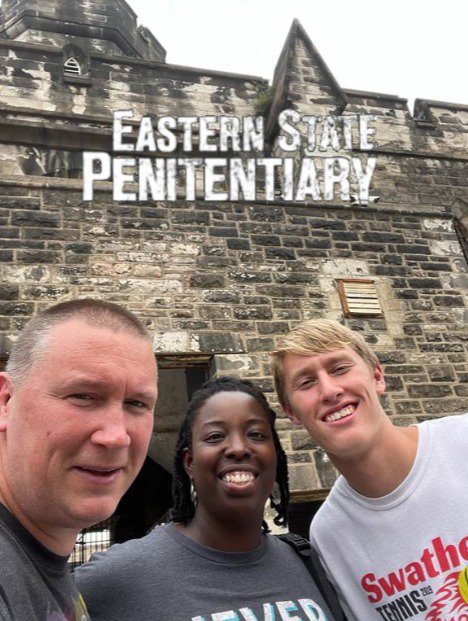
Eastern State Penitentiary in Philadelphia produced a similar reaction. Opened in 1829, it became famous for a system of separation intended to inspire penitence through isolation.[3] Walking its long cellblocks, I heard the familiar lore of whispers and shadowy figures. What stayed with me was the human cost of confinement: how time, silence and isolation might distort a person's sense of the world.
At the Crescent Hotel in Eureka Springs, Arkansas, the building's most disturbing chapter involved Norman Baker. In 1937, Baker converted the hotel into a hospital and advertised a supposed cancer treatment despite having no medical training. He was later convicted of mail fraud connected to the enterprise.[4] Current ghost stories often focus on former patients and the building's basement. Whether those reports have a paranormal explanation is unresolved. The exploitation of desperately ill people is not.
The Lizzie Borden House in Fall River, Massachusetts, offered another lesson in presentation. Our guide placed historical photographs in the rooms associated with the 1892 killings. The images did not prove any haunting, but they restored names, faces and physical context to a story often treated as entertainment. Good interpretation makes the past more specific, not merely more frightening.
Two Dolls and the Power of Expectation
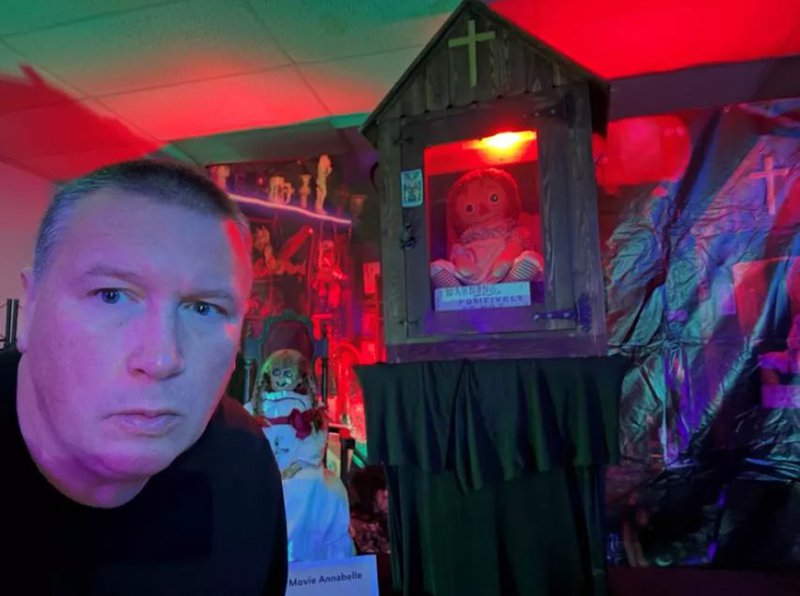
Few parts of my search drew more interest than Robert the Doll and Annabelle. Their reputations arrived before I did.
At Fort East Martello in Key West, our guide explained the custom of asking Robert's permission before taking a photograph and saying goodbye before leaving.[7] I was eager and began taking pictures without following the ritual. My camera recorded a doll behind glass. Around me, other visitors carefully observed the rules. The ritual created a shared expectation: everyone knew what might happen if Robert was offended, even though no one could test that warning under controlled conditions.
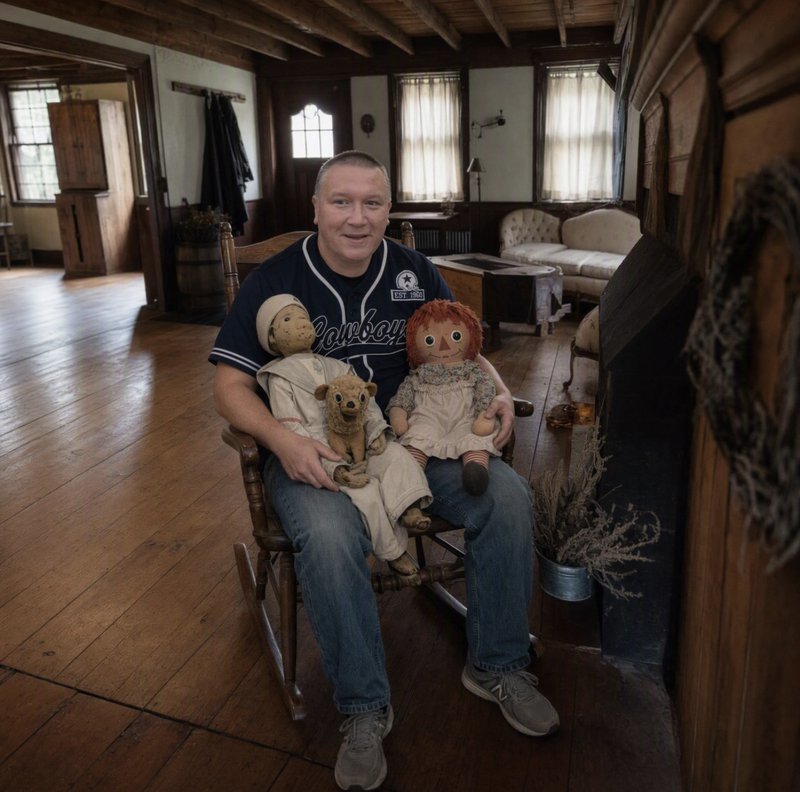
I encountered Annabelle in 2025 at a horror convention in Rock Island, Illinois. The doll associated with Ed and Lorraine Warren's accounts is a Raggedy Ann, unlike the porcelain figure created for the films. She sat behind glass as people approached slowly, spoke quietly and lifted their phones. I photographed her and watched the crowd.
The object itself looked ordinary. The atmosphere around it did not. Books, testimony, warnings, films and social media had taught everyone in the room how to react. That did not establish that the doll was dangerous. It demonstrated how a story can shape an encounter before the encounter begins.
Skepticism did not make the moment meaningless. It changed the question. Instead of asking only whether the doll was haunted, I began asking what fear reveals about the people sharing it. Believers, skeptics and the undecided were all standing before the same glass case, but each person had brought a different story into the room.
The Last Three Stops
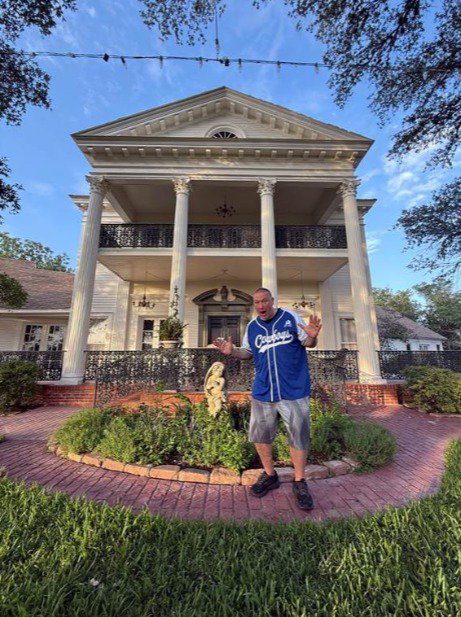
In 2026, my final three haunted destinations were the Conjuring House, the Winchester Mystery House and the Queen Mary. Each showed a different way that history becomes legend.
At the Winchester Mystery House in San Jose, I moved through stairs, doors and rooms made famous by decades of stories about Sarah Winchester. The house is real, as are Winchester's losses and years of construction. The common claim that she built continuously to confuse or appease spirits is disputed by historians, and surviving evidence does not settle every motive.[5] The uncertainty is part of the attraction. Visitors encounter a remarkable building and a legend that has become difficult to separate from it.
I ended the journey with an overnight stay aboard the Queen Mary in Long Beach. The ship's documented service includes its years as a luxury liner and its military role during World War II.[6] Its corridors also carry generations of reported encounters. At night, machinery hummed behind the walls and metal shifted with changes in temperature and movement. Ordinary sounds became difficult to place. Once again, the setting and the stories worked together.
As I walked a corridor, I wondered whether someone else was nearby. I found no evidence that required a paranormal explanation. Still, I understood why the ship continues to generate stories. It is enormous, layered with history and filled with spaces most visitors cannot see. The Queen Mary did not need to produce a ghost to make me feel the presence of the past.
Back in the Barn
The Black Swan Inn remains my favorite stop because I had time to explore without being rushed toward a promised scare. My guide invited me to sit before a mirror and consider whether I might glimpse a younger or older version of myself. Later, alone in the barn, I waited for the pull or scratch others had described.
It never came. But the absence of an unexplained event did not make the visit a failure. It gave me room to recognize what had been happening throughout the journey. A guide's account had focused my attention. Darkness had removed visual certainty. The history of the property and my own expectations had filled the gaps.
Other places raised the same problem. At the Sallie House in Atchison, Kansas, I wondered how the reported story of a young girl dying during surgery had hardened into accepted local history even though key details remain difficult to document. In Tennessee, the Bell Witch legend has shaped the identity of a community for generations. Repetition can preserve a story, but it can also make a claim feel more certain than its evidence allows.
After forty years and 25 haunted locations, I remain interested in what might wait around the next corner. I am simply more careful about naming it. A sound can be real without being supernatural. A legend can be meaningful without being historically exact. Skepticism and wonder do not have to cancel each other.
I left these places without proof of ghosts, but with greater respect for the lives behind the legends: patients, prisoners, victims, workers, owners, storytellers and visitors. A room can gather history, rumor, commerce and belief until one becomes difficult to distinguish from another. Perhaps that is why haunted places endure. They do not merely ask whether the dead remain. They reveal what the living refuse to forget.
The next time I step into the darkness, I will listen for the next sound. I will also ask what I already carried into the room with me.
Sources
1. The Stanley Hotel History and Stephen King connection https://www.stanleyhotel.com/
2. National Park Service Weston State Hospital National Historic Landmark documentation https://npgallery.nps.gov/AssetDetail/NRIS/78002805
3. Eastern State Penitentiary Historic Site History of the Pennsylvania system https://www.easternstate.org/research/history-eastern-state
4. Encyclopedia of Arkansas Norman Baker https://encyclopediaofarkansas.net/entries/norman-g-baker-4885/
5. Winchester Mystery House Estate history https://winchestermysteryhouse.com/
6. The Queen Mary Ship history https://www.queenmary.com/history/
7. Fort East Martello Museum Robert the Doll https://www.kwahs.org/museums/fort-east-martello/robert-the-doll
Article header image of the Black Swan Inn front door attribution:
Nicolas Henderson from Coppell, Texas, CC BY 2.0, via Wikimedia Commons

No comments:
Post a Comment