Showing posts with label mystery. Show all posts

Thursday, 16 July 2026

Cleopatra’s Needles: Cursed Obelisks in London & New York

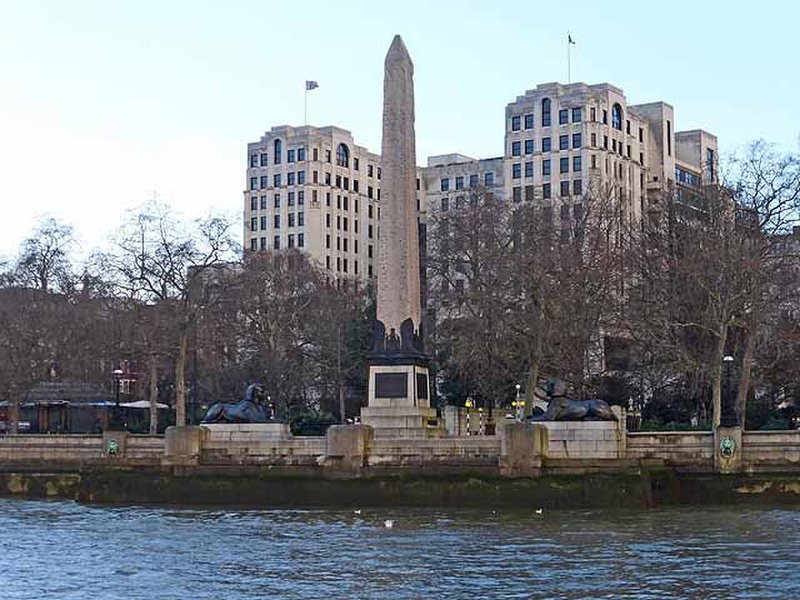
​A pair of obelisks, together named Cleopatra's Needles, were taken in the 19th century from the ruins of the Caesareum of Alexandria in Egypt; one to the London Embankment and the other to New York’s Central Park.

Inscribed by Thutmose III and later Ramesses II of the Egyptian New Kingdom, the obelisks were first moved in 12 BC to Alexandria, remaining there for over 1,800 years.
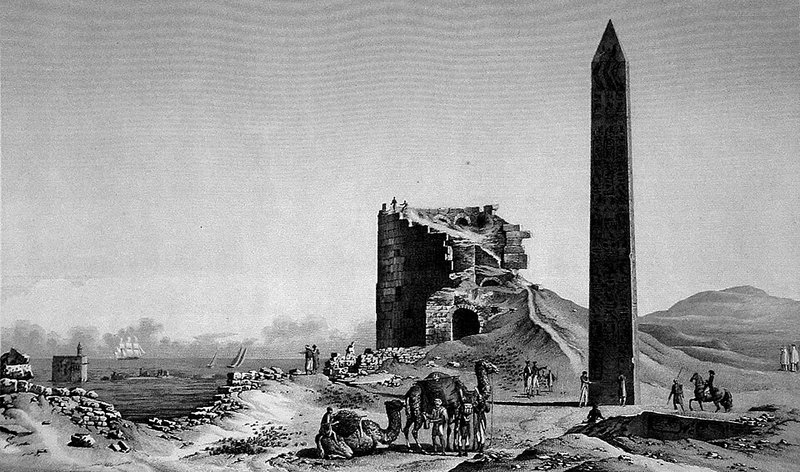
Cleopatra's needles and the Tower of the Romans, drawn c.1798,
Public domain, via Wikimedia Commons

Cleopatra’s Needle - London

cleopatra's needle
Cleopatra’s Needle
​Cleopatra's Needle and the Victoria Embankment by Oliver Dixon, CC BY-SA 2.0 , via Wikimedia Commons

​The obelisk that was eventually re-erected in London was presented to the Prince Regent in 1819 by Egyptian ruler Muhammad Ali, a gift to mark British beating the French at the Battle of the Nile in 1798 and in 1801’s Battle of Alexandria.

​The obelisk remained in Alexandria until 1877 when anatomist and dermatologist Sir William James Erasmus Wilson sponsored its transportation to London at the cost of £10,000, around £1,553,000 in today’s money.

​The 224 ton artifact was encased in a iron cylinder, 92 feet long and 16 feet wide, dubbed Cleopatra, commanded by one Captain Carter, towed to London by the ship Olga, under Captain Booth. On October 14th 1877, a violent storm in the Bay of Biscay caused the Cleopatra to list uncontrollably, forcing the tow ropes to be cut. The Olga launched a rescue boat with six volunteers but the boat capsized, and all crew members died. Captain Carter his five shipmates aboard Cleopatra were eventually rescued though.

​The paddle tug Anglia was then commissioned to tow the Cleopatra to London where it arrived in January 1878 and set up with some pomp at the Embankment on September 12th 1878.

​Cleopatra's Needle is flanked by George John Vulliamy’s two faux-Egyptian bronze sphinxes, made at the Eccleston Iron Works in Pimlico in 1881. The sphinxes bear hieroglyphic inscriptions that say “netjer nefer men-kheper-re di ankh”, meaning "the good god, Thuthmosis III given life". Oddly, they are looking at the Needle rather than guarding it - or are they?

Possibly their role was NOT to stop harm from coming to the obelisk but rather to prevent anything supernatural from escaping, a task in which they appear to have singularly failed.The Embankment boasts other Egyptian touches, such as the well-endowed winged female sphinxes gracing the armrests of nearby benches.

​A time capsule was concealed in the front part of the pedestal, containing twelve candid photographs of the most attractive English women of the day, hairpins, cigars, tobacco pipes, a set of imperial weights, a baby's bottle, children's toys, a razor, a hydraulic jack and some samples of the cable used in the erection, a 3-foot (90-centimetre) bronze model of the monument, and a complete set of contemporary British coins.

A rupee, a portrait of Queen Victoria, a history of the transport of the monument plans, a translation of the inscriptions, the Bible in several languages, a copy of John 3:16 in 215 languages, Whitaker's Almanack, a Bradshaw Railway Guide, a map of London, daily newspapers and finally, a twenty-four inch metal ruler, were also squirrelled away in the capsule.

It has been posited that the pictures of women and a razor amongst the items deposited beneath the monolith emitted waves of evil occult energy that eventually resulted in the crimes of Jack the Ripper decades later.

As The Ripper puts it in Alan Moore’s From Hell (1999): “They call it Cleopatra’s Needle. He who’d wield it would the BEST of tailors be, to do its work, increase the Sun God’s sovereignty … encoded in this city’s stones are symbols thunderous enough to rouse the sleeping Gods submerged beneath the sea-bed of our dreams.”

In 1977, my school Nower Hill High secreted a time capsule, which was (typically) forgotten about until accidentally rediscovered in 2013.

Cleopatra’s Needle: Shades of Ancient Egypt Gather

Soon, eerie unexplained events began to unfold around London’s Cleopatra monument, including the following;

​The Spectral Seaman

The ghost of a naked man has been seen on a number of occasions, leaping from out behind the obelisk and throwing himself into the River without making a splash. The first sighting of this apparition occurred only a few weeks after the installation of the obelisk, leading many to conjecture it was the shade of one of the sailors who drowned in the Bay of Biscay. Or it was simply a ‘flasher’ with a taste for the theatrical?

​Aleister Crowley Was ‘Ere

It is said that the notorious occultist Aleister Crowley performed dark rituals late one evening at the base of the obelisk in order to release the trapped spirit of the Pharoah Rameses. The ceremony supposedly involved animal blood and a human skeleton. Crowley failed in his endeavour, which was accompanied by the sound of Rameses mocking guffaws. File under: unlikely.

Suicide Isn’t Painless

Cleopatra’s Needle soon became a site associated with suicide. A policeman claimed a hysterical woman approached the officer, urging him to come to the banks of the Thames by the obelisk to prevent someone from hurling themselves into the water. As he left her and reached the area, he saw the same woman leap into the river, cackling as she did so.

​The Laughing Man-Fish

In Elliott O’Donnell’s Haunted Waters (1957) he recounts, “the spot where Cleopatra’s Needle stands was well-know to be haunted. None of the outcasts would venture near it. Two of them told me that one night they saw a tall, nude, shadowy figure, with a pear-shaped head and a body covered with what looked like scales, suddenly appear by the needle, wave a long arm at them and leap over the wall into the river. They said that they sometimes heard unearthly groans and hellish, mocking laughter in the river.”

​The Ancient World in London - Egyptomania in London

Near where I used to live in Islington:

Cleopatra’s Needle - New York
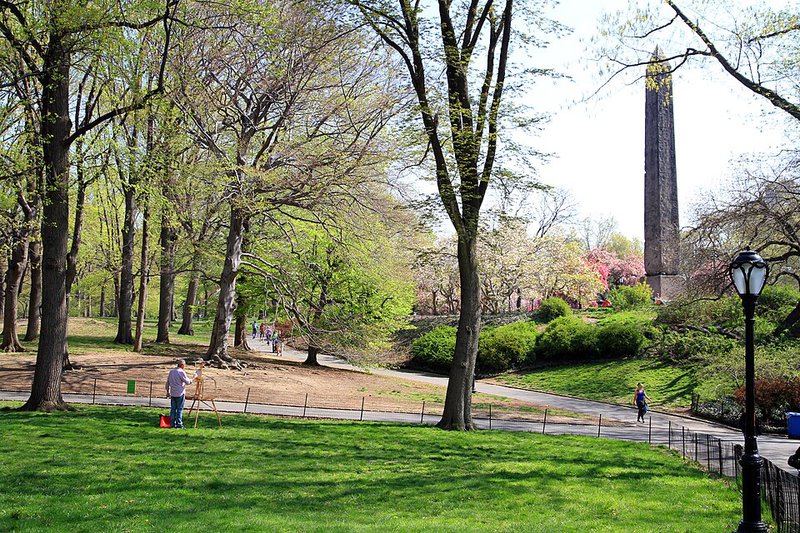
cleopatra's needle
Greywacke Knoll, Central Park, New York
​Ingfbruno, CC BY-SA 3.0 , via Wikimedia Commons

​New York’s Needle was gifted in May 1877 to United States Consul General by Cairo Judge Elbert E. Farman, as thanks from the Khedive for the US remaining a friendly neutral as France and Britain vied for control of Egypt and the Suez Canal. Transportation costs were largely paid by the railroad magnate William Henry Vanderbilt, eldest son of Cornelius Vanderbilt.

The obelisk was transported seven miles to Alexandria and then put into the modified hold of the steamship SS Dessoug, which set sail June 12th, 1880. The Needle and its accompanying 50-ton pedestal arrived at the Quarantine Station in New York a month later. The ground was flattened so the obelisk could be rolled out of the ship and transported to an interim location off Fifth Avenue. Finally a steam engine pushed the object across a specially built trestle bridge from Fifth Avenue to Greywacke Knoll, just across from the Metropolitan Museum of Art.

It took a mammoth 112 days to move the obelisk from Quarantine Station to its current location.

Jesse B. Anthony, Grand Master of Masons in the State of New York, presided as the cornerstone for the obelisk was laid in place with full Masonic ceremony on October 2nd, 1880. Over 9,000 Masons paraded up Fifth Avenue from 14th Street to 82nd Street. The official ceremony for erecting the obelisk was held January 22, 1881. A time capsule buried beneath the obelisk contains an 1870 U.S. census, a Bible, a Webster's Dictionary, the complete works of William Shakespeare, a guide to Egypt, and a copy of the United States Declaration of Independence.

A small chest was also placed in the capsule, but its contents remain unknown to this very day.

The wonderfully named Henry Honeychurch Gorringe, who supervised the movement of the obelisk, claimed the prime advantage of the Knoll was its "isolation", and it was elevated, with the foundation firmly anchored in local bedrock, supposedly preventing collapse if Manhattan suffered "some violent convulsion of nature."

The League of Shadows

​In 1885 Gorringe died at the age of 43 as a result of injuries when he fell (or was he pushed?) from a moving train. 1885 was the year in which Gorringe published his book Egyptian Obelisks, which mainly explored his acquisition of Cleopatra’s Needle for Central Park. Gorringe was buried in Rockland Cemetery, Sparkhill, New York State. His memorial stone declares: “His crowning work was the removal of Cleopatra’s Needle from Egypt to the United States, a feat of engineering without parallel.” In 1886, his friends erected a replica of Cleopatra’s Needle over his grave, the unveiling drawing 500 people. Like the original obelisk in Central Park – it stands on its own knoll, overlooking the Hudson River.

There are far less stories of ghosts and curses linked to the New York obelisk than its London sibling, attributed by some to the elaborate Masonic ceremonies that prepared the plinth for the monument’s arrival, which may have pacified any unquiet ancient spirits.

​In 2011, the pollution-blighted Needle was inspected by Zahi Hawass (Minister of Egypt’s Supreme Council of Antiquities) who declared: “If the Central Park Conservancy and the City of New York cannot properly care for the obelisk, I will take the necessary steps to bring this precious artefact home and save it from ruin.” The London obelisk is in a better condition, but in 2018 Hawass also weighed in, “I went to see it yesterday and I was ashamed … If they don’t care, they should return it.”

Note: The 50-foot granite walls of Manhattan’s now demolished Croton Reservoir (completed in 1842) were constructed in the Egyptian style popular at the time.
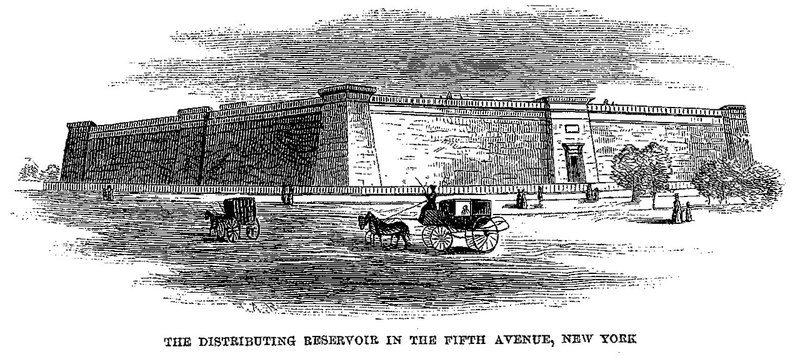
cleopatra's needle
New York
​unidentified illustrator of an article by T. Addison Richards, Public domain, via Wikimedia Commons

Cleopatra (1999)

​Kenneth Anger’s Lucifer Rising (1972); film director Donald Cammell was the god Osiris; Marianne Faithfull plays primordial she-demon Lilith:

LINKS

​Cleopatra’s Needle – London & New York’s Cursed & Haunted Egyptian Obelisks: https://www.davidcastleton.net/cleopatras-needle-london-new-york-city-central-park-obelisk-cursed-haunted-ancient-egypt/

​Hidden Alignments Documentary – NYC Masonic Obelisks: http://glasscapsule.com/2015/12/hidden-alignments-documentary-nyc-masonic-obelisks/

​The Mystery of the Central Park Obelisk: https://www.boweryboyshistory.com/2020/10/cleopatras-needle-and-secret-of-new.html

​NYC – Cleopatra’s Needle: https://imagerysmith.wordpress.com/

​How Cleopatra’s Needle came to London: https://www.londonmuseum.org.uk/collections/london-stories/how-cleopatras-needle-came-london/

​The Curse of Cleopatra’s Needle: https://hauntedpalaceblog.com/2022/06/07/the-curse-of-cleopatras-needle/

STEPHEN ARNELL’S ROMAN MYSTERY THE GREAT ONE IS AVAILABLE NOW ON AMAZON KINDLE:

SAMPLE

Cover image of London’s Cleopatra Needle attribution: Canva Pro

Tuesday, 7 July 2026

The Rudston Monolith & Yorkshire’s Mysterious ‘Wold Newton Triangle’

Up in the East Riding of Yorkshire, where I once studied history at the University of Hull, in the parish churchyard of Rudston village, stands the towering Rudston Monolith, at over 25 feet (and weighing 40 tonnes), the tallest standing stone in the United Kingdom. A smaller stone, also in All Saints churchyard, was once located near its larger sibling. The Norman church was constructed on an ancient pagan site, a common practice through the ages.

rudston monolith
Rudston Monolith
​Angela Findlay, CC BY-SA 3.0, via Wikimedia Commons

Rudston Monolith

The name of Rudston stems from the Old English "Rood-stane", equating to "cross-stone", meaning the monolith was probably already an object of some heathen veneration, adopted (as always) by Christianity.

The Rudston Monolith is associated with several local legends; one claims the stone was thrown by the Devil at the church, but missed due to divine intervention, others say it fell from the sky to flatten evildoers bent on desecrating the churchyard for satanic reasons.

Those who hold with belief in the ancient ley lines etched across England’s landscape, claim no fewer than five actually converge in Rudston.

Antiquarian Sir William Stukeley (1687–1765) found a large quantity of skulls during his dig at the Monolith, and understandably suggested it may have been a site for human sacrifice. An experiment conducted by William Strickland in the 18th century suggested the stone may even extend underground to a similar depth as above ground. This has yet to be confirmed.

Other prehistoric monuments in the area include four ‘cursi’ - huge Neolithic enclosure structures resembling Roman chariot-racing tracks which comprised parallel banks with external trenches. Three of these constructions converge on the site of the monolith itself. Some say they were used in rituals connected with ancestor worship, or were astronomical in nature. They may also have served as buffer zones between ceremonial and occupation landscapes.

The famed ‘disappearing’ Gypsey Race chalk stream bisects four of the cursus monuments and would have had to be crossed, were these routes to be followed to the Monolith. Local folklore says when the Gypsey Race is flowing in flood (The Woe Waters), ill fortune or great events are close at hand. The Race was in flood in the year before the Great Plague of 1665–66, at the restoration of Charles II (1660), when William of Orange landed in 1688, and before both World War One and World War Two, as well as the exceptionally cold winters of 1947 and 1962.

Recent studies posit the cursi were, in reality, used for ceremonial athletic or military competitions, in keeping with their resemblance to Roman circuses.

Not too far away in North Yorkshire stand The Devil’s Arrows (named due for a similar reason as Rudston) at Boroughbridge; three prehistoric standing stones, the tallest stone measuring 22.5 feet, second in height in the United Kingdom after the Rudston Monolith.

The Rudston Monolith is impressive, but is overshadowed by France’s Grand Menhir Brisé, also known as the Pierres-Pages Menhir, situated in Locmariaquer, Brittany, estimated to have been 20 meters (65 feet) tall originally. Although it subsequently broke into several pieces, the Menhir remains far taller than the Rudston - if it was still standing, not strewn into massive chunks on the ground.

The Wold Newton Triangle

The East Riding is also known for another strange occurrence, that of the boggles, ghosts and others who dwell in the mysterious area known as the Wold Newton Triangle, which runs from Scarborough to Driffield then stretching east to Flamborough.

The Wold’s many myths and legends also include green-hued faerie folk, headless ghosts, a greedy Queen, a black skeleton, a Parkin (gingerbread)-eating dragon, sea serpents, shape shifters, enchanted wells, and the giant monoliths, ley lines and the disappearing river which I’ve already mentioned.

But why should such a relatively remote and sparsely populated place be the location for so much supernatural phenomena? In terms of explanations, two are offered: the Ley Lines and the Gypsey Race River, which grant Newton Wold a unique place in the paranormal world.

The Wold has more recently become associated with some of the greatest heroes and villains of pulp, crime and science fiction; the home of a literary conceit conceived by legendary fantasy/sci-fi writer Philip Jose Farmer (1918-2009). In 1795, this part of the Yorkshire Wolds was disturbed by what came to be known as the Wold Cottage meteorite, which supposedly led to genetic mutations in the local population. The object is currently on display at London’s Natural History Museum:

rudston monolith
Wold Cottage Meteorite
​Chemical Engineer, CC BY-SA 3.0, via Wikimedia Commons

A monument marks the spot where the stone fell, with this inscription:

Here On this Spot, Decr. 13th, 1795
Fell from the Atmoſphere
AN EXTRAORDINARY STONE
In Breadth 28 inches
In Length 36 inches and
Whole Weight was 56 pounds.
THIS COLUMN
In Memory of it Was erected by
EDWARD TOPHAM
1799

Mischievous supernatural spirits, known as ‘Boggles’, lurk in the area, causing chaos and fires on the roads - to this day. In addition, it was/is believed that each dale in the Triangle possessed its own brand of hobgoblins that help, or hinder, both locals and the relatively few visitors. They apparently resemble small hairy men and regularly interacted/interact with humans. Having lived near the area, the description pretty much nails the local inhabitants, so I would take this with a (fairly large) pinch of salt.

A family at Hart Hall Farm in Glaisdale had been aided by their hobgoblin for generations and it was indeed mutually beneficial. The head of the house caught sight of the creature at his work late at night, and was shocked to see he was buck naked, aside from his covering of coarse, matted hair. Instead of milk or cream, he decided to pay that night with a smock for it to wear. But the hobgoblin was incredibly insulted, bellowing at the master for the correct payment and abandoning the hall. The sprite didn’t want to cause any harm or mischief, but never helped them out again.

rudston monolith
The Hob of Hart Hall Glaisdale
​The Hob of Hart Hall by Mick Garratt, CC BY-SA 2.0, via Wikimedia Commons

A Yorkshire hobgoblin supposedly inhabits the cliffs at Boggle Hole. Stroll along the beach from Robin Hood’s Bay and you’ll find a rocky cove with a youth hostel set in an historic mill.

If you linger beside the rock pool looking for fossils, you may just catch a glimpse of the Boggle, either ambling towards you, or on a mission further afield...

Stephen Arnell’s novel THE GREAT ONE, is available on Amazon Kindle; a new book, titled THE FORTUNATE ONE, will be published later this year.

https://www.amazon.co.uk/Great-One-Secret-Memoirs-Pompey-ebook/dp/B0BNLTB2G7

References

Mysteries and Monsters: Wold Newton Triangle interview with Charles Christian: https://youtu.be/P5TsBe6b3sY?si=XQIZ8m_7fqOW4s4a

The Tallest Monolith in Britain: https://youtu.be/nPcLsAeui6k

Children of the Stones: FromThe Urban Prehistorian, “...there is a healthy Children of the Stones vibe at the Devil’s Arrows.” https://youtu.be/F67_DB-BFwc

Friday, 19 June 2026

Midsummer Oak Tree Tales, Traditions & Dancing Skeletons

​​The oak is the national tree of England; symbolising Strength, Longevity, Wisdom, Spirituality, Nobility and Trustworthiness. Virtues sadly currently lacking in ALL England and the UK’s leadership cliques, regardless of party affiliation.

​For the Greeks, Romans, Celts, Slavs and Teutons, the mighty oak ranked first amongst venerated trees and was associated with many of the supreme gods (or high ranking deities) in each Pantheon. Oak trees are more susceptible to lightning strikes than other trees, a perceived link with the Sky Gods. This is actually due to their tree’s natural high water content and their stature; all quite logical, really.

​England’s oldest oak is considered by many to be King Offa's Oak in Windsor Great Park (Berkshire), estimated to be between 1,300 and 1,500 years old. The Bowthorpe Oak in Lincolnshire is the UK's widest oak with a 13-metre girth, it is estimated to be over 1,000 years old. Its immense hollow trunk was once used as a dining room, seating 12 people “with ease”.

​An ancient 450 yera-old oak looms over my back garden; sometimes a forbidding presence it also reminds one of the continuity of life in the English Shires. It’s the home to a colony of rather cheeky squirrels, who now gather each morning for the daily handout of nuts (twenty of the critters at the last count). On June 11th, 2026, a huge part of the oak suddenly collapsed in my garden almost breaking through my drawing room windows, necessitating the urgent attendance of tree surgeons. ‘Sudden Branch Drop Syndrome’, apparently.

This occurred AFTER I had filed my Oak Tree investigation. Eerily reminiscent of the ‘evil tree’ scene in the 1982 horror movie, Poltergeist.

oak tree
My garden. (Author’s image)

Poltergeist Evil Tree scene

Sherwood Forest’s Major Oak in Nottinghamshire is between 800 to 1,000 years old and linked of course to the legends of Robin Hood. It is the largest by mass, weighing around 23 tonnes. The Marton Oak in Cheshire is approximately 1,200 years old, famed for its 14-metre girth:

oak tree
The Marton Oak
​Hypercolius, CC BY-SA 4.0 , via Wikimedia Commons

The oak has royal connections in England, probably with the last monarch to display much in the way of personality, intelligence and political acumen - Charles II. The Royal Oak was the tree in which the future King Charles II of England hid to escape Cromwell’s Roundheads after his defeat at the Battle of Worcester in 1651.

​The tree standing on the site today is believed to be a two or three hundred year-old descendant of the original and is thus known as 'Son of Royal Oak'. The original tree was destroyed during the seventeenth and eighteenth centuries by tourists who cut off branches and chunks of bark as souvenirs.

​Restoration Day, more commonly known as Oak Apple Day or Royal Oak Day, was an English, Welsh and Irish public holiday, observed annually on May 29th, to commemorate the restoration of the Stuart monarchy in May 1660. The public holiday was officially abolished under the Anniversary Days Observance Act 1859, but in some parts of England the day is still celebrated with gusto.

Celebrations to mark the event included the wearing of oak apples or sprigs of oak leaves. Those who failed to wear a sprig of oak were pelted with bird's eggs or beaten harshly with stinging nettles. In Sussex, those not wearing oak were liable to be pinched on the backside, giving rise to the unofficial name of "Pinch-bum Day"; similarly it was known as "Bumping Day" in Essex.

​Events still take place at Aston-on-Clun in Shropshire, Great Wishford in Wiltshire, Upton-upon-Severn in Worcestershire, Marsh Gibbon in Buckinghamshire and Membury in Devon. At All Saints' Church, Northampton, a statue of Charles II is garlanded with oak leaves at noon every Oak Apple Day, followed by a celebration of the Holy Communion according to the Book of Common Prayer. Oak Apple Day is also celebrated in the Cornish village of St Neot, with a vicar led procession through the village. In 2021, Oak Apple Day was celebrated at Eton Wick within sight of Windsor Castle, one of Charles II’s many homes.

Our old friend The Green Man is always depicted wreathed in oak leaves; here he is in his most savage aspect, as shown at the beginning of BBC1’s adaptation the Kingsley Amis’ classic chiller The Green Man (1990):

Generally, the oak is regarded as a benevolent plant but, as always, there are exceptions to every rule...

​The Midsummer Tree, Sussex

​The Midsummer Tree, by the Grove Lodge roundabout in Broadwater: legend says that every year on Midsummer’s Eve, June 23rd, skeletons would rise from the roots of the tree and dance underneath it.

A plaque states: "This tree, believed to be over 300 years old, was once celebrated in local folklore. Every year, at Midnight on Midsummer's Eve, it was believed that skeletons would rise up from its roots and dance to the rattling of their own bones until daybreak."

​In 2006, local paper The Argus reported that the tree was under threat from the Highways Agency as it was suffering from brown cubical rot. Following a campaign by neighbours and folklorists, the tree was saved by conservationist Chris Hare, who proclaimed, “This tree is a vital part of Worthing's heritage. The origin of the Midsummer Tree is to be found in England's pagan past, when Midsummer, rather than Halloween, was viewed as the most auspicious time to commune with the spirit world."

​The tale of the dancing skeletons was first recorded by Sussex folklorist Charlotte Latham in 1868, writing, “There stood, and still may stand, upon the downs, close to Broadwater, an old oak-tree, that I used, in days gone by, to gaze at with an uncomfortable and suspicious look from having heard that always on Midsummer Eve, just at midnight, a number of skeletons started up from its roots, and, joining hands, danced round it till cock-crow, and then as suddenly sank down again. “My informant knew several persons who had actually seen this dance of death, but one young man in particular was named to me who, having been detained at Finden by business till very late, and forgetting that it was Midsummer Eve, had been frightened (no difficult matter we may suspect) out of his very senses by seeing the dead men capering to the rattling of their own bones.”

​According to Chris Hare, there has been a gathering of would-be believers at the tree every midnight on June 23rd in recent years...

The Chained Oak, Staffordshire

The Chained Oak, near the village of Alton, Staffordshire
​Gary Rogers / Chained Oak

On an autumn night in 1821, the wealthy Earl of Shrewsbury was travelling through the village of Alton on his way home to the family estate of Alton Towers. Without any warning, an old woman (or man, according to alternative versions) popped up in front of his coach, startling his horses. The coach stopped to find why she was there, and the crone pleaded for the charity of a coin. The Earl cruelly dismissed her, so she placed a curse on him, croaking, "For every branch on the Old Oak Tree here that falls... a member of the Earl’s family will die.”

The Earl wasted little time with the wittering of the wretched old woman, dismissing any talk of a curse and headed back to Alton Towers. But that very evening, whilst the Earl snored in his grand bed, a terrible storm raged, tearing a single branch from the oak tree. That same night, a member of the Earl’s family mysteriously passed away. When the Earl awoke and learned the news, he was convinced of the hag’s curse, and thereby the power of the oak. The flustered Earl immediately ordered every branch of the oak tree be bound up in chains to prevent it from falling, and to this day, the old oak remains bound by chains.

A large branch fell from the old oak in 2007, but the Earl’s descendants confirmed that no-one had perished. Sadly, some of the oak has disintegrated, in part due to the action of chains; one had rusted so much as to cause the collapse of a large part of the tree. However, most of the tree still stands.

​The 16th Earl, John Talbot, appeared to have learned Scrooge-lesson of his predecessor and was widely known for his philanthropy and support of local schools and churches; earning him the nickname ‘Good Earl John’.

​In modern Alton life, the story of the chained oak lives on in Alton Towers theme park, where the story has been re-written and dramatised for the ride ‘Hex – The Legend of the Towers’, a walkthrough dark ride based around the chained oak legend.

​In 2014, an independent horror film based on the legend was released.

​Old Knobbley, East Anglia

A notable old Oak tree has stood in Mistley, Essex for 800 years, taking anchor around the time Bad King John signed the Charter of the Forest. Named Old Knobbley, due to its lumpy appearance, the trunk is 9.5 metres wide (more than twice its height), topped by gaunt branches.

Infamous 17th-century Witchfinder General Matthew Hopkins lived in nearby Manningtree, making his name torturing those accused of witchcraft to extort false confessions, killing hundreds. Village folklore says some of the accused successfully sought shelter in the hollows and branches of Old Knobbley.

This is of course unlikely, but chimes with the folklore image of trees as protectors; comforting to think of Old Knobbley doing his bit to offer sanctuary to those in extreme peril.

One does wonder why Hopkins, with his propensity for arson, didn’t just set light to the tree and settle down comfortably to watch the fun.

​According to local legend, Hopkins' ghost is said to haunt Mistley Pond.

Hywel Sele was a cousin of Owain Glyndŵr, self-proclaimed Prince of Wales, but was also friend of Henry IV of England and opposed Glyndŵr’s rebellion (1400-1415). After Sele was captured by Glyndŵr he accepted a gracious invitation to hunt with the ‘Prince’ on the Nannau Estate, but, after failing to kill the rebel leader Sele was slain and sealed up within the hollow of a gnarled oak tree. The oak naturally enough, was soon haunted by his shade, becoming known as Derwen Ceubren yr Ellyl ("The Hollow Oak of the Devils"), Ceubren yr Ellyll ("The Hollow Tree of the Ghost") or simply the Nannau Oak.

APPENDIX - WALES: Derwen Ceubren yr Ellyl ("The Hollow Oak of the Devils")/Ceubren yr Ellyll ("The Hollow Tree of the Ghost")

In 1778 one Thomas Pennant inspected the oak and noted that it was 27 feet 6 inches (8.38 m) in girth but that it was in an advanced state of decay, resembling the shape of a gothic arch. The oak collapsed on July 13th 1813; it was said Sele’s corpse fell from within it and was supposedly buried in the ruins of Cymer Abbey.

And finally, The Oaks of Avalon

​The Oaks of Avalon iare a pair of ancient 2,000 year-old oak trees in Glastonbury (Somerset), named after the ancient apocalyptic figures Gog and Magog. Believed to have been originally part of a ceremonial druidic avenue at the entrance to Glastonbury Tor/Avalon, most of which was cut down in 1906 to make way for a farm. Christian belief has Joseph of Arimathea following the row of trees towards the tor upon his arrival in Albion.

​In April 2017, though already lifeless, Gog was badly damaged by an accidental fire believed to be from an incense burning candle, but was extinguished by the Devon and Somerset Fire and Rescue Service.

LINKS:

​Meetings with Remarkable Trees - The Bowthorpe Oak: https://www.youtube.com/watch?v=cSoa2N3UDD4

The Folklore of the Oak Tree: https://www.youtube.com/watch?v=0rCJjJCd3ug

​'Do not sit under trees', council warns park-goers: https://www.bbc.co.uk/news/articles/ckgdly19j6yo

The English Oak: https://www.historic-uk.com/CultureUK/The-English-Oak/

​Walks in Somerset: In Search of the Oaks of Avalon, Glastonbury: https://www.youtube.com/watch?v=SNgi2dzKmxc

​The Mighty Oak: https://walkingthewolds.co.uk/f/the-mighty-oak

​Trees: myths and folklore: https://www.rhs.org.uk/education-learning/school-gardening/resources/curriculum-linked/trees-myths-and-folklore

​Sussex folklore explored: Worthing tree where skeletons are said to dance on Midsummer's Eve: https://www.sussexexpress.co.uk/heritage-and-retro/retro/sussex-folklore-explored-worthing-tree-where-skeletons-are-said-to-dance-on-midsummers-eve-4464732

300-year-old 'haunted' Sussex tree where skeletons 'dance' once a year: https://www.theargus.co.uk/news/24619238.worthing-story-midsummer-skeleton-tree/

​Midsummer Tree Worthing, West Sussex: https://ati.woodlandtrust.org.uk/tree-search/tree/?treeId=55875#/

​The Legend of Old Knobbley, East Anglia's Spookiest Tree: https://www.thorogood.co.uk/the-legend-of-old-knobbley-east-anglias-spookiest-tree/

​The Legend of the Chained Oak: https://burialsandbeyond.com/2023/12/18/the-legend-of-the-chained-oak/

​Old Knobbley Oak Tree: https://oldknobbley.com/

​Country diary: Old Knobbley – a tree of twisted branches and even twistier myths: https://www.theguardian.com/environment/2022/nov/10/country-diary-old-knobbley-a-tree-of-twisted-branches-and-even-twistier-myths

​Sleepy Hollow - The (Oak) Tree of the Dead (1999): https://www.youtube.com/watch?v=72_-phtcbEw

​Derwen Ceubren yr Ellyl, Nannau Park: https://www.nationaltrustcollections.org.uk/object/1149879

Hywel Sele and the Demon Oak: https://geoffbrookes.co.uk/hywel-sele-and-the-demon-oak/

Broadwater Midsummer Oak Tree, Worthing, West Sussex: https://www.youtube.com/watch?v=a6UCIXwPKzg

​Ancient Glastonbury oak tree known as Gog damaged in fire: https://www.theguardian.com/uk-news/2017/apr/27/ancient-glastonbury-oak-tree-known-as-gog-damaged-in-fire

​People are crying as they visit 2,000-year-old tree Gog that went up in flames near Glastonbury: https://www.somersetlive.co.uk/news/somerset-news/distressed-visitors-survey-damage-2000-38464

STEPHEN ARNELL’S NOVEL THE GREAT ONE IS AVAILABLE NOW ON AMAZON KINDLE:

SAMPLE:

Thursday, 18 June 2026

When Supernatural Monsters Like Vampires Stopped to Count

The Forgotten Folklore of Seeds, Salt, and Supernatural Weaknesses

Many supernatural monsters in folklore were believed to possess strange weaknesses. From vampires and witches to troublesome spirits and fairies, stories from around the world describe creatures that could be distracted or delayed by seeds, grains, salt, and other curious objects. These unusual beliefs reveal a lesser-known side of traditional monster folklore.

​A Strange Detail That Wouldn't Go Away

The first reference occupied no more than a few lines.

I nearly skipped past it.

A vampire. A handful of seeds. And a suggestion that the creature would stop to count them.

That was all.

I made a note and carried on with whatever I had originally been researching. Folklore collections are full of odd details. Most turn out to be local curiosities that never seem to appear anywhere else.

At least, that is what I assumed.

Then the same idea surfaced in another source.

Not exactly the same story. Not even the same country.

But close enough.

A supernatural being confronted with a collection of small objects and somehow compelled to count them.

I started keeping notes.

Finding examples was not as straightforward as I expected. Many references were brief. Others appeared almost in passing, tucked away among discussions of completely different subjects. Still, the list slowly grew.

The subject of Vampires and their behavior drifted into the background for a while until recently, when I attended a talk on vampire folklore and the sometimes surprising measures communities once used to protect themselves from suspected vampires.

The old note came back to mind.

So did the seeds.

The Supernatural Monster Who Had To Count

Today there is a word for an obsessive need to count.

Arithmomania

The term belongs to modern psychology rather than folklore, but it provides a convenient label for something that appears surprisingly often in traditional stories.

The details vary.

The creatures vary.

Yet the basic idea remains remarkably consistent.

Present certain supernatural beings with enough objects to count and they become distracted from whatever they were doing.

For a modern reader, it feels like an odd weakness.

For the people who preserved these stories, it was often a useful one.

Salt appeared frequently in protective folklore. Beyond its practical value, scattered grains could also become a challenge for troublesome spirits and other supernatural visitors.

supernatural monsters: Vampires
In parts of Eastern Europe, poppy seeds and other grains were sometimes scattered to distract vampires, buying precious time until dawn.

A Handful of Seeds and a Vampire

The clearest examples tend to involve vampires.

Across parts of Eastern Europe, particularly within Slavic traditions, seeds were sometimes associated with protection against the undead. Poppy seeds appear frequently, although millet and other grains can also be found in the stories.

The reasoning was simple.

Scatter enough seeds and the vampire begins counting.

One grain.

Then the next.

Then another.

And another.

It is not how most of us picture a vampire.

Popular culture has given us elegant aristocrats, dark castles, flowing capes, and dramatic confrontations.

Traditional folklore could be much stranger.

The vampire remained dangerous, but it also seemed constrained by peculiar rules. In some stories, seeds were scattered over graves suspected of harboring the restless dead. In others, they might be thrown behind a fleeing traveler.

The goal was not necessarily victory.

A delay could be enough.

A few minutes might help somebody reach shelter.

A few hours might carry the night toward dawn.

And dawn was often the thing a vampire feared most.

Nets, Knots, and Other Problems

The more examples I found, the more often another object appeared.

Fishing nets.

At first they seem unrelated.

Then the connection becomes obvious.

A net contains countless openings.

According to some traditions, a supernatural intruder confronted by a fishing net would become occupied counting every gap before proceeding.

Similar ideas appear elsewhere.

  • Knots.
  • Threads.
  • Tangled cords.

Sometimes the creature is counting. Sometimes it is untangling. Sometimes it is simply trapped in an endless repetitive task.

The details change.

The principle remains familiar.

Keep the creature busy.

Let time do the rest.


Witches at the Threshold

The same motif appears in traditions concerning witches.

In parts of Italy, sieves and colanders occasionally acquired a protective role. Left near a doorway or entrance, they supposedly forced a witch to stop and count the many holes before entering.

  • Every hole mattered.
  • Every hole had to be counted.
  • By then, the night might be nearly over.

As with much folklore, it is difficult to know how literally such stories were taken. What matters is that the idea survived.

Versions of the belief later appeared in parts of Appalachia after European traditions crossed the Atlantic. Details shifted from place to place, but the central theme remained recognizable.

The witch encounters something that demands counting.

The counting becomes the trap.

According to some traditions, witches could be delayed by objects containing numerous holes, such as sieves or colanders, forcing them to count until sunrise.

Fairies Were Not Always Friendly

The fairies found in older folklore can be surprisingly unpleasant.

Many were blamed for spoiled milk, missing household items, frightened livestock, and various forms of everyday mischief.

People responded accordingly.

In several traditions, grains, flax seeds, or salt could be scattered around places frequented by troublesome spirits. The being would supposedly become occupied counting rather than causing trouble.

One note in particular caught my attention.

It concerned a mischievous spirit from Spain known as the Trasgu.

Descriptions vary from region to region, but the creature is usually portrayed as an energetic household nuisance. It moves objects, creates disorder, and generally makes life difficult for the people sharing its home.

One recurring detail is especially curious.

The Trasgu is often described as having holes in its hands.

As a result, small objects slip through its fingers. Certain tasks become impossible to complete.

Stories frequently place the spirit in situations where this weakness works against it. It is assigned impossible jobs, repetitive tasks, or challenges involving tiny objects that continually escape its grasp.

The result is less a confrontation than an exercise in frustration.

Why Salt Appears Everywhere

At a certain point I began noticing another recurring feature.

Salt.

It turns up repeatedly in folklore.

  • On thresholds.
  • Across windowsills.
  • Around doorways.
  • Within protective rituals.

That probably should not be surprising.

For most of human history, salt was far more valuable than many of us appreciate today. It preserved food, supported trade networks, and helped communities survive difficult seasons.

People depended on it.

Folklore tends to attach meaning to things that matter.

Salt also appeared to resist corruption. Food preserved with salt lasted longer. Decay slowed. Spoilage could be delayed.

Then there is the counting element.

Unlike a stone or a piece of iron, salt can be scattered into thousands of individual grains.

A protective substance.

A symbolic purifier.

And, according to some traditions, a counting challenge.

All in the same handful.

supernatural monsters
Salt appeared frequently in protective folklore. Beyond its practical value, scattered grains could also become a challenge for troublesome spirits and other supernatural visitors.

More Than Just Superstition

A bag of seeds is a curious thing to carry as protection.

Yet the idea appears often enough that it must have appealed to people for a reason.

The stories may differ, but they all arrive at roughly the same place.

The creature can be delayed.

The night can be bought a little time.

That is what interests me most.

Not whether vampires counted poppy seeds.

Not whether witches paused outside a doorway to count holes in a sieve.

But the way these stories impose rules on something frightening.

The supernatural threat remains dangerous.

Yet it becomes predictable.

A weakness exists.

A loophole can be found.

Sometimes that loophole is nothing more than a handful of seeds dropped onto a dark road.

The Last Grain

I originally assumed the reference was a local oddity.

It turned out not to be.

  • A vampire distracted by seeds.
  • A witch counting holes in a sieve.
  • A troublesome spirit trapped by an impossible task.

The stories are separated by geography, language, and centuries.

Yet somehow they arrive at the same strange conclusion.

Give a monster enough things to count and, for a while at least, it may leave you alone.

Today most people know vampires through novels, movies, and television. They recognize the fangs, the coffins, and the dramatic entrances.

Few remember the seeds.

Yet the seeds remained in the stories long after many other details changed.

That, perhaps, is worth counting.


Further Reading

Briggs, Katharine. An Encyclopedia of Fairies

Dundes, Alan (ed.). The Vampire: A Casebook

Guiley, Rosemary Ellen. The Encyclopedia of Vampires, Werewolves, and Other Monsters

Kligman, Gail. The Wedding of the Dead: Ritual, Poetics, and Popular Culture in Transylvania

Simpson, Jacqueline and Steve Roud. A Dictionary of English Folklore

Summers, Montague. The Vampire in Europe

Westwood, Jennifer and Jacqueline Simpson. The Lore of the Land

Wednesday, 20 May 2026

Satan Summoned by Stone? England’s Ancient Demonic Rocks, Lore & Legends

The Devil, Probably?

In England, there’s a plethora of ancient stones associated with the Devil - and in many cases with related lore in how to summon him in. Here are just a few of them.

Ladies and Gentlemen, Boys & Girls, Angels & Imps, I give you... England’s Satanic Stones. This one, a mere 5 minutes by motor vehicle from my abode.

The Devil’s Boot (Soulbury, Buckinghamshire)

Not a summoning place, as such, but worth a mention; a glacial chunk of 300-million-year-old carboniferous limestone deposited from the Peak District some 450,000 years ago. Oliver Cromwell has speechified from it, tanks during WWII tried to dislodge it and boy racers have pranged it, but the Boot abides on its hillside vigil. Come the stroke of midnight and the chime of the bells at Soulbury’s All Saints Church every evening though, the object rolls down the hill to face The Boot Inn public house - and presumably then swiftly returns to its original site. Therein lies a tale. The ‘Boot’ is in fact the Devil’s Hoof, sheared off by irate Soulbury villagers after Old Nick tried to trash the church.

The Blood Stone (Wiltshire)

Near the ancient battlefield of Edington (Alfred the Great vs Guthrum’s Danes, 878 AD) in Wiltshire is The Blood Stone. This from The Witchery Arts:

“One of the smallest and most overlooked of these sites is the Blood Stone, situated in the center of a sheep infested valley between Westbury White Horse Hill and Picket Hill in Bratton, on the edge of Salisbury Plain.

The stone itself is about three feet across, two feet high and a dark, scabby red in colour. It’s said that the stone was one of those used by King Alfred’s men as a block upon which to behead Danish prisoners of war after the Battle of Ethendune of AD 878, which is how it is supposed to have got its particular shade. There are even paired indentations in the surface of the rock, which look uncannily like the marks left by a pair of front teeth.

There is archeological evidence to suggest that it really is an ancient execution site since a large pile of headless skeletons, dated to around that time, were excavated from the nearby watercress beds at the bottom of the valley in the 1970s. The skulls were found a half mile away, buried upside-down, apparently according to the Saxon tradition that if a soul escaped through the top of the head it could be thus trapped into heading straight down into the bowels of the Earth.”

The 'blood stains' are actually Iron Oxide traces. Apparently.

​The Devil's Stone (Kent)

The Devil’s Stone is noted for what appears to be a cloven strange footmark indented in it. The Devil, who so annoyed by the sound of Newington-next-Sittingbourne’s church bells, climbed the steeple with a bag over his shoulder, and nicked them.

As the fiend leapt from the tower, he slipped, and his foot hit the stone, the bells rolling out of the bag and into the nearby Libbet Stream. As a result, the well was said to continuously bubble, and bizarrely, the stone is also said to sparkle when hit. Another version of the legend blames the church wardens, who decided to sell the great bell of the church to pay for the repair of the remaining bells. Under the cover of darkness, the bell was drawn up to the roof of the bell tower in order that it could be lowered from outside. The Devil appeared, and seized it. The church wardens, after seeing that Old Nick had gone, attempted to remove the bell with grappling irons and ropes. At first, they had great success at raising the bell to the surface, but the rope broke and down went the bell! Again, they tried and again they failed. In both versions, a local witch arrived and told them that the only way in which the bell could be raised is by drawing it up by four pure white oxen. This was done, and it was almost raised to the surface until a local urchin, who was passing, shouted out at the top of his voice, 'Look at the black spot behind that bull's ear'. The rope instantly broke, and the bell was lost forever!

The Devil’s Stone in Crook (County Durham)

You must run around it seven times anticlockwise at midnight, sometimes with added, much darker rituals.

​The stone is an erratic glacial, beginning in the Lake District more than 10,000 years ago during the last Ice Age. A glacier moved it 60 miles east and dropped it on the edge of the Durham market town of Crook. It is now made up of three large lumps of igneous rock after someone blew it up looking for a diamond reputed to be hidden inside.

Chanctonbury Ring (Sussex): Run round this prehistoric ring fort three or seven times backward or naked and the devil will appear and offer a bowl of soup or porridge for your soul. Nice deal.

The Witch's Stone (Westleton, Suffolk)

Place a handkerchief or piece of straw in the grating beside the chancel door and (using the Witch’s Stone) as a base – run around the church three or seven times widdershins (or counter-clockwise) without looking at the grating; once back at the Witch’s Stone, the item in the grating will be gone and the eerie rattling of the Devil’s chains can heard from the church crypt. Cool. I guess.

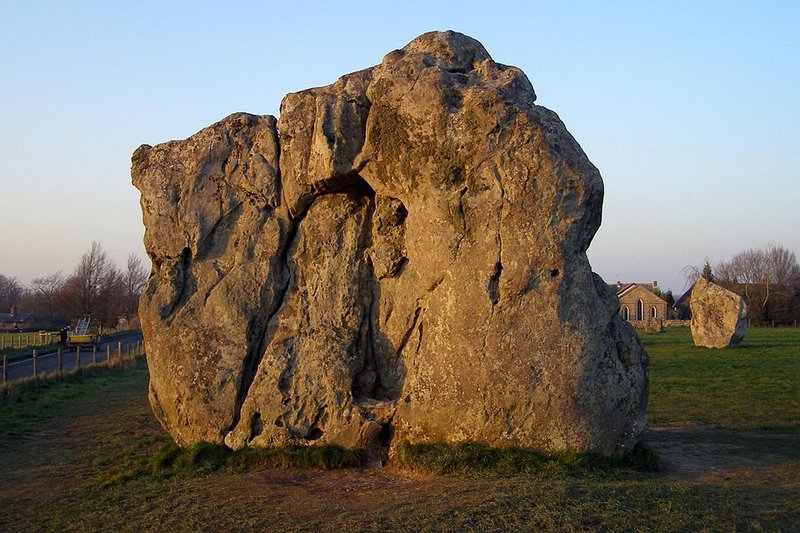
​The Devil's Chair, Avebury (Wiltshire)

devil
The Devil’s Chair
​See page for author, Public domain, via Wikimedia Commons

L​egend says that if you run around this megalithic stone at Avebury Henge one hundred times, the Devil will pop up for a chat.

​In an original ceremony devised by Philip Shallcrass of the British Druid Order in 1993, pagans assemble and divide into two groups, one the God party and the other the Goddess party. Those with the Goddess party go to the Devil's Chair, where a woman representing the spirit guardian of the site is a vessel for the voice of the Goddess.

Avebury in fiction:

​Children of the Stones (1977) - full series

The Devil’s Den (Avebury)

​A dolmen burial chamber, part of a Neolithic passage grave on Fyfield Down.

A local tradition says if water was poured into hollows on the capstone, Satan would come in the night and slurp it. Super.

The Devil's Arrows (North Yorkshire)

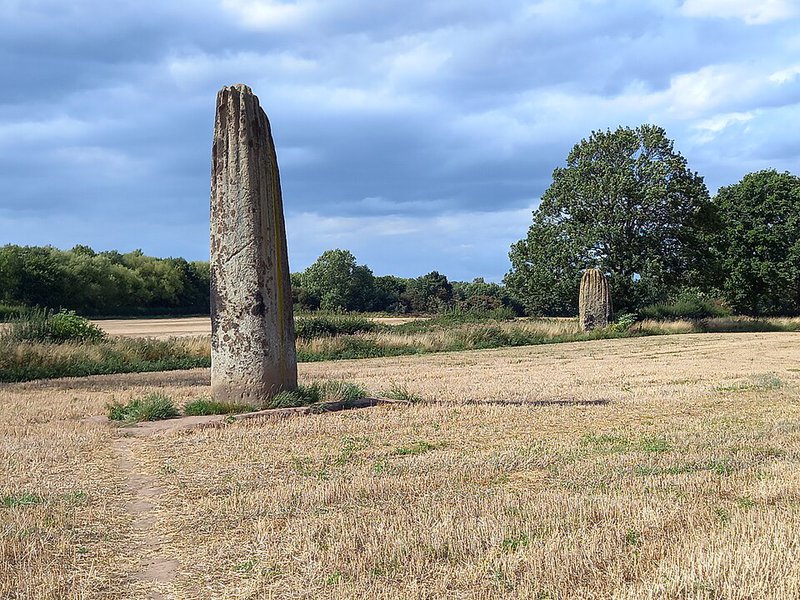
Two of the Devil's Arrows
​Two of the Devil's Arrows by Gordon Hatton, CC BY-SA 2.0, via Wikimedia Commons

​These millennia-old standing stones in North Yorkshire are the second tallest in the United Kingdom, after the Rudston Monolith.

The common Dark Age belief was that the Devil was shooting or throwing arrows from a neighbouring hill at the Christian settlement of Aldborough nearby, but he fell short of his target. Human sacrifices were supposedly conducted on the top of the stones, where the bodies were left to rot.

​​The Devil's Ring and Finger (Staffordshire)

​Some posit this Neolithic pile as a Druid’s altar within a sacred grove, the circular Ring Stone an altar piece for the Sun God, who represented the power of life, of good, of increase, and the Finger representing the Serpent God, which represented evil and death - in other words Satan, to later inhabitants. The Ring Stone’s porthole, is large enough for a person to climb through, or be passed through, to increase fertility. Or is it a portal to another dimension? Faerie perhaps?

The Devil's Quoits (Oxfordshire)

​The Devil's Quoits are located in Oxfordshire, Neolithic henge and stone circle near the village of Stanton Harcourt. Folklore says the Devil threw large stones from Wytham Hill, some 8 miles away, during a game of quoits with a beggar for his soul. The beggar lost.

In a different version, Satan was actually playing solo on a Sunday and was b*llocked by God for playing games on His Holy Day. Understandably, a frustrated Old Nick threw his huge stones down in a hissy fit at Stanton Harcourt.

Traditionally, the stones were thought to resist being moved; one story tells of a stone moved to make a bridge that would not stay in place. In fact, the henge has been disturbed many times in recent history. The stone circle originally featured 36 stones, some removed during the medieval period (used as building materials); during WWII, the site was levelled for an airfield. More recently, there have been efforts to restore the henge; the remaining stones being re-erected, missing stones replaced with modern blocks, and the earthworks surrounding the circle re-dug between 2002 and 2008. So a tad ersatz then.

The Devil's Stone (Shebbear, Devon)

The stone is rolled over every November 5th to "turn the Devil away" and prevent the next year's crops failing. Also, if the stone is NOT overturned, Satan will the appear. The Shebbear Yeomanry has yet to try leaving the stone unrolled as a test, local parish records show.

​​The Nine Stones, Winterbourne Abbas (Dorset)

These sarsen stones were erected in the Bronze Age; legend claims they were the Devil, his wife, and his children and cannot be counted; others say they had once been children who were turned to stone as punishment for playing ‘Five-Stones’ on a Sunday. A bit severe.

​In 2007, the Dolmen Grove Druids claimed they’ve had to confront individuals hurling abuse at them as they performed their rituals at the Nine Stones.

The Devil’s Toenail (Bedfordshire)

​This Neolithic stone (10,000 to 4,500 BC) marks the spot where the Devil joined some local kids who were defying the sabbath by enjoying a cheeky game of leapfrog. Satan merrily participated in their game, then opened a hole in the ground into which they were cast and never seen again.

20 minutes or so from my dwelling.

Roche Rock (Cornwall)

devil
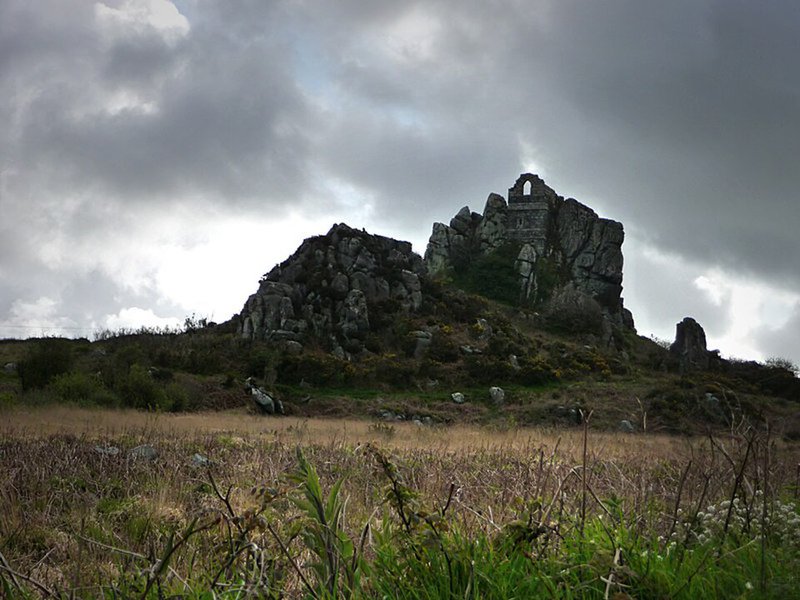
Roche Rock
​Roche Rock by Chris Gunns, CC BY-SA 2.0, via Wikimedia Commons

I’ve been to Cornwall’s chapel of St Michael at Roche Rock, mainly I admit from curiosity to see the location for one of the doomed killer monks attempts on Damien’s life in 1981’s Omen III: The Final Conflict than anything else.

The Chapel in Omen III: The Final Conflict (1981)

​Roche Rock features in Cornish myth; the ruined chapel that we see today was built more than 600 years ago in 1409 by the wealthy Tregarrick family. The last resident of Roche Rock is said to have been Sir John Tregarrick who hid himself there for many years after contracting leprosy. His only visitor was his daughter who brought him food and fresh water from a nearby well. 17th century magistrate Jan Tregeagle’s evil spirit was set to roam the wilds of Cornwall pursued by Satan’s demons. Tregeagle sought sanctuary in the chapel’s holy ground, but only managed to get his head stuck in the east window, with his body dangling outside to be welted by the Devil’s eager helpers. On a stormy night you can still hear the howls and tortured screams of cornered Tregeagle on the wind.

​In the time of King Arthur, it was said to have been the base of hermit/holy man Ogrin. Ogrin helped the famous star-crossed lovers Tristan and Isolde in their attempted escape from an enraged King Mark, hiding the couple with him on the rock.

Devil's Chimney (Gloucestershire)

The Devil, cheesed off by the many Christian chapels in the area, took to perching on Leckhampton Hill, mocking and hurling rocks at those who attended church on a Sunday. But the treacherous, turncoat rocks rebelled and drove Satan back beneath the ground, preventing him from harassing the pious villagers any further.

The mass of stones then formed a chimney to hell - as can be seen by tendrils of smoke that waft from the structure at night. Visitors still leave a coin among the stones, to protect them from the wrath of the Devil.

​The Devil's Lapstone (Durham)

The Devil himself offered to help build Durham Cathedral but with the wicked intention of constructing foundations of such crumbly rock, the building would soon collapse, killing anyone inside. Naughty Satan.

Lucifer would fly up and down the length of the River Dene, collecting stones for the cathedral, but one day, his leather apron snapped and the stone within plummeted to earth. The Devil snatched at it, trying to catch it again and again, leaving deep scratches and Satanic blood in the rock. If you ever see the Devil’s Lapstone, take a close look, as you can still see the rents and blood left by The Horned One in his fury.

LINKS:

​The Blood Stone at Luccombe: https://www.gothichorrorstories.com/journal/folk-horror-from-wiltshire-the-blood-stone-at-luccombe-spring-starving-out-the-vikings-at-bratton-camp-the-white-horse-of-westbury-and-the-nature-of-folklore/

​The Devil’s Boulder: https://www.shebbearvillage.co.uk/people/the-devils-stone/

​Soulbury Stone: https://www.bbc.co.uk/news/uk-england-beds-bucks-herts-36024009

​Sitting in The Devil’s Chair: https://marywoodenglandandireland2015.wordpress.com/2015/05/29/sitting-in-the-devils-chair-erasure-of-ancient-culture-and-fear-of-the-other/

​Devil's Toenail: Bedfordshire's frightening version of Stonehenge: https://www.bedfordshirelive.co.uk/news/history/devils-toenail-bedfordshires-frightening-version-5808785

​Ritual Protection Marks & Ritual Practices - The Devil’s Stone: https://ritualprotectionmarks.com/2022/10/31/a-chill-tale-for-halloween-the-legend-of-the-devils-stone/

​The Devil's Den and Fyfield Down: https://www.hiddenwiltshire.com/post/the-devil-s-den-and-fyfield-down

​The Devil in Westleton: The Westleton Witch’s Stone: https://withthefaeries.wordpress.com/2022/11/27/the-devil-in-westleton-the-westleton-witchs-stone/

The British Druid Order: https://web.archive.org/web/20120808075032/http://www.druidry.co.uk/bdocaerabiri.html

​The Devil’s Ring and Finger: https://thehistorydetective.org/2019/02/15/the-devils-ring-and-finger/

​The Devil's Quoits: https://www.darkoxfordshire.co.uk/explore/the-devils-quoits/

​Pagans suffer ritual abuse: https://www.dorsetecho.co.uk/news/1267293.Pagans_suffer_ritual_abuse/

​The Nine Stones of Winterbourne Abbas: https://shows.acast.com/dark-darzet/episodes/the-nine-stones-of-winterbourne-abbas

​Devil's Lapstone: https://www.atlasobscura.com/places/devils-lapstone

​Roche Rock: https://www.cornwalls.co.uk/st-austell/roche-rock

​A tale of rocks and rogues: https://www.boltholeretreats.co.uk/blog/a-tale-of-rocks-and-rogues/#

​Why not visit the enigma of the Devil's chimney: https://www.bbc.co.uk/gloucestershire/content/articles/2005/06/17/devils_chimney_feature.shtml

​A look at devil-lore in Gloucestershire and Oxfordshire: https://www.greatbritishlife.co.uk/magazines/cotswold/24329332.look-devil-lore-gloucestershire-oxfordshire/

STEPHEN ARNELL’S NOVEL THE GREAT ONE IS AVAILABLE ON AMAZON KINDLE NOW:

SAMPLE: