A pair of obelisks, together named Cleopatra's Needles, were taken in the 19th century from the ruins of the Caesareum of Alexandria in Egypt; one to the London Embankment and the other to New York’s Central Park.
Inscribed by Thutmose III and later Ramesses II of the Egyptian New Kingdom, the obelisks were first moved in 12 BC to Alexandria, remaining there for over 1,800 years.
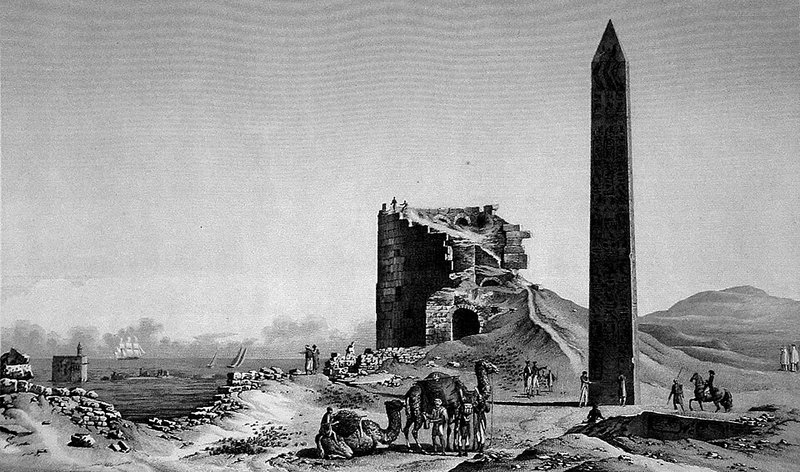
Public domain, via Wikimedia CommonsCleopatra’s Needle - London
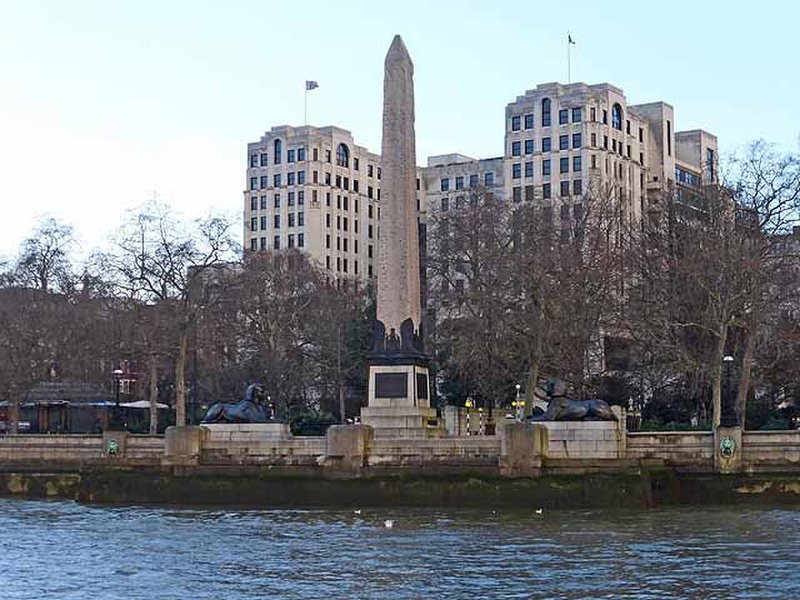
Cleopatra's Needle and the Victoria Embankment by Oliver Dixon, CC BY-SA 2.0 , via Wikimedia CommonsThe obelisk that was eventually re-erected in London was presented to the Prince Regent in 1819 by Egyptian ruler Muhammad Ali, a gift to mark British beating the French at the Battle of the Nile in 1798 and in 1801’s Battle of Alexandria.
The obelisk remained in Alexandria until 1877 when anatomist and dermatologist Sir William James Erasmus Wilson sponsored its transportation to London at the cost of £10,000, around £1,553,000 in today’s money.
The 224 ton artifact was encased in a iron cylinder, 92 feet long and 16 feet wide, dubbed Cleopatra, commanded by one Captain Carter, towed to London by the ship Olga, under Captain Booth. On October 14th 1877, a violent storm in the Bay of Biscay caused the Cleopatra to list uncontrollably, forcing the tow ropes to be cut. The Olga launched a rescue boat with six volunteers but the boat capsized, and all crew members died. Captain Carter his five shipmates aboard Cleopatra were eventually rescued though.
The paddle tug Anglia was then commissioned to tow the Cleopatra to London where it arrived in January 1878 and set up with some pomp at the Embankment on September 12th 1878.
Cleopatra's Needle is flanked by George John Vulliamy’s two faux-Egyptian bronze sphinxes, made at the Eccleston Iron Works in Pimlico in 1881. The sphinxes bear hieroglyphic inscriptions that say “netjer nefer men-kheper-re di ankh”, meaning "the good god, Thuthmosis III given life". Oddly, they are looking at the Needle rather than guarding it - or are they?
Possibly their role was NOT to stop harm from coming to the obelisk but rather to prevent anything supernatural from escaping, a task in which they appear to have singularly failed.The Embankment boasts other Egyptian touches, such as the well-endowed winged female sphinxes gracing the armrests of nearby benches.
A time capsule was concealed in the front part of the pedestal, containing twelve candid photographs of the most attractive English women of the day, hairpins, cigars, tobacco pipes, a set of imperial weights, a baby's bottle, children's toys, a razor, a hydraulic jack and some samples of the cable used in the erection, a 3-foot (90-centimetre) bronze model of the monument, and a complete set of contemporary British coins.
A rupee, a portrait of Queen Victoria, a history of the transport of the monument plans, a translation of the inscriptions, the Bible in several languages, a copy of John 3:16 in 215 languages, Whitaker's Almanack, a Bradshaw Railway Guide, a map of London, daily newspapers and finally, a twenty-four inch metal ruler, were also squirrelled away in the capsule.
It has been posited that the pictures of women and a razor amongst the items deposited beneath the monolith emitted waves of evil occult energy that eventually resulted in the crimes of Jack the Ripper decades later.
As The Ripper puts it in Alan Moore’s From Hell (1999): “They call it Cleopatra’s Needle. He who’d wield it would the BEST of tailors be, to do its work, increase the Sun God’s sovereignty … encoded in this city’s stones are symbols thunderous enough to rouse the sleeping Gods submerged beneath the sea-bed of our dreams.”
In 1977, my school Nower Hill High secreted a time capsule, which was (typically) forgotten about until accidentally rediscovered in 2013.
Cleopatra’s Needle: Shades of Ancient Egypt Gather
Soon, eerie unexplained events began to unfold around London’s Cleopatra monument, including the following;
The Spectral Seaman
The ghost of a naked man has been seen on a number of occasions, leaping from out behind the obelisk and throwing himself into the River without making a splash. The first sighting of this apparition occurred only a few weeks after the installation of the obelisk, leading many to conjecture it was the shade of one of the sailors who drowned in the Bay of Biscay. Or it was simply a ‘flasher’ with a taste for the theatrical?
Aleister Crowley Was ‘Ere
It is said that the notorious occultist Aleister Crowley performed dark rituals late one evening at the base of the obelisk in order to release the trapped spirit of the Pharoah Rameses. The ceremony supposedly involved animal blood and a human skeleton. Crowley failed in his endeavour, which was accompanied by the sound of Rameses mocking guffaws. File under: unlikely.
Suicide Isn’t Painless
Cleopatra’s Needle soon became a site associated with suicide. A policeman claimed a hysterical woman approached the officer, urging him to come to the banks of the Thames by the obelisk to prevent someone from hurling themselves into the water. As he left her and reached the area, he saw the same woman leap into the river, cackling as she did so.
The Laughing Man-Fish
In Elliott O’Donnell’s Haunted Waters (1957) he recounts, “the spot where Cleopatra’s Needle stands was well-know to be haunted. None of the outcasts would venture near it. Two of them told me that one night they saw a tall, nude, shadowy figure, with a pear-shaped head and a body covered with what looked like scales, suddenly appear by the needle, wave a long arm at them and leap over the wall into the river. They said that they sometimes heard unearthly groans and hellish, mocking laughter in the river.”
The Ancient World in London - Egyptomania in London
Near where I used to live in Islington:
Cleopatra’s Needle - New York
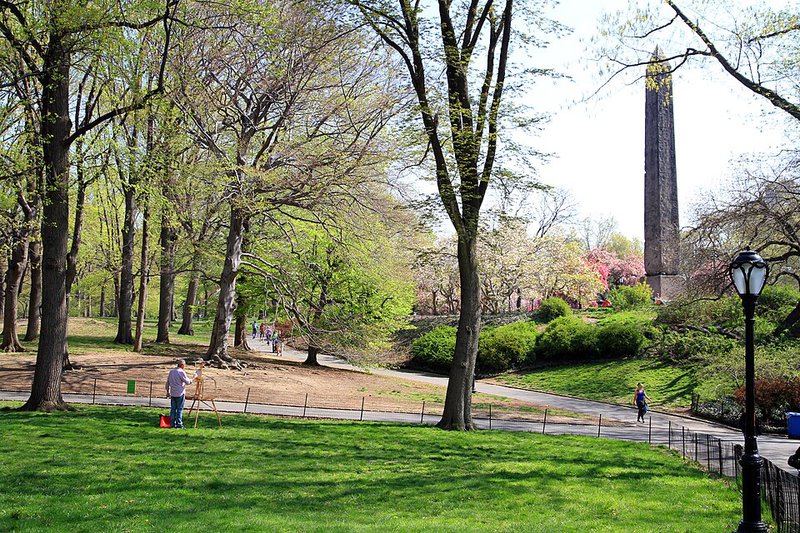
Ingfbruno, CC BY-SA 3.0 , via Wikimedia CommonsNew York’s Needle was gifted in May 1877 to United States Consul General by Cairo Judge Elbert E. Farman, as thanks from the Khedive for the US remaining a friendly neutral as France and Britain vied for control of Egypt and the Suez Canal. Transportation costs were largely paid by the railroad magnate William Henry Vanderbilt, eldest son of Cornelius Vanderbilt.
The obelisk was transported seven miles to Alexandria and then put into the modified hold of the steamship SS Dessoug, which set sail June 12th, 1880. The Needle and its accompanying 50-ton pedestal arrived at the Quarantine Station in New York a month later. The ground was flattened so the obelisk could be rolled out of the ship and transported to an interim location off Fifth Avenue. Finally a steam engine pushed the object across a specially built trestle bridge from Fifth Avenue to Greywacke Knoll, just across from the Metropolitan Museum of Art.
It took a mammoth 112 days to move the obelisk from Quarantine Station to its current location.
Jesse B. Anthony, Grand Master of Masons in the State of New York, presided as the cornerstone for the obelisk was laid in place with full Masonic ceremony on October 2nd, 1880. Over 9,000 Masons paraded up Fifth Avenue from 14th Street to 82nd Street. The official ceremony for erecting the obelisk was held January 22, 1881. A time capsule buried beneath the obelisk contains an 1870 U.S. census, a Bible, a Webster's Dictionary, the complete works of William Shakespeare, a guide to Egypt, and a copy of the United States Declaration of Independence.
A small chest was also placed in the capsule, but its contents remain unknown to this very day.
The wonderfully named Henry Honeychurch Gorringe, who supervised the movement of the obelisk, claimed the prime advantage of the Knoll was its "isolation", and it was elevated, with the foundation firmly anchored in local bedrock, supposedly preventing collapse if Manhattan suffered "some violent convulsion of nature."
The League of Shadows
In 1885 Gorringe died at the age of 43 as a result of injuries when he fell (or was he pushed?) from a moving train. 1885 was the year in which Gorringe published his book Egyptian Obelisks, which mainly explored his acquisition of Cleopatra’s Needle for Central Park. Gorringe was buried in Rockland Cemetery, Sparkhill, New York State. His memorial stone declares: “His crowning work was the removal of Cleopatra’s Needle from Egypt to the United States, a feat of engineering without parallel.” In 1886, his friends erected a replica of Cleopatra’s Needle over his grave, the unveiling drawing 500 people. Like the original obelisk in Central Park – it stands on its own knoll, overlooking the Hudson River.
There are far less stories of ghosts and curses linked to the New York obelisk than its London sibling, attributed by some to the elaborate Masonic ceremonies that prepared the plinth for the monument’s arrival, which may have pacified any unquiet ancient spirits.
In 2011, the pollution-blighted Needle was inspected by Zahi Hawass (Minister of Egypt’s Supreme Council of Antiquities) who declared: “If the Central Park Conservancy and the City of New York cannot properly care for the obelisk, I will take the necessary steps to bring this precious artefact home and save it from ruin.” The London obelisk is in a better condition, but in 2018 Hawass also weighed in, “I went to see it yesterday and I was ashamed … If they don’t care, they should return it.”
Note: The 50-foot granite walls of Manhattan’s now demolished Croton Reservoir (completed in 1842) were constructed in the Egyptian style popular at the time.
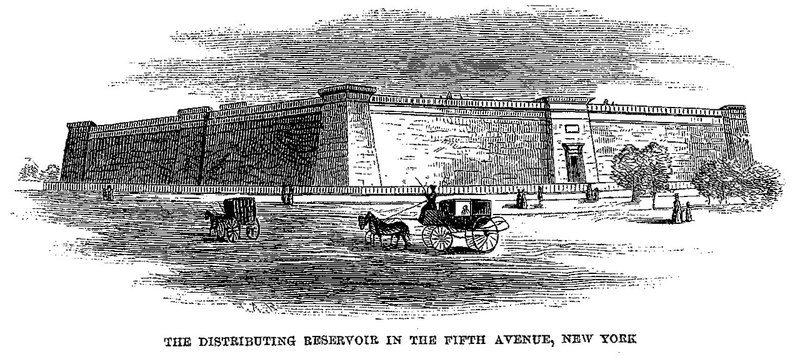
unidentified illustrator of an article by T. Addison Richards, Public domain, via Wikimedia CommonsCleopatra (1999)
Kenneth Anger’s Lucifer Rising (1972); film director Donald Cammell was the god Osiris; Marianne Faithfull plays primordial she-demon Lilith:
LINKS
Cleopatra’s Needle – London & New York’s Cursed & Haunted Egyptian Obelisks: https://www.davidcastleton.net/cleopatras-needle-london-new-york-city-central-park-obelisk-cursed-haunted-ancient-egypt/
Hidden Alignments Documentary – NYC Masonic Obelisks: http://glasscapsule.com/2015/12/hidden-alignments-documentary-nyc-masonic-obelisks/
The Mystery of the Central Park Obelisk: https://www.boweryboyshistory.com/2020/10/cleopatras-needle-and-secret-of-new.html
NYC – Cleopatra’s Needle: https://imagerysmith.wordpress.com/
How Cleopatra’s Needle came to London: https://www.londonmuseum.org.uk/collections/london-stories/how-cleopatras-needle-came-london/
The Curse of Cleopatra’s Needle: https://hauntedpalaceblog.com/2022/06/07/the-curse-of-cleopatras-needle/
STEPHEN ARNELL’S ROMAN MYSTERY THE GREAT ONE IS AVAILABLE NOW ON AMAZON KINDLE:
SAMPLE
Cover image of London’s Cleopatra Needle attribution: Canva Pro


No comments:
Post a Comment