In my front garden stands a typically fast-growing Ash tree, one whose roots are perilously close to destroying the garage.
Which got me thinking about the Ash tree in folklore and in the paranormal world; my cultural touchstone being M.R. James’ disturbing tale The Ash Tree (1904); links to two BBC2 versions are linked below.
The Ash (or Fraxinus) is generally regarded as a positive member of a genus of plants in the olive and lilac family, or Oleaceae. Indeed, in Norse mythology, the World Tree Yggdrasil is held to be a sacred Ash tree and was regarded across Northern Europe as a symbol of cosmic connection, healing, and strength.
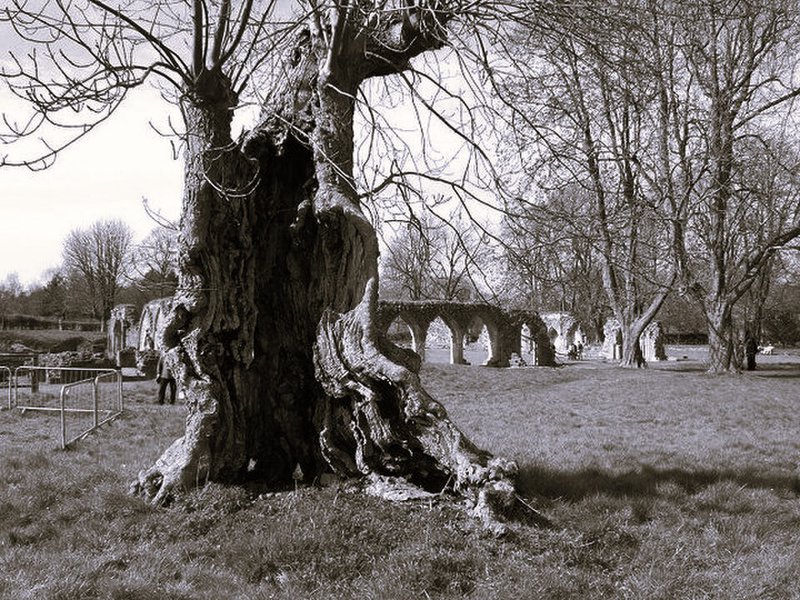
Symon Parsley / Old Ash TreeIn popular culture, the World Tree recently featured in season 2 of Marvel’s LOKI (2023).
For the Vikings, the first man, Askr, was formed from an Ash, whilst the first woman Embla was made from an elm. In the Norse poem Hávamál, Odin described hanging himself from a "wind-swept (Ash) tree" for nine nights, wounded by a spear, in a self-sacrifice to himself to gain wisdom and learn the secrets of the runes.
In Celtic and British folklore, the Ash is one of the three sacred trees, along with Oak and Thorn; a healing tree, particularly used in rituals to cure poorly children.
For the ancient Greeks, the Meliae were nymphs associated with the Ash tree, born from the blood of Uranus falling onto Gaia.
The Askafroa (wife of the Ash tree), or in Danish ‘Askefrue’ is the guardian of the Ash tree, a malicious creature. To appease her, it was necessary to make a sacrifice every Ash Wednesday by pouring water on her roots and declaring: "I am offering to you so that you do us no harm".
Ash Wednesday, while nowadays of course, a Christian observance marking the start of Lent, has roots in pagan customs of purification, mourning, and the return of spring, including using ash for protection, fertility, and renewal. Ashes were used to mark the forehead for Odin’s protection often done on "Odin's Day" (Wednesday). In Celtic tradition, ashes were used to bless livestock and ensure fertility during the transition from winter to spring, frequently associated with Imbolc celebrations.
There are fictional takes on less than benevolent Ash trees, including in the 1990 3-part BBC television adaptation of Kingsley Amis’s novel, The Green Man (1969), where it puts in a truly terrifying appearance at the beginning of the first episode:
Note: Green Man sculptures are often created from fallen Ash trees.
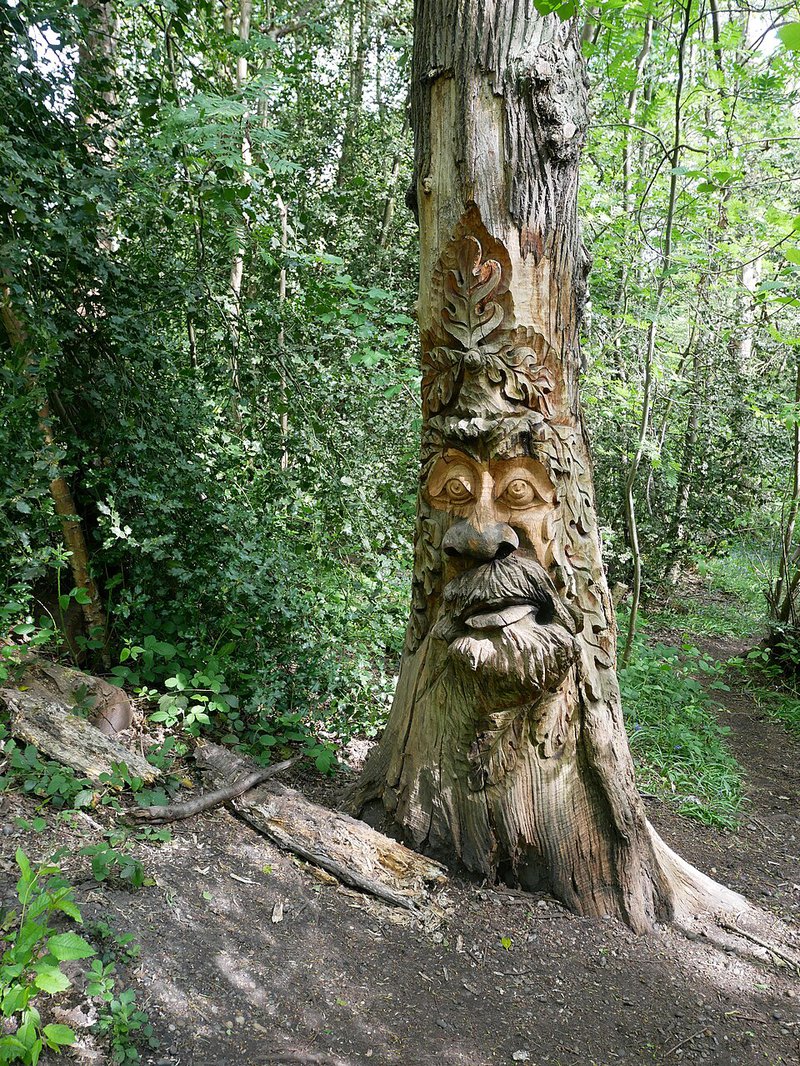
Ethan Doyle White, CC BY-SA 4.0 , via Wikimedia CommonsThe UK - in ‘real’ life?
1869’s Haunted Ash of Lampits (Scotland), part of The Ghosts of Carnwath series of supernatural reportage
An account in Scotland’s Hamilton Advertiser of 28th August 1869 detailed a melancholy apparition and haunted Ash tree near Lampits Farm, to the east of Carstairs Junction in South Lanarkshire:
“There long stood a solitary, melancholy-looking ash tree in a field on the Lampits Farm, in the vicinity of Cockysyetts, which was cut down to make way for the Queen’s branch of the Caledonian Railway, and which was still more melancholy, in my imagination, from its dismal associations; for here, on one of the branches of this dowie-looking tree, a poor heart-broken girl of Cockysyetts closed her earthly sorrows and her earthly pilgrimage. No mavis or blackbird was ever seen to nestle in it scanty foliage, no merry note of music was ever heard from its dull half-blasted branches; the raven might croak and the pyot chatter there by day, and the owl scream by night, but no other merriment, dear tree, was thine. Ghosts love the darkness and the shade, and the ghost of poor Jessie was often seen gliding at midnight among the shadows of the fearsome neuk.”
Today, few trees grow on the flat windswept carseland around Lampits. There remains, however, a solitary ancient ash tree that commands a view across the flat fields towards the Caledonian Railway. Many of its upper branches have been lost to past storms, and disease ravages others, however new growth continues to sprout from a gnarled and weathered old trunk.
With scanty foliage and half-blasted branches it has an uncanny resemblance to the melancholy old ash tree described in the newspaper article over 150 years ago. Ash trees can live for up to three hundred years, therefore it’s possible that the surviving tree could have witnessed Jessie’s melancholy end, early in the 19th century. It might even have sprung from a seed of the haunted ash.
The Hardy Tree (St Pancras Old Church, London)
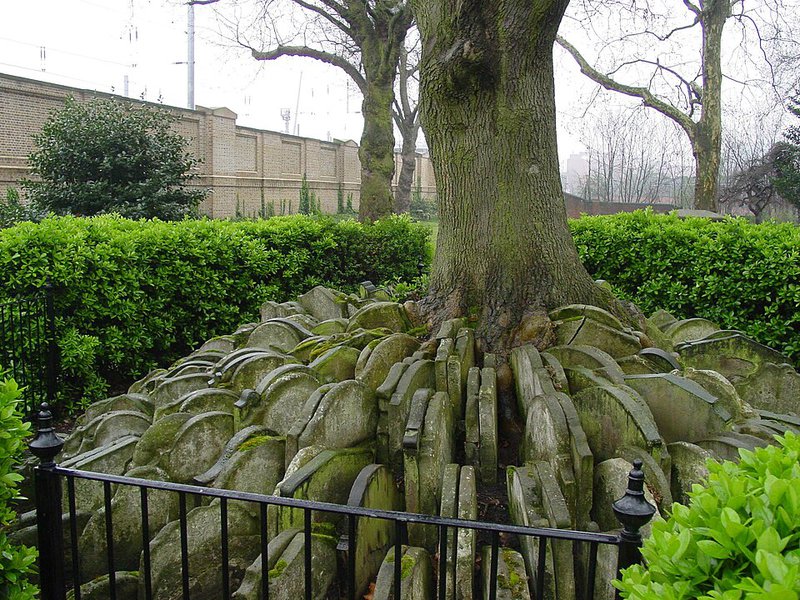
David Edgar, CC BY-SA 3.0 , via Wikimedia CommonsThe Hardy tree was an Ash tree located in the very ancient, possibly Roman St Pancras Old Church's churchyard in London. Notable for the stacked gravestones embedded at its base in around 1860, when graves were moved by writer-then-architect Thomas Hardy to make way for the Midland Railway to run through the churchyard.
In 2014, the tree was infected with fungus, and with storms further weakening it, the tree fell in December 2022.
The Hell Tree
From: The Mysterious Hardy Tree | Graves that Circle a Tree….(2021)
It’s thought that during his time here, Hardy actually uncovered the body of a two-headed man during the excavations. Thomas never documented anything regarding and this and more recent photographs of the tree has encouraged speculation if he ever had anything to do creating the design at all. He did write a poem named Levell’d Churchyard. Thomas’s poem suggests that he didn’t have fond memories of the work he did here but its hardly surprising given the job he was expected to do.
In letters that were written by the St Pancras Old Church vicar John Tweed in 1859 to his wife Charlotte, he appeared to have witnessed a supernatural manifestation. The vicar detailed how his churchyard was home to a mass gathering of apparitions and how tombstones seem to appear at the Ash tree and that he had even seen them moving towards this tree by a unseen force.
In December 1859 he wrote to Charlotte: ”More missing headstones. Increasingly certain of connection with my guests. Today I traced strange lines of disturbed earth across the graveyard. Each lead to the Ash Tree. Are they being dragged there? And then where? The ash tree itself is looking increasingly unhealthy, possibly diseased. I don’t like to get too close to it.”
And then: “If I hadn’t seen such as I have seen these past months I may not have trusted my eyes, but trust them I must. I shall record it in as plain a manner as I know how: By the light of the moon last night I saw a gravestone, moving with some speed, and quite of its own accord, across the graveyard. It hurtled towards the ash tree, at the base of which it disappeared, as if plunging in to the very bowels of the tree.” Finally: “Good God. Hundreds of them, of all shapes, just pouring into the tree.” He later refers to the tree being a gateway and it’s believed by some that he felt it could have possibly been a hell gate.
“Dearest Charlotte, I do so love hearing your news from the vale, it pains me to have to recount the horrors of my life here… At night I am plagued by nightmares so vivid and dreadful that I am afraid to sleep at all. I have been nailed to the cursed iron frontage of a flame-licked and hell-bound locomotive. I have walked through the dark miasma and fetid slime of a London choked by death. I have seen the flagstones of the church floor thrust violently upwards by a sudden eruption of uncertain origin. And these are only the visions I have the constitution to retell… I begin to suspect that it is not just the lost ones that are being dragged down to that place. For how to account for the sheer number I watch descend every night? Where will it end? Must every dead soul in the parish, every dead soul in London be reclaimed for damnation?! No Charlotte, I shall not see it happen.”
Allegedly John Tweed closed the hell gate in 1860 by burying a Bible under the tree, and scans of the Ash tree show a large book buried within the roots… but nobody has ever been allowed to dig the area. No reports were made from Tweed after 1860, when he lost the ability to record his findings; his writing hand apparently useless.
And...this from Exit Strategy for the Restless Dead: The Hell Tree of St Pancras (2017)
He wrote to Charlotte: “Every thief, vagabond and ne’er-do-well in London seems to have wound up buried at St P. Which would be all well and good, except that the digging up of late seems to have unearthed more than just bones. Judging by the number of lost souls drifting about the place in one spirit form or another, I would offer that many of my guests are far from welcome in Heaven. I can only assume that having been buried in consecrated ground further precludes them from the other place, which leaves them, it is my horror to say, stuck in the churchyard with me”.
Tweed was not entirely without sympathy for his ghostly companions, going on to tell his wife that they were: “Sad seeming things. I feel quite sorry for them. I don’t suppose I should mind at all if only they kept their mournful meanderings to the night-time hours. Last Sunday I was midway through service when a wraith came down the aisle – an infernal thing, it stalked among the shadows between the shafts of morning light, wailing and moaning like a baleful cat. There were already murmurings amongst the parishioners about the foul stench from the digging up. Dearest Charlotte, I am not sure how much longer I can pacify them.”
The Beatles at Old St Pancras (1968)
Although St Pancras Old Church is in central London, minutes away from the great Victorian Gothic pile of a station, the area can be quite a haunting, lonely place, perched on a hill overlooking the railway junctions of St Pancras and King’s Cross. I remember visiting in the snows and blizzards of Winter 2015, when the church grounds felt like something from one of Grimm’s tales.
The Lively Arts: Thomas Hardy - A Haunted Man (1978)
The Ash Tree - Vampire/Zombie Killer
In folklore, an ash stake is traditionally used to kill vampires, especially in Slavic, Russian, and Baltic traditions. Ash wood represents protective, "life" energy in Norse mythology, where it can help destroy the Draugr (Undead), or at least weaken their supernatural powers. The Viking version of vampires/zombies are described as bloated “death-blue/black” revenants who ferociously protect their treasure, with the ability to grow to giant sizes and shapeshift.
Note: other words for the Undead or Vampires in Norse legend include:
Aptrgangr (Again-walker): One who walks again.
Haugbúi (Barrow-dweller): One that dwells within its burial mound (howe).
Gjenganger: A ghost or revenant.
In Bram Stoker’s Dracula (1897), Abraham Van Helsing utilizes wooden stakes associated with specific woods like ash or white oak to impale vampires by piercing their Undead hearts.
Three BBC adaptations of The Ash Tree by M.R James
The Ash-Tree (1986)
And a later telling from 2000; my idea but ripped off by a then senior BBC colleague:
A Ghost Story for Christmas: The Ash Tree (1975) - The big reveal...
Ash Wednesday (1973) full movie
LINKS
The Haunted Ash of Lampits: https://clydesdalesheritage.org.uk/article/the-haunted-ash-of-lampits/
Askafroa: https://www.stronghold-nation.com/history/myth/askafroa
Ash Wednesday and its pagan origins: https://susannesanlier.wordpress.com/2015/02/18/ash-wednesday-and-its-pagan-origins/
What is Imbolc? The Celtic fire festival that welcomes spring—in February: https://www.nationalgeographic.com/culture/article/imbolc-celtic-celebration-brigid
Draugr, Haugbui And Aptrgangr – The Undead of Norse Myths: https://vikingr.org/other-beings/undead-viking-age?srsltid=AfmBOooD9FPhdZ_fGZNJpou74mRFiwpS_qX8UmyR39HCDmJHrj0w4hDj
Thomas Hardy: Gravestone-encircled tree falls in Camden: https://www.bbc.co.uk/news/uk-england-london-64110086
The Mysterious Hardy Tree | Graves that Circle a Tree….:https://paranormalhauntings.blog/2021/12/26/the-mysterious-hardy-tree-graves-that-circle-a-tree/
Exit strategy for a restless dead: The Hell Tree of St Pancras: https://portalsoflondon.com/2017/01/20/the-hell-tree-of-st-pancras/


No comments:
Post a Comment