The more you learn about the Occult Art of Law, as presented by UK psychiatrist Alan of Salisbury during an impromptu Birbeck lecture at London University, the more you wonder how this age-old, illegitimate legal charade is still permitted to continue. Part 3 of this Mass Occultic Deception series focuses on how to lawfully rebut the 12 Presumptions of Court and has been inspired by The Principles channel host, Adrian.
In his 12 Presumptions of Court overview, Adrian reminds us that:
~ Common Law is based on God’s Law or Natural Law and is based on two simple principles: Do No Harm and Cause No Loss. Everything else fits in and under them.
~ The legal system has over 100 million codes and laws. If you had access to these immense libraries of law books, there is no way that any individual, group, organisation, company or even country could come anywhere near close to any or all of the codes that are in these code books.
~ Most countries, if not all, are companies masquerading as countries. Legalese is the language of the Law Society and corporate employees. When they summons you to court, you are being given an invitation to appear in court; the same way you would summons the dead.
Adrian encourages people to ‘get to grips with the fact that you can rebut the presumptions of court which negates them and brings everything back into order the way it should be.’ In his experience, you start to behave like a grown man or woman when you take the time to ‘figure out how this works’. And he is right on the money when he describes this information as being ‘well hidden, obfuscated, occulted if you will... so the merry gang of gangsters can carry on with their illegitimate and unlawful theft of everything from us to fan their own coffers...’ (Surely their coffers burst a long time ago?)
Adrian also believes that all of the courts and all of the lawyers have been trained incorrectly:
“When we step into the Canon Law 3228, you may be shocked at how corrupt and bent the game really is. But when you understand this, you are in a much better position to do something with it because all you need to do is rebut the presumptions...
Read through these presumptions many times so you can start to internalise them and capture the information into your being because this is very much about mindset and knowing your position and who you really are.”
Canon Law 3288 – The 12 Presumptions of Court
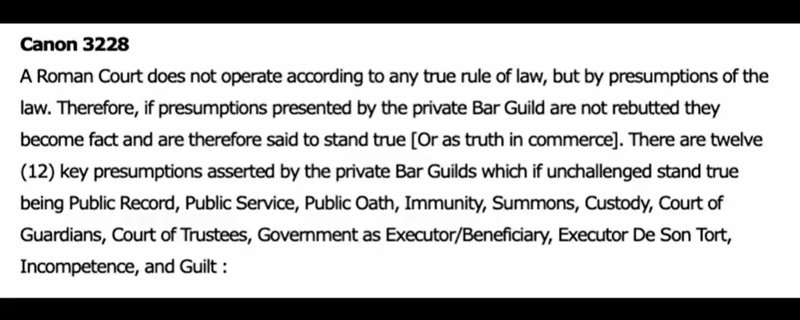
Presumption of Private Record: Any matter that is brought before the lower Roman court is a matter for the public record when in fact it is presumed by the members of the Private Bar Guild that the matter is a Private Bar Guild business matter unless openly rebuked and rejected by stating clearly that the matter is to be on the public record. Unless you state that you want this as a matter of public record, it remains in the private where a whole different set of rules apply.
Presumption of Public Service: All members of the Public Guild have all sworn a solemn secret oath to their guild and then act as public agents of the government or public officials that make additional oaths to public office that openly and deliberately contradict their private superior oaths to their own guild. Unless openly rebuked and rejected, the claim stands that these Private Guild Members are legitimate public servants and therefore Trustees under public oath.
Presumption of Public Oath: Unless openly challenged and demanded, the presumption stands that the Private Bar Guild members have functioned under their public oath in contradiction to their guild oath. If challenged, such individuals must recuse themselves as having a conflict of interest and cannot possibly stand under a public oath.
Presumption of Immunity: Key members of the Private Bar Guild in the capacity of public officials acting as judges, prosecutors, and magistrates, who have sworn a public oath in good faith, are immune from personal claims of injury and liability. Unless openly challenged and their oath demanded, the presumption stands that the members of the Private Bar Guild has public trustees acting as judges, prosecutors and magistrates, are immune from any personal accountability for their actions.
Presumption of Summons: By custom, the summons unrebutted stands, and therefore one who attends court is presumed to accept a position: defendant, juror, witness, and jurisdiction of the court. Attendance in court is usually invitation by summons. Unless the summons is rejected and returned with a copy of the rejection filed prior to choosing to visit or attend, jurisdiction and position as the accused and the existence of guilt, stands. You can read that as meaning since you turned up as the defendant, you are presumed guilty unless you can prove your innocence.
Presumption of Custody: By custom, the summons or warrant for arrest unrebutted, stands, and therefore one who attends court is presumed to be a thing and therefore liable to be detained by custodians. This includes the dead legal fiction, not human person that government rules and regulations are written for. Custodians may only lawfully hold custody of property and things, not flesh and blood soul possessing beings. Unless this presumption is openly challenged, by rejection of summons and/or at court, the presumption stands that you are a thing and property, therefore lawfully kept in custody by custodians.
Presumption of Court of Guardians: the presumption that you may be listed as a ward of a local government area and have listed on your passport the letter p. You are a pauper and therefore, under the guardian powers of the government and its agents as courts of guardians. Unless this is openly challenged to demonstrate you are both a general guardian and general executor of the matter, which is the trust before the court, the presumption stands that you are by default a pauper, a lunatic and therefore must obey the rules of the clerk of the magistrates court. (Apart from you, the clerk is the most powerful figure in the courtroom.)
Presumption of Trustees: Members of the Private Bar Guild presume you accept the Office of Trustee as a public servant and government employee. Just by attending a Roman court, as such courts are always for the public trustees by the rules of the guild and the Roman system, unless this presumption is openly challenged to state you are merely visiting by invitation to clear up the matter, and you are not a government employee or public trustee in this instance, the presumption stands and is assumed as one of the most significant reasons to claim jurisdiction simply because you appeared.
Presumption of Dual Role: The presumption of government acting in two roles as executor and officiary is that for the matter at hand, the Private Bar Guild appoints the judge/magistrate in the capacity of executor while the prosecutor acts in the capacity of beneficiary of the trust for the current matter. Unless this presumption is openly challenged to demonstrate that you are both the general guardian and general executor of the matter, which is the trust before the court, the presumption stands and you are by default the trustee, therefore must obey the rules of the executor, the judge and the magistrate.
Presumption of False Executor: The presumption of Executor de son tort is the presumption that if the accused does seek to assert their right as the Executor and Beneficiary over their body, mind and soul, they are acting as an Executor de son tort or false Executor, challenging the rightful judge as the executor. Therefore, the judge/magistrate assumes the role of true Executor, has the right to have you arrested, detained, fined or forced into a psychiatric evaluation. Unless this presumption is openly challenged by not only asserting oneself as executor as well as questioning whether the judge or magistrate is seeking to act as Executor de son tort, the presumption stands and a judge or magistrate of the Private Bar Guild may seek the assistance of bailiffs or sheriffs to assert their false claim.
Presumption of Incompetence: Presumption that you are at least ignorant of the law, therefore incompetent to present yourself and argue properly. Therefore the judge/magistrate as executor has the right to have you arrested, detained, fined or forced into a psychiatric evaluation. Unless this presumption is openly challenged to the fact that you know your position as executor and beneficiary, and actively rebuke, and object to any contrary presumptions, then it stands by the time of pleading that you are incompetent and the judge/magistrate can do what is needed to keep you obedient.
Presumption of Guilt: The presumption that it is presumed that the private business meeting of the Bar Guild that you are guilty whether you plead guilty or not plead or plead not guilty. Therefore, unless you have prepared an affidavit of truth and motioned to dismiss with extreme public prejudicee onto the record or call a demurer, then the presumption is that you are guilty and even the Bar Guild can hold you until a bond is prepared to guarantee the amount the guild wants to profit from you.
Watch the Presentation
The Principles: The 12 (Shocking) Presumptions of Court
December 2020 - Runtime: 17 mins

The aforementioned 12 Presumptions of Court were originally sourced from The Bridge - Life in the Mix - well worth a visit for additional information:
Note: The Digital ID is also based on presumption and not on your biological reality. Learn more on the For the Love of Truth - Law or Legal page.
More legalese curiosities to ponder
Definitions of Human & Homo Sapien
Legally, the NAME OF A HUMAN MUST ALWAYS BE IN CAPITALS (DOG-LATIN) TO IDENTIFY THAT INDIVIDUAL AS PROPERTY as distinct from a free man.
Human: ‘Hu’ and ‘man’ mean ‘hue’ and ‘man’. Color of man. It has form but not substance. A living body without spirit is not in the realm of reality. A human being is therefore the form rather than the substance of man.
Websters Dictionary 1828 definition of human: [Latin Humanus; Heb. Form, species] 3. Profane; not sacred or divine; as a human author.
Oxford New English Dictionary 1901 definition of human: Belonging or relative to man as distinguished from God or superhuman beings; pertaining to the sphere or faculties of man (with implication of limitation or inferiority); Mundane; Secular; Often opposed to Divine.
Unbaptized indigenous populations were legally defined as ‘humans’ and therefore ‘animals’.
Homo Sapien: Latin homō (stem homin-) means ‘man’ in the sense of ‘human being’ (male or female). Sapien means “wise, sensible, judicious man or woman."
Sapient Animals: Animals that have self-awareness and the capacity for abstract thought (dolphins, some apes, us) are called sapient (again, thoughtful or wise). Animals with senses are described as sentient (sentientem – ‘feeling, ‘perceiving’).
Ballentine's Law Dictionery 3rd Edition definition of human: ‘Human. Of the form and characteristics of man.’ Therefore, by Ballentine's definition, a human is not a man but resembles one.
Source ~ Aetherical Blogspot: Human Image - The Fundamental Legal Fiction
Why the 14th c. Vatican global slave trade needed ‘human beings’
The following definition of human being was provided by ex Jesuit Frank O’Collins in 2005:
Human Being. From Latin ‘Humanus’; a lesser/inferior man or woman defined legally as an ANIMAL or MONSTER distinct from the ancient (pre-Vatican) term homo: man.
A key rule of law from the 14th century describing a fundamental LEGAL FICTION was the NOTION of an inferior man or woman as an animal (as defined by Papal Decree) and therefore not subject to the laws of free men, but the laws of property.
The decision to create a second word for Homo (man) denoting an inferior ‘animal’ man, was crucial to the legal implementation of the Vatican global slave trade from the 14th century – to overcome the questions of legality and morality of the Vatican slave trade.
End of Part 3. Part 4 will explore the origins of our Cestui Que Vie Trusts that most people don’t realize they have and how ‘double-dipping’ governments and corporations secretly access our money from our trusts as well as bill us for the same service from our ‘sweat equity’ income.
Part 1
Part 2


No comments:
Post a Comment