
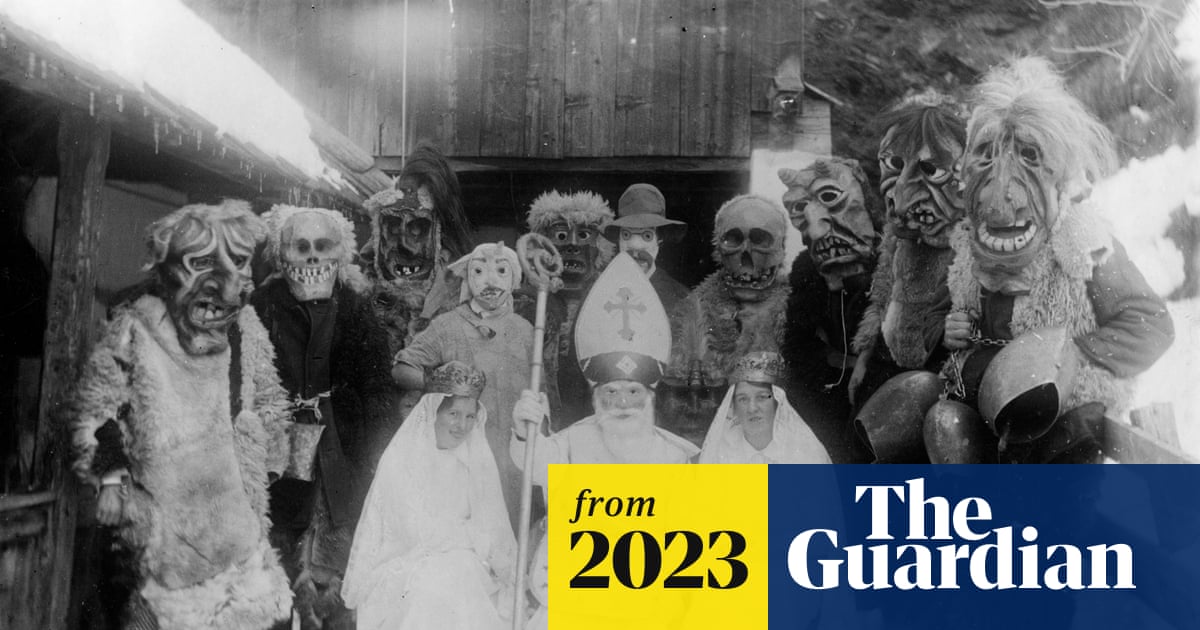
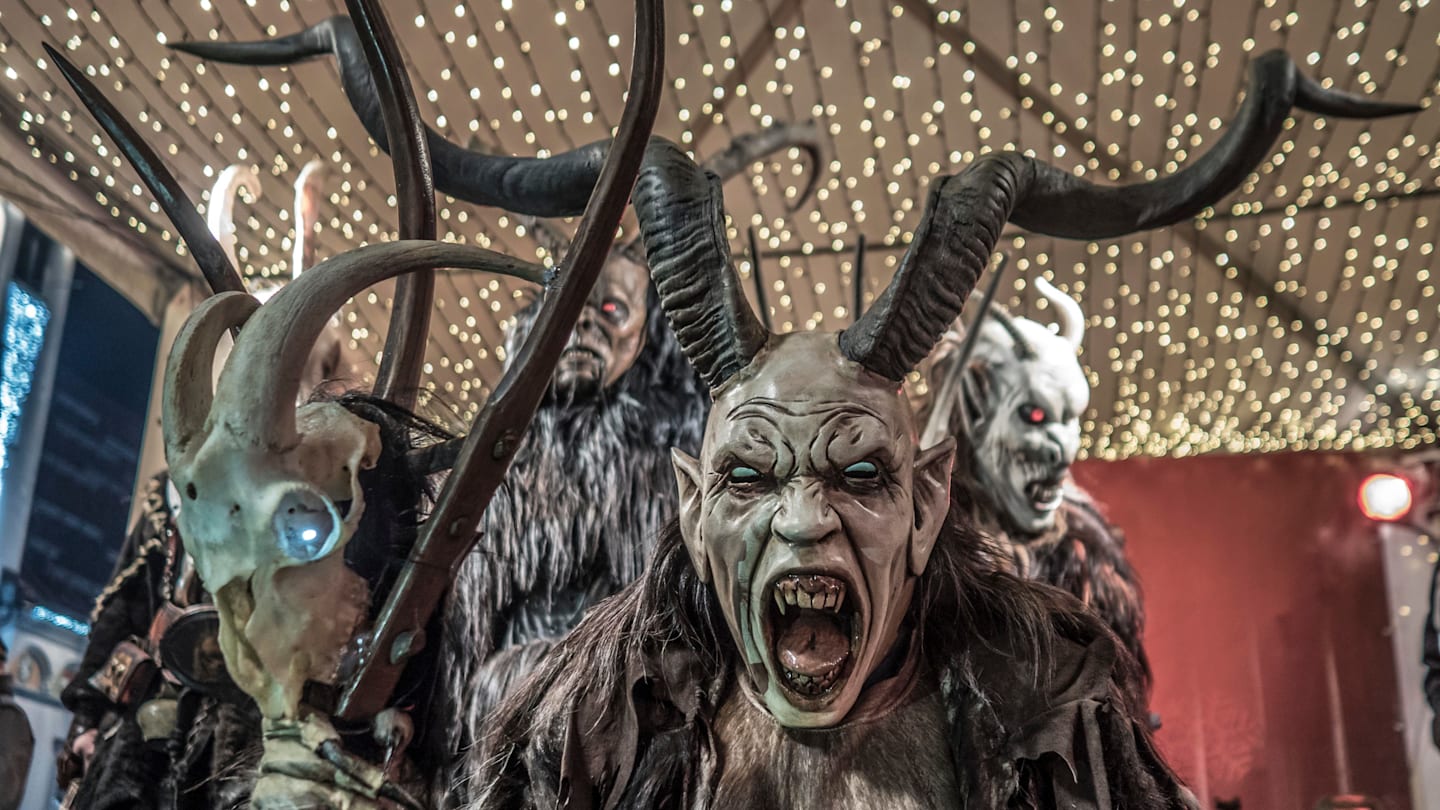
Over recent years the Festive Season has seen an uptick in interest in Austria’s Krampus - the mythic ‘Anti-Santa’ who punishes wicked children and generally acts as a primal, early Yuletide supernatural entity:
Throughout Europe there are indeed many other nasty Christmas demons, including the Kallikantzari, Frau Perchta, Hans Trapp, Gryla and her Yule Cat, Knecht Ruprecht, La Befana, the Yule Lads, Père Fouettard and Zwarte Piet, all of whom can be explored in Further Reading below.
But the focus of this investigation is the UK, where there is a relative scarcity of similar Yuletide fiends - with two exceptions; the menacing horse-skulled Mari Lywd of South Wales and the demonic Dorset Ooser.
Mari Lywd
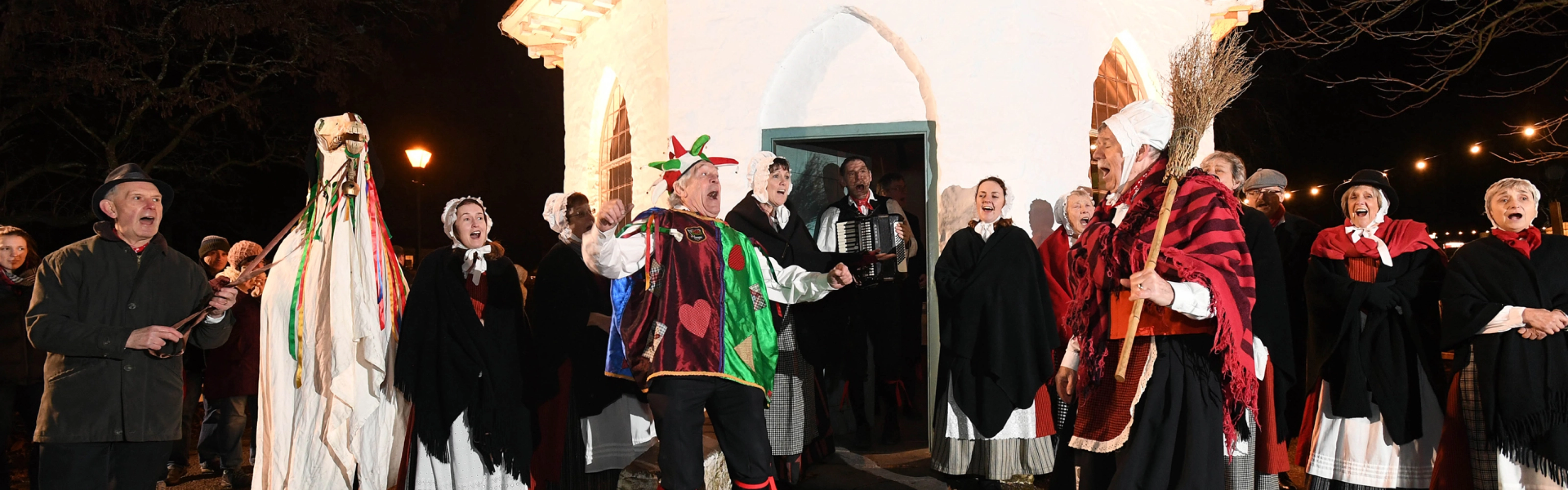
The Mari Lwyd is a wassailing (a pagan Winter fertility festival) folk custom in South Wales, led by a hobby horse with a nag’s skull mounted on a pole, carried under a white sheet. The custom was first recorded in 1800, carrying on into the early twentieth century, before retreating to remote villages before its revival in recent decades.
The Mari Lwyd was performed at Christmas time by groups of men who would carry the unnerving symbol to local houses, requesting entry through song. The householders would be expected to deny them entry, again through song, with this back and forth ‘Sing Off’ carrying on interminably in typical Welsh fashion. When inhabitants eventually gave in, the team would be let in and given food and drink.
Folklorists believed that the tradition had once possibly been a pre-Christian religious rite, in keeping with British hooded animal lore —such as the Hoodening of Kent, the Broad of the Cotswolds, and the Old Ball, Old Tup, and Old Horse of northern England. Or perhaps, a link to the sixteenth and seventeenth-century craze for hobby horses among the social elite, which the lower orders mocked with their antics? As Mary Lwyd most often targeted wealthier homes, this is one theory.
An account from Gower stated the horse’s skull was buried throughout the year, only being dug up for use during the Christmas season, when the fun began at dusk and lasted late into the night.
Welsh writer and folklorist Marie Trevelyan (1853-1922) posited the name Mari Lwyd derived from "Grey Death", a symbol of "the dying or dead year". Fellow folklorist Iorwerth Peate (1901-1982) claimed it the horse was, “a survival of a pre-Christian tradition" once spread across Britain and Europe, and surviving the Christianization of Britain, renamed Mari Lwyd as homage to the Virgin Mary. He theorized the original custom had been "horrific in origin and intention". Scholar Ellen Ettlinger (1902–1994) believed the Mari Lwyd was a "death horse", symbolized by the white cloth worn by its carrier, and began as pre-Christian ritual to mark the festival of Samhain.
My personal theory is that Mari Lywd may owe something to those who inhabited the region at various times throughout the ages, as the Celts, Romans and Vikings all sacrificed horses as part of their religious practices. A syncretic folk memory survival perhaps?
From December 2024: Alister Bailey travels to a remote Welsh town to help inspire his latest book, however what he finds is more than simply inspiring. (IMDB)
The Dorset Ooser
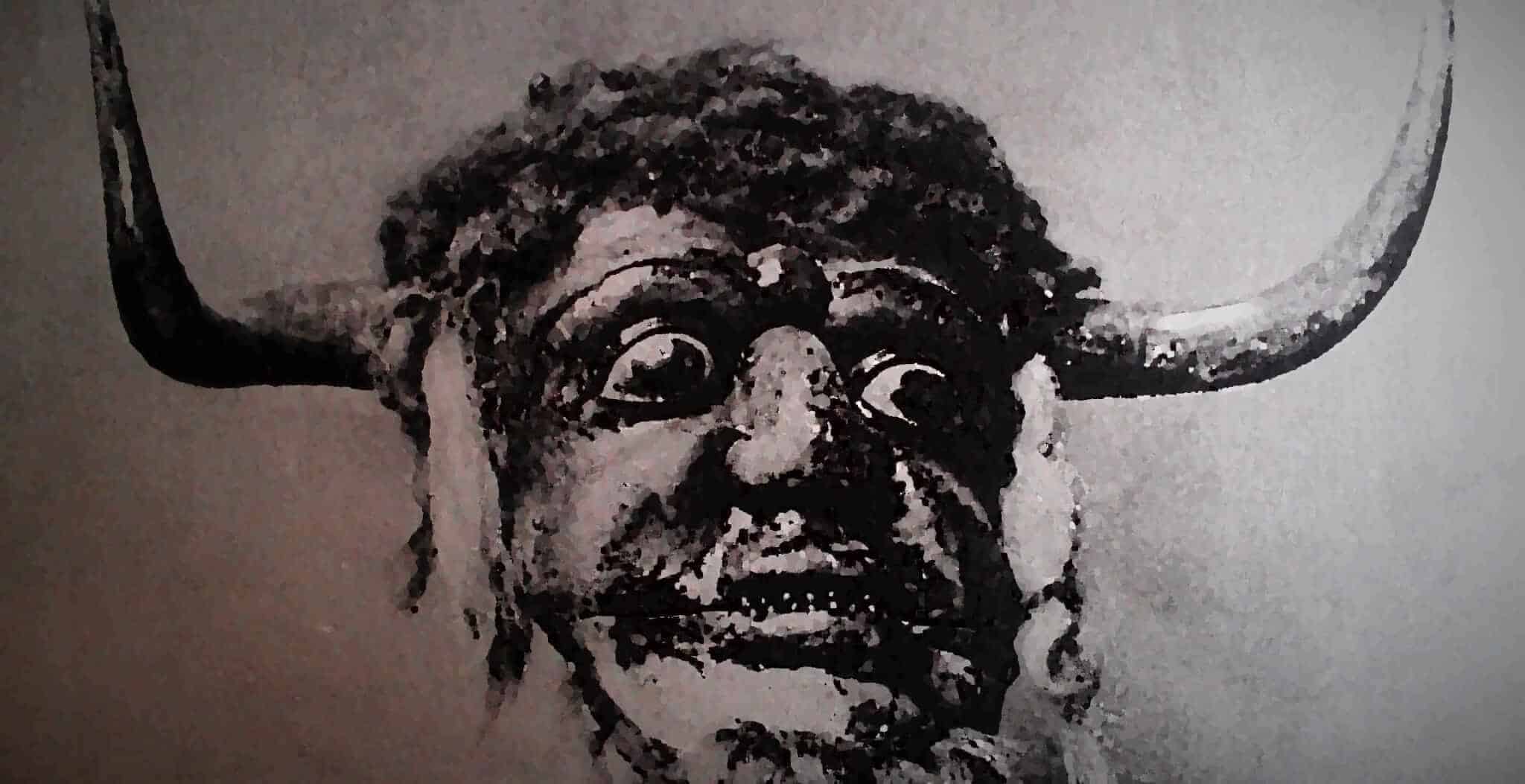
The Dorset Ooser is a demonic wooden head which was part of the folk culture of the Dorset village of Melbury Osmond, in southwestern England, the fabled ‘Wessex’ of Thomas Hardy*. The head was hollow, possibly used as a mask, with a hinged jaw which creepily enabled the mouth to open and close. Sometimes used to scare people for practical jokes, the Ooser was part of local charivari custom "skimity riding" aka "rough music", where immoral behaviour was punished.
*Thomas Hardy's mother lived in Melbury Osmond as a child; the village appears as "Little Hintock" in his novel The Woodlanders. The Return of the Native and The Mayor of Casterbridge contain brief references to the Dorset Ooser.
First brought to public attention in 1891, the head was owned by the Cave family of Melbury but Ooser went missing in 1897 when taken on a tour of Somerset. Folklorists and historians have debated the origins of the head; some believed that it was a representation of Satan designed to terrify people into obeying the local community's moral codes. Others suggested that it represented a pre-Christian god of fertility whose worship survived in Dorset into the Victorian era - or even later.
In 1975 a replica of the original Ooser was made, which has since been on display at the Dorset Museum in Dorchester. This mask is used in local Morris dancing processions and inspired copies used as representations of the Horned God in the modern Pagan religion of Wicca, both in the UK and United States.
It’s still unknown if the head was actually the Ooser, or whether it instead was designed as a mere depiction of an entity called the Ooser; folklore historian H. S. L. Dewar (1892-1976) connected it to the term Wurse, used for the Devil in Layamon's Brut (The Chronicle of Britain), or the 17th-century Italian term Oser, again meaning Devil.

Local tales say that the ‘real’ Ooser lies sleeping beneath the Hell Stone in Dorset’s Portesham parish, only woken by the clattering of hailstones. He then proceeds to stalk the locality looking for anyone mug enough to be out and about in the hailstorm. Interestingly, bearing in mind Mari Lwyd, the remains of another tomb, The Grey Mare and her Colts, is 1+1⁄4 miles (2 km) to the west of the Hell Stone.
It has also been suggested that Ooser or Osser is possibly derived from Wooset, a term used in the dialect around Wiltshire to refer to a pole upon which a horse's skull with deer's horns was affixed; recorded as having been paraded by unruly youths in the Marlborough district until the 1830s, where it was used to mock neighbors whose partners were suspected of marital infidelity, the horns being a traditional sign of cuckoldry.
The Ooser at Christmas
“In my childhood [the Ooser] was doing service – at Christmas mummings*, surely it was. Our Cerne Abbas nurse was quite up in all relating to the "Wurser", as I should spell it phonetically. I did not know of the horns, indeed in our embryo Latinity we thought the word an attempt at Ursa, if I remember rightly. What crowds of odd bits I could note if, alas, I did but "remember rightly" all nurse's folk-lore and folk-speeches." —H. J. Moule, Dorchester, 1892
*Mummings - traditional form of folk performance, particularly associated with the British Isles, involving groups of amateur actors known as mummers or ‘guisers’
In some Dorset villages such as Shillingstone, the Ooser mask (or a close relative) had become the ‘Christmas Bull’, a terrifying creature that roamed through the streets at the end of each year demanding food and drink from the locals.
In 2005, a Guardian journalist reported a dawn ceremony on May Day atop Giant Hill near Cerne Abbas, involving one member carrying the Dorset Ooser replica atop his head, with other Morris men dancing around him. After the frolics they proceeded, still dancing, to a local hostelry the Red Lion. Next Summer, the Wessex Morris Men took the replica to Melbury Osmond for the first time in over a century where they performed a dance for amused locals.
Daniel Patrick Quinn’s The Dorset Ooser (reproduced on www.wessexmorrismen.co.uk by permission of the author, September 2013):
https://www.wessexmorrismen.co.uk/docs/TheDorsetOoser.pdf
Crom Dubh na Nollaig – the Dark Crooked One of Christmas
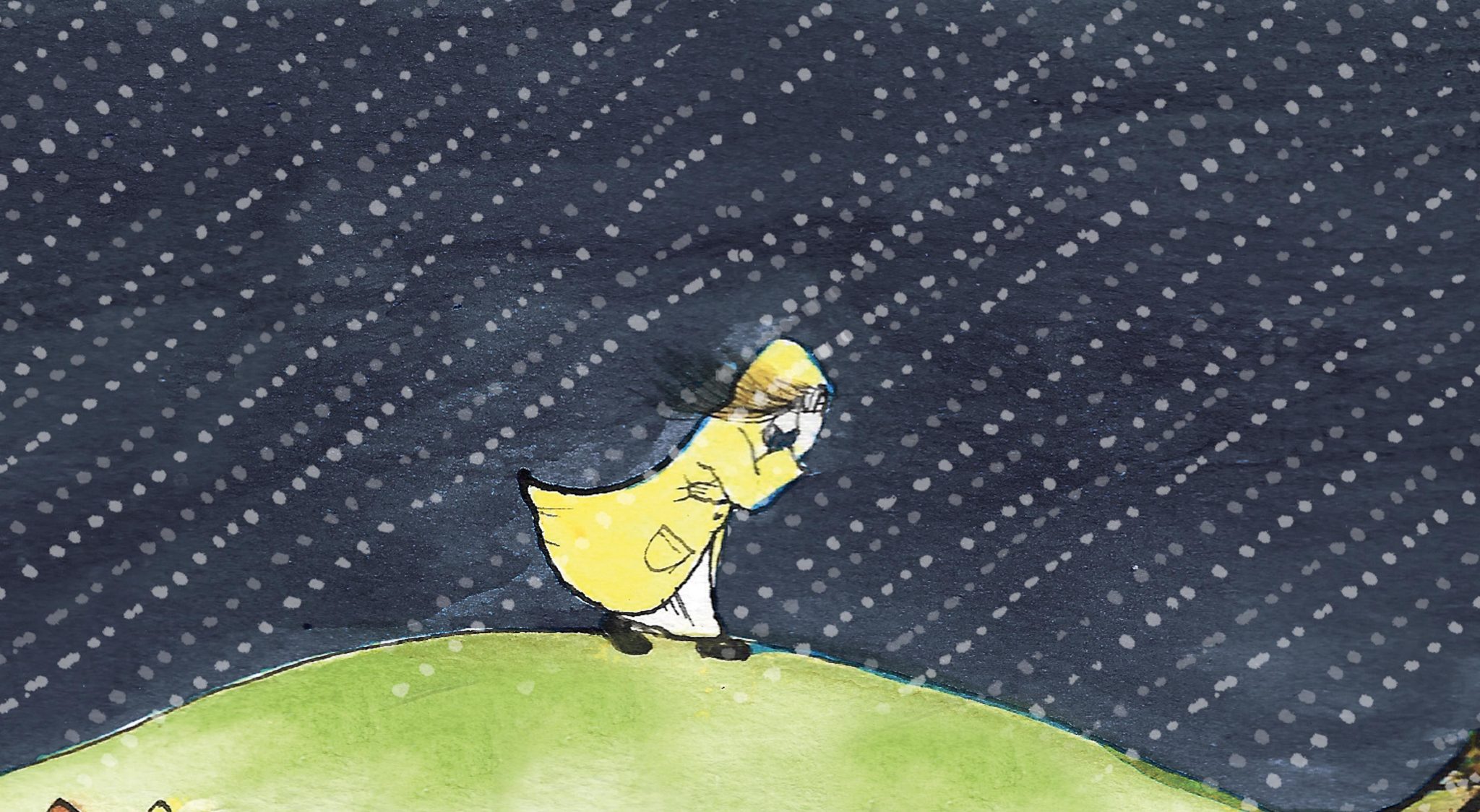
The coming of Crom Dubh na Nollaig or The Dark Crooked One of Christmas is heralded by the sound of wind howling in the chimney. This is to terrorize naughty children, in a legend not too dissimilar to Krampus.

On the Inner Hebridean Isle of Islay, Crom Dubh na Nollaig was once a notable element of the holiday season. Back in a 1969 interview, islander Peggy Earl said as a child she was was threatened with a terrifying Yuletide visit from The Dark Crooked One if she ever misbehaved or cheeked her parents.
Nice.
Crom Dubh derives from the Irish pagan god Crom Cruaich, who was associated with fertility and linked to the practice of human sacrifice.
The Dark Crooked One of Christmas is usually depicted as a goat-like entity boasting huge horns, razor-sharp fangs, with glowing demonic eyes; also akin to Krampus, he would whip wicked children frenziedly with birch branches, yowling with laughter as he laid into the weeping youngsters.
Further reading:









Stephen Arnell’s novel THE GREAT ONE is available on Amazon Kindle:
https://www.amazon.co.uk/Great-One-Secret-Memoirs-Pompey-ebook/dp/B0BNLTB2G7
Sample:


.jpg)

No comments:
Post a Comment