
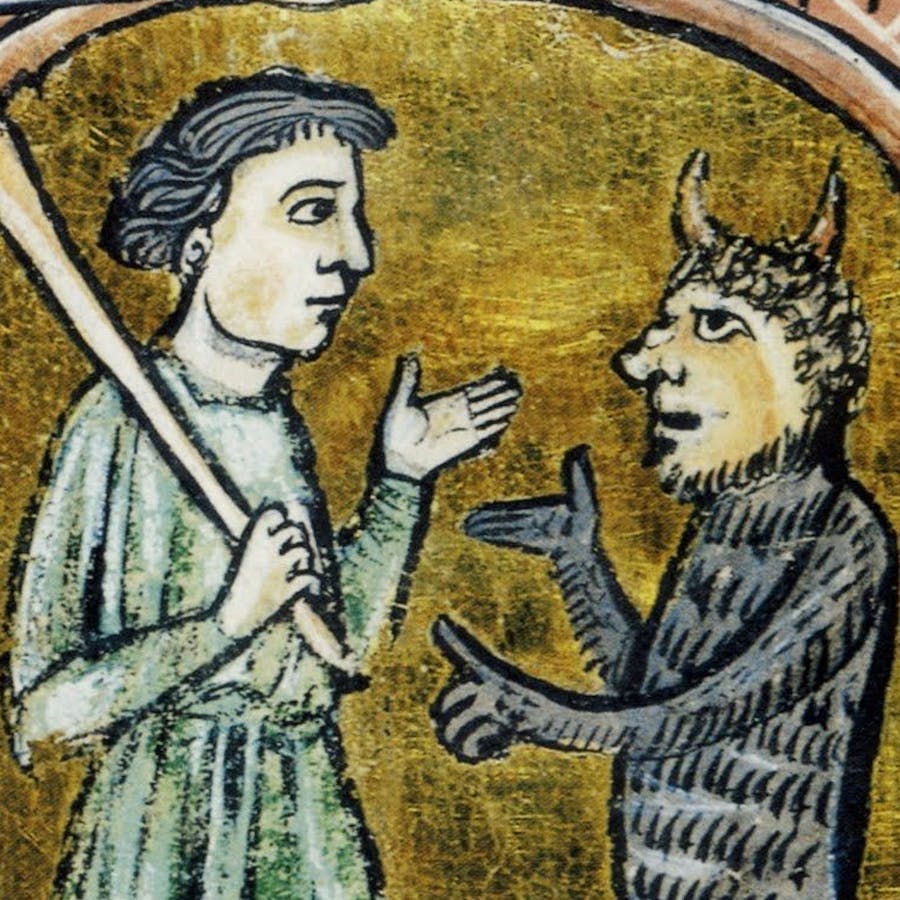
Jack o' Kent or Jack-a-Kent is a folkloric character from the Welsh Marches bordering England and Wales, either a cleric or wizard, but primarily a trickster known for regularly beating the Devil in various challenges and wagers.

Jack’s tales are used to tell the origin of many of the geological formations around the region, ascribing them to his contests with The Horned One. Jack is said to have bet the Devil that Monmouthshire’s Sugar Loaf Mountain (Wales) was higher than the Malvern Hills of Worcestershire, Herefordshire and northern Gloucestershire in England.

When Jack proved the Devil wrong, Old Nick tried to put more earth on top of the Malvern Hills, but his wheelbarrow broke and dropped it, forming a lump. The cleft in the western part of Skirrid in the Black Mountains is said to have been caused by a presumably giant-sized Jack's bootee as he jumped onto it from the Sugar Loaf Mountain.

Trelleck’s Standing Stones are said to have been thrown there by Jack, resulting from a stone-flinging competition held on Trelleck Beacon between him and his adversary.

He first appears in print in the play ‘John a Kent and John a Cumber’, by playwright/spy Anthony Munday, from around 1590, with Jack as an aged hermit with supernatural powers. Real-life figures on whom o’ Kent could be based on include John Kent, a Robin Hood-like figure of the Late Middle Ages who roamed the Welsh Marches, Dr. John Gwent, a Welsh Franciscan and worker of miracles who died in 1348, Dr John Kent Caerleon, an astronomer, who wrote a treatise on witchcraft in the thirteenth century and Father John of Kentchurch, a Franciscan friar, bard, and Oxford Professor who lived and died in the fifteenth century.
As Jack o' Kent appears in a sixteenth-century play, it could be taken that he was well known in local culture before this time, used as bogeyman figure until the early twentieth century, or even later. There is also speculation that Jack could be Welsh language poet Siôn Cent (c. 1400–1430/45 or or 1367–1430) or Welsh freedom-fighter Owain Glyndŵr, (1359–c. 1416), who was supposed to have an affinity with the supernatural, hence, his boastful claim, “I can call spirits from the vasty deep” in Shakespeare’s Henry IV, Part One.
However it is more likely that Jack was a syncretic amalgam of a number of people and myths from the Welsh Borders.
Sidebar The Swansea Devil: a true story

The Swansea Devil, also called Old Nick, is a wood carving of the Devil in Swansea, Wales. It was carved by an architect whose design for St. Mary's Church in the 1890s was nixed by a committee. Some time later, when designing an office building across the road, the rejected architect placed a carving of Satan facing the church and prophesied "When your church is destroyed and burnt to the ground my devil will remain laughing". This prophecy came true when the church was bombed during WWII.

Back to Jack
The myths surrounding John o’ Kent tend to revolve around his outwitting the devil. This power perversely stemming from him having sold his soul to the devil as a young boy to gain supernatural power or to have the ability to use Satan as his servant for a fixed period of time, Faust-style.
Jack used his power on occasion for public good; the best-known one associated with a bridge over the River Monnow between Kentchurch and Grosmont. With the Devil’s help, Jack built a bridge in a single night, on the promise that the Evil One could have the soul of the first to cross. With the bridge complete, the devil impatiently wanted his reward for keeping his side of the bargain before daylight approached, wanting Jack to be the first to cross his new bridge. Not a total halfwit, Jack spotted a poor old starving dog nearby and threw a the bone across the bridge and the hapless mutt chased after it. As the cock crowed, Satan was forced to take the soul of the harmless creature as his reward.

On one occasion, when passing a field when seeds were sown with his evil companion, Jack offered the Devil a choice at harvest-time, of having half the crop and offered the top or the bottom. Satan, thinking it would be wheat, barley, oats, rye, peas, beans or some such, opted for the top. When the harvest came, he discovered it was a field of turnips. Jack made the same offer again and the Devil chose the bottom half, only to discover at harvest-time that the crop was wheat. Silly Devil and rather petty Jack, methinks.
Jack o’ Kent was said to have stabled great horses with magical powers of flight in Herefordshire’s Kentchurch Court. One day he set off at dawn with a steaming mince pie to take to the King for breakfast in London for some reason; he reached the city with the pie still hot – though he had shamefully lost his garter on the way, caught on the weathervane of a London church as his mighty steed leapt over it.

On another occasion, Jack was employed by a farmer as a crow-scarer. Deciding he wanted to go to the fair that had just arrived in the local Welsh town, he summoned the crows and put them into an old roofless barn, where they stayed. At the fair, he bumped into the farmer who furiously hauled Jack back to the farm. But when Jack led him to the barn: all the crows were quietly gathered, despite the want of roof.
And you’ll probably guess how this one goes: Jack and the Devil agree to split a drift of pigs. Satan agrees to take all the ones with straight tails, but o’ Kent feeds them all with beans and drives them though a stream, apparently resulting in the requisite kinks. Nice one Jack.
By this point, one might be feeling a trifle sorry for Old Nick, so one may sympathize with his plan to get his own back on the Welsh trickster.
The Devil informs Jack that he will have his soul whether or not he is buried inside or outside a church, and will personally carry him off, body and soul, to Hell for a smorgasbord of legendary torments.
Crafty Jack’s answer was to be buried inside the thickness of the wall at Grosmont Church (or was it Kentchurch Church?), so neither inside nor outside the church, but in a liminal space between.
According to local folklore, there’s some proof that Jack escaped the fiery depths: in Kentchurch Court on stormy nights, a ghostly figure walks out of the wall and plays tricks, which could be a form of eternal damnation, if you ask me.

It’s also recounted the spikes on the top of the walls of Grosmont Church are where Jack’s innards and eyes were placed after his death. Akin to Prometheus, a crow and a dove return each evening at midnight to spar over his spiritual remains. If one wins, the old rogue’s final fate will be at last be decided…
In St Nicholas’ churchyard, there once was a medieval preaching cross which had crudely carved depictions of Christ crucified and Mary the Virgin with baby Jesus. It was locally called Jack o’ Kent’s Cross.
Cross Ash School, Churches And Castles — Within the Grosmont Skenfrith and White Castle Trilateral, (1985) tell us about a local giant, saying that: “Under the wall of the South Transept, according to legend, lies the body of the giant, Jack of Kent, buried half inside the church and half outside the church, where his tombstone can still be seen.”
Jack Of Kent by Huw and Tony Williams
Jack o' Kent by Albion
Beat the Devil (1953)
Incidentally, a recent PDB investigation of mine into another Jack - Hertfordshire’s ‘Jack O’Legs’:
LINKS:

Stephen Arnell’s historical novel THE GREAT ONE is available on Amazon Kindle:
His next book THE FORTUNATE ONE, on the life of Roman Dictator Sulla, will be published later this year.
Sulla as portrayed by Richard Harris, with Chris Noth as Pompey (the subject of THE GREAT ONE)


No comments:
Post a Comment