The Salt Tower is part of the Tower of London, typically used as a prison for both noble personages (the comfortable upper levels) and the lower runs of society (the dungeons). Many carved images and religious tracts into the walls protesting their innocence or indulging in more esoteric practices. One such captive was one Hew Draper, a 16th-century Bristol innkeeper (’vintner’) who got sent to the Tower in 1560 for attempted sorcery. Specifically: cursing Lady Elizabeth St. Loe, better known as ‘Bess of Hardwick’ and husband William St. Loe; Bess being one of the most powerful and wealthy figures of Elizabethan England. The couple held sizeable estates at Tormarton near Bristol, disputes over which may have been the reason for the Draper’s alleged malediction.
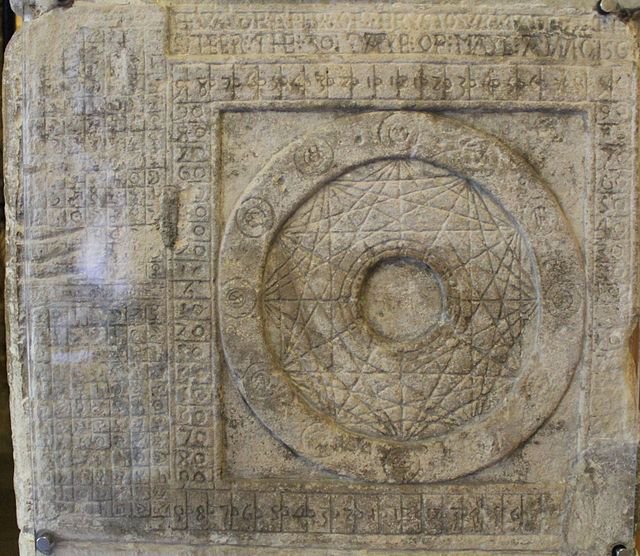
Richard Nevell, CC BY-SA 3.0 , via Wikimedia CommonsHew claimed he had once been interested in magic, but had since rid himself of his spell books (burned), but his engravings point to an educated man with a deep knowledge of the mystic arts.
On one wall, he carved a detailed astrological sphere with Zodiacal signs, demonstrating Draper's deep belief in the power of the stars, on which he wrote: "Hew Draper of Brystow made this spheere the 30 day of Maye anno 1561."
Close by Draper’s Zodiac is an even more adeptly crafted craving that of a bronze astrological globe. These are probably the most proficient of the 300 surviving examples of prisoners’ graffiti at The Tower of London. Certain scholars believe the position of the inscriptions - both of which were made very low to the ground in his cell - suggest he was seriously ill when he made them.
Others, suspect he drew the inscriptions there simply to hide them from the Tower Guard’s cursory probes.
Draper was no scholar, priest, or a gentleman, but a freethinking, educated everyman from Tudor Bristol who attempted to achieve a measure of earthly power through arcane means, in the manner of Queen Elizabeth I’s Welsh-descended court astronomer Doctor John Dee, also a famed occultist, and alchemist.
But what happened to Draper?
There is no record of his death in the detailed annals of the Towers; nor any mention of an escape; Draper simply disappears from the archives. Perhaps, like the Marvel comic character Doctor Strange, Hew somehow either fashioned or acquired a kind of interdimensional ‘Sling Ring’ and magicked himself from the confines of the dreaded Salt Tower?
Whatever became of Hew Draper, his supposed enemy Bess of Hardwick continued to thrive, so maybe he didn’t hold a grudge. Or, she, recognising Draper’s sorcerous skills, helped free him, then used the mage as a confederate in her schemes, aping the relationship between Elizabeth and Dee?
Bess went on to live to 87, a VERY great age, even today. Almost supernaturally so, some might say.
TOWER OF LONDON - SALT TOWER
DRAPER’S GLOBE
Doctor John Dee - Court Astronomer
Briefly, Dee was the court astronomer for, and advisor to Elizabeth I, and as an antiquarian, he had one of the largest libraries in England at the time. Dee left Elizabeth's service to seek deeper, dark knowledge in the realms of the occult and supernatural. He enjoyed (if that’s the right word) many adventures on the continent, acquiring the reputation as both a sorcerer and spy of his ‘former’ employer. Upon his return to England and the Queen’s official service, he found his home ransacked library stolen and ‘scientific’ instruments missing.
After the Queen’s death in 1603, Dee was shunned; he died in poverty aged 81 in 1608/09, his grave unknown. In 2013 a memorial plaque to Dee was placed on the south wall of the present church of St Mary’s in Mortlake, where he resided in later years.

Henry Gillard Glindoni, CC BY 4.0 , via Wikimedia CommonsQueen Elizabeth with Dr John Dee
Dee’s astrological chart - in his own hand

National Library of Wales, CC0, via Wikimedia CommonsAnd turning to ‘fiction’, the virtually contemporary figure of Doctor Faustus...
Faust, the protagonist of a Teutonic legend, was supposedly based on the real-life magician/physician/Doctor of Philosophy/sodomite/alchemist/astrologer and trickster, Johann Georg Faust (c. 1480–1540). Grimoires or magical texts later attributed to Faust are artificially dated to his lifetime, either to "1540", or to "1501", "1510", etc., some even to unreasonably early dates, such as "1405" and "1469".
An educated but deeply dissatisfied man, the fictional Faust makes pact with Satan, exchanging his soul for unlimited knowledge and all the pleasures the world can offer.
The Faust timeline:
Faust - Marlowe
Faust - Goethe
And this from Doctor Who - The Masque of Mandragora (S14, 1976); in Renaissance Italy, astrologer Hieronymous (Norman Jones) seeks to summon the power of an intelligence called the Mandragora Helix to rule the Earth.
My own explorations in the area:

Stephen Arnell’s novel THE GREAT ONE is available on Amazon Kindle. His second book, THE FORTUNATE ONE will be published sometime later this year.
https://www.amazon.co.uk/Great-One-Secret-Memoirs-Pompey-ebook/dp/B0BNLTB2G7
References & Further Reading
https://www.englishmonarchs.co.uk/tower_london_16.html https://spitalfieldslife.com/2024/07/14/graffiti-at-the-tower-of-london-i/ https://www.rct.uk/collection/2102215/carving-by-hew-draper-on-the-wall-of-his-cell-in-the-salt-tower
https://www.enotes.com/topics/renaissance-natural-philosophy/criticism/astrology/keith-thomas http://www.tudorplace.com.ar/Documents/magic_witchcraft.htm https://www.enotes.com/topics/renaissance-natural-philosophy/criticism/astrology/keith-thomas https://daily.jstor.org/treating-wounds-with-magic/


No comments:
Post a Comment