Halifax is no stranger to tragedy, a tragedy steeped in blood and suffering. In 1758 a bill was passed to create an asylum strictly for the poor, a convention that had origins in Victorian England. The first poor house, also known as the Poor Asylum, was built on Spring Garden Road across from the courthouse and completed near Christmas in 1759. The property is now known as Grafton Park. There were several smallpox outbreaks in the poor houses, the worst of them occuring in 1827 due to immigration and overpopulation in Halifax.
A new poor house was constructed on the corner of Robie and South streets in 1867, where IWK Health now sits. Builder Henry Peters hired an architect David Sterling whose building plans were in the form of a “Latin cross, with four wings descending from a central building, which measured 180 feet long, 50 feet wide, and four stories high.” The completed main brick building stood five stories high, with a French style roof and soon housed the elderly, orphans, mental patients, sailors, medical patients and inebriates.
The Old Burying Ground was adjacent to the poor house on Spring Garden Road. It was believed to house the remains of 800 people. People who lived in the poor house were not allowed at St. Paul’s Cemetery. Today, Grafton Street Park and the Halifax Memorial Library have erased the history and sight of the poor house and burying grounds.
Halifax poor house corruption, bleak conditions & fire tragedy
The poor house was very underfunded and led by corrupt managers. The conditions in the poor house were terrible and patients suffered whipping and stocks. One patient was found chained and wearing a dog collar that pierced his throat and neck if he moved. The people who lived in the poor house were expected to work hard and contribute. They helped to stoke the furnace, and worked in the kitchen, the hospital, the garden or cared for the livestock.
The building was destroyed by a fire on November 6, 1882 in the wee hours of the night. The fire was believed to have begun in the laundry room in the northeast section. Some claim it started in the kitchen. It claimed the lives of the most defenseless people - the elderly, the infirm and mentally ill who were asleep in their beds when the fire began. They were so unwell they may not have been able to comprehend what was happening. The patients had nowhere else to go.

See page for author, Public domain, via Wikimedia CommonsThe Halifax Fire Department arrived quickly, but the fire raged out of control. The building’s layout confused the firemen and panic spread amongst the patients. 31 people died in the fire. Most of them were residents of the poor house that were not able to be rescued in time. The tragedy gained significant public attention about the inhumane conditions of the asylum.
The firemen helped many inmates escape the fire. They rushed up to the upper sections of the building and carried the inmates who were sleeping or were unaware of the fire at the time. Two clergymen were rescued. One man was exhausted from smoke inhalation and the other had almost suffocated. A woman stood at the window on the fifth floor, her arms resting on the ledge with her hands clasped. Sadly, she fell backwards into the devouring flames. Her screams rang out mingled with the screams of the other patients who were not able to be rescued. Nothing could be done for them.
Prior to the tragic fire, a total of three hundred twenty inmates lived in the poor house. 42 of those patients were in the hospital. The inmates that were fortunate enough to have escaped sought shelter in outhouses and stables. The main building was engulfed in flames. Most of the building could not be saved. The hoses used to extinguish the fires were destroyed. During that time, a man was spotted on the uppermost story of the western wing. Smoke billowed out the window the man was looking through. Behind him, the flames raged. The brave firemen were determined to rescue him. The firemen raised ladders. The man eagerly climbed down the ladders and reached the ground. He was Mister James White, of the number one division, (Salamander) U.E.C. The rescue was just in the nick of time. After his escape, the window was in flames. The adjoining buildings were saved.
Another building was constructed in the same place by 1886. The asylum was renamed City Home in 1907 and remained as a hospital for mentally unwell patients until its eventual closure. In 1972, City Home was torn down and Abbey Lane was built.
Halifax Poor House fire inquiry
There has not been such a fire in Halifax since that tragic time. The amount of casualties is the highest ever recorded in Halifax’s history. After the tragic fire, an inquiry was held to investigate the conditions of the poor house. The conditions revealed overcrowding, insufficient fire safety, and outdated wood construction. The conditions for the patients were indeed inhumane. A hundred people died annually at the poor house.
Fire breeds change. Changes were in store for the patients who endured harsh conditions in poor houses in Halifax. The fire marked a turning point in the conditions the patients suffered. Reforms were set in how the province cared for the mentally unwell. New institutions were built that were meant to improve safety and guarantee more humane living conditions. The fire is remembered not just for the tragic loss of life, but also that broad social changes were made for public health, welfare and reform in Nova Scotia.
In 1913 construction workers unearthed human remains and bones. There was very little speculation about how that happened. 20,000 bodies are buried in what is now a parking lot for St. Mary’s Basilica and the surrounding areas. One of those areas was the corner of Grafton Street and Spring Garden Road, near the courthouse. The Old Burying Ground was connected to St. Peter’s, the first Roman Catholic Church in Halifax. It no longer stands and has since been replaced by St. Mary’s Basilica.
Halifax Poor House gives the old court house a grim reputation
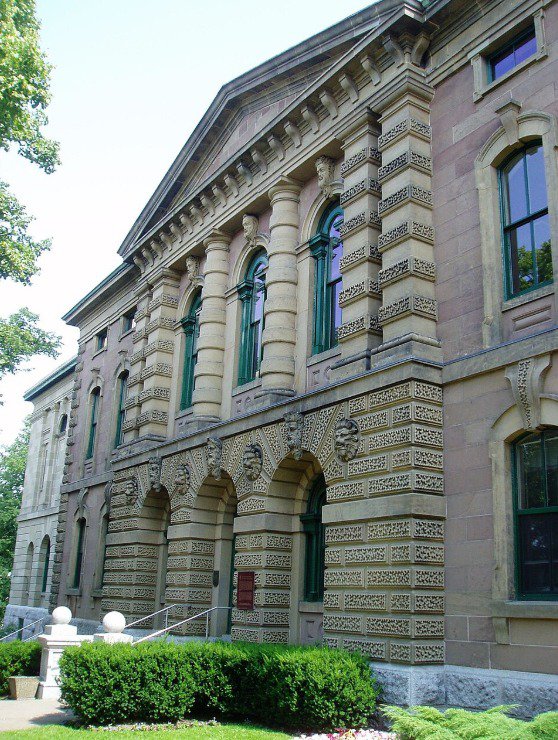
SimonP at the English-language Wikipedia, CC BY-SA 3.0, via Wikimedia CommonsThe old Halifax Courthouse is a prominent Classical Revival building constructed between 1859-1863, designed by William Thomas and Sons. The building features a classical stone facade made with durable sandstone from Wallace, Cumberland County. Its style features an imposing facade, classical pediment and Tuscan columns.
Set back far from the sidewalk and grass, the building was expanded on over time. Between the years 1881-1882, a rear addition was built for county courts. In 1908 a west wing was added and in 1930 an east wing was added. In 1969 it was designated as a national historic site and served until 1971 as a provincial courthouse until a new waterfront law courthouse was opened downtown. From then on, it briefly served as a provincial law courthouse, and was restored in 1985.
The dark history of the poor house gives the old Halifax courthouse a grim, unsettling reputation. A grassy park now disguises the poor house that interred those who were mentally unwell and impoverished.
A long forgotten necropolis
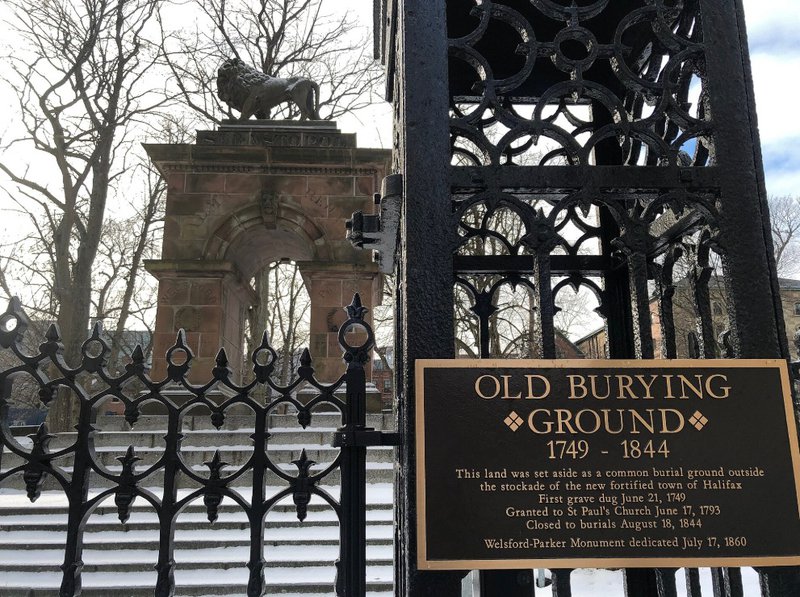
The Old Burying Ground, the church, the church parking lot and the other nearby buildings are a long forgotten necropolis. The parking lot of St. Mary’s Basilica contains 3,000 bodies. The Old Burying Ground (also known as St. Paul's Church Cemetery) was established in 1749 opposite the courthouse and closed in 1844. The remains of 12,000 people were buried there. The Old Burying Ground contained the most preserved mortuary art, an odd fact considering there were very few headstones for the many graves. It was designated a national historic site in 1991.
In 1958 a petition was made to pave over the cemetery to make it a park for local businesses. The public outcry defeated the petition. The other cemeteries in Halifax were not so fortunate. A cemetery existed near the Old Burying Ground for the Jewish community since the 1750s, but no longer exists.
Paulo O from Halifax, Canada, CC BY 2.0, via Wikimedia CommonsAcross the street from the Old Burying Ground, the church and the courthouse, stands the old Halifax Memorial Library. A committee met in 1945 to decide on building a war memorial in Halifax. It was agreed that the war memorial would be in the form of a library. Over the years, the library amassed a number of items such as flags, memorials, plaques, a Silver Cross replica, a Book of Remembrance, and murals. There are two Books of Remembrance: the first one contains the names of people who died in WWI, and the second contains the names of people who died in WWII and the Korean War, donated in 1955 from Silver Cross Canada.
A cornerstone stands near the library and bears the inscription, “This building was erected in memory of those who gave their lives in defence of their country 1914-1918 1939-1945. For their faith – for their courage – for their sacrifice, we will remember them.” Grafton Street park rests in front of the main entrance of the library and features a statue of Winston Churchill which was unveiled in 1980. Where today people enjoy tea or a snack on colorful benches and savor the fresh air, was once a burial ground for the inmates of the poor house. Park visitors heading either uptown or downtown, may be unaware they are walking over unmarked graves. This small cemetery was in operation for a hundred years from 1761. 4,500 people were interred there. When the Halifax Memorial library was being built, countless human remains were discovered. The inmates were as unfortunate in death as they were in life.
The Presbyterian Church of St. David stands near the library and overlooks Pizza Corner. Between the years of 1793 and 1844, the church was the burying place for Halifax’s Methodists. The interred bodies were forced to make way for more construction. A wooden church was erected where the bodies were buried. The church burned down and was replaced with a brick and stone building that still stands today.
In 2016 and 2017 more construction forced the 244 dead who were buried there to be buried again in a new spot. The Old Burying Ground is the only cemetery that has national historic site status. The other nearby cemeteries have been destroyed and paved over.
Halifax Memorial Library Hauntings
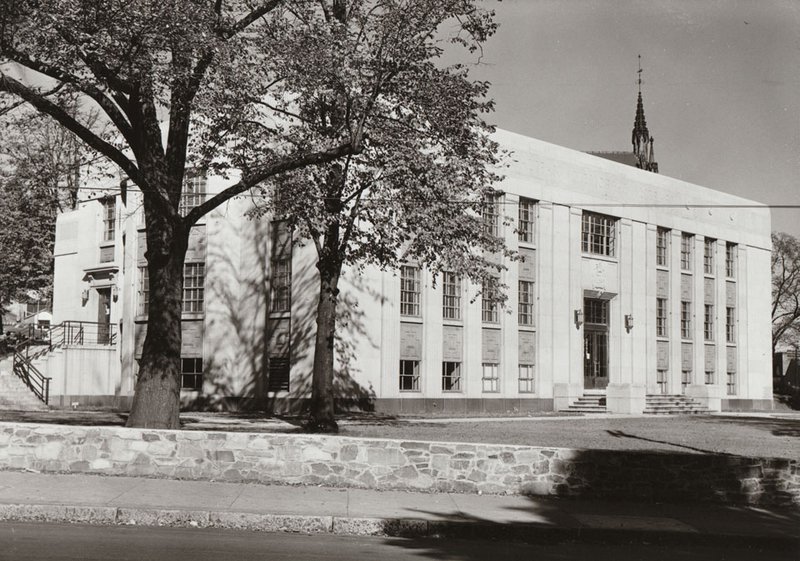
Nova Scotia Information Service, Public domain, via Wikimedia CommonsThe Halifax Memorial library closed in 2014 and was recently designated a historic site. That is good news for the ghosts who reside in the library, and the bodies buried underneath and near the library in the park. One afternoon, I was using a computer in the library and felt a hand on my shoulder. When I turned to see who it was, no one was there. I hurried to another section of the library.
Today, Halifax Central library stands on another chapter of Halifax’s history, the Bellevue House, built in 1801 for the Duke of Kent when he was the Commander of the Army in Nova Scotia. It was a popular spot for the military and was the social hub for 100 years. Parties were a weekly occurrence with hundreds of guests attending, up to as much as 600 people. One of those socialites was Adele Hugo, daughter of Victor Hugo. Another was Charles Austen, the brother of Jane Austen. Bellevue House was torn down and became a parking lot. That changed again in 2011 when an archaelogical excavation began in preparation for the construction of Halifax Central Library. The excavation unearthed dozens of artifacts from 1800 to 1850.
1850 was a booming time for Halifax. Some of the objects that were found included wine glasses, a pearlware platter, children’s mugs, even cobble remains of the horse stables along Spring Garden Road, a large water cistern and a rock drain system. A privy was also found which contained other objects dating back to 1850 such as a pearlware chamber pot. Those items lay buried until the excavation occured.
The Halifax necropolis of the poor house dead are long forgotten, their unmarked graves paved over for a park or condominium. It is a sad reality in the modern world, but not as sad as the fates of those who suffered and perished.
REFERENCES:
Nova Scotia Archives: https://archives.novascotia.ca/halifax/archives/?ID=45
Neglect, corruption, and the history behind Halifax’s deadliest fire: https://www.cbc.ca/news/canada/nova-scotia/deadly-halifax-fire-poor-house-30-killed-1.3918547

Thousands of people are buried under downtown Halifax: https://www.cbc.ca/news/canada/nova-scotia/jonathan-fowler-halifax-burial-ground-cemetery-archeology-1.5471209
1882 The Poor Asylum Fire: https://www.hfxfirehistory.ca/fires/the-poor-asylum-fire


No comments:
Post a Comment