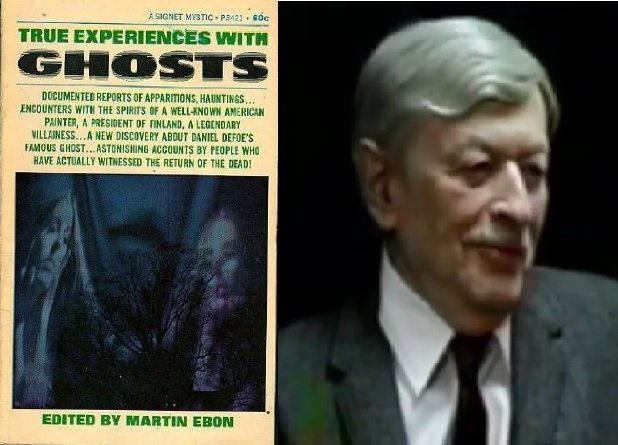
Popular folklore, films, and TV shows have a tendency to depict an encounter with an apparition (or “ghost”) of the dead as being an overly scary or terrifying experience. But a lot of true-life encounters seem to actually give a different impression. As the late parapsychologist Martin Ebon once observed in his edited book True Experiences with Ghosts:
“Fictional accounts notwithstanding, the usual encounter with a ghost is no more frightening than an unexpected meeting with a living stranger. Afterward, when the full impact of the otherworldly event is understood, memory of the encounter can be quite a shock.” [1, p. 10]
One of the more intriguing aspects of a ghostly encounter - which can potentially leave a lasting impression on the witness - is when the ghost seems to convey some sort of detail or a piece of information that the witness was personally unaware of at the time, but which is later independently verified by someone else as being accurate. A classic example of an apparitional encounter that illustrates this is the following case from 1876, which is recounted in the fourth chapter of Ebon’s book.
“The Scratched Cheek” Revisited
Originally included in a survey of cases conducted by early psychical researcher Frederic Myers [2], this century-and-a-half old case from the archives of the Society for Psychical Research focuses on a young traveling salesman from Boston, whose spontaneous encounter with the spectral figure of his deceased sister had, in his words, “...made a more powerful impression on my mind than the combined incidents of my whole life” [2, p. 17]. The salesman’s sister had passed away nine years earlier from a cholera infection, and he’d previously shared a very close bond with her while she was alive.
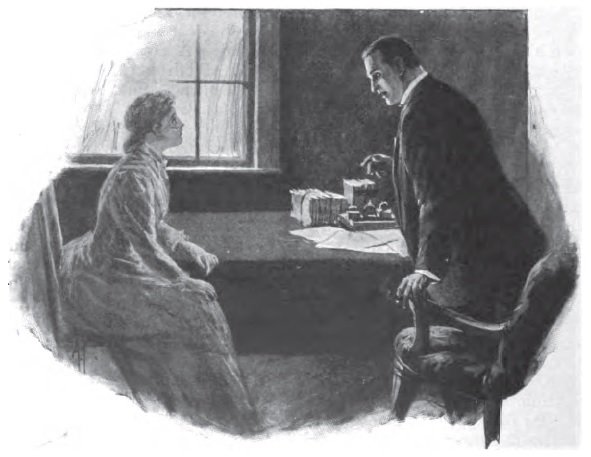
At the time of the encounter, the young salesman was away on a business trip, and casually working at a table in his hotel room in St. Joseph, Missouri. As he stated in his personal account of the experience:
“I had not been thinking of my late sister, or in any manner reflecting on the past. The hour was high noon, and the sun was shining cheerfully into my room. While busily smoking a cigar, and writing out my orders, I suddenly became conscious that some one was sitting on my left, with one arm resting on the table. Quick as a flash I turned and distinctly saw the form of my dead sister, and for a brief second or so looked her squarely in the face; and so sure was I that it was she, that I sprang forward in delight, calling her by name, and as I did so, the apparition instantly vanished. Naturally I was startled and dumbfounded, almost doubting my senses; but [being aware of] the cigar in my mouth, and pen in hand, with the ink still moist on my letter, I satisfied myself [that] I had not been dreaming, and was wide awake. I was near enough to touch her, had it been a physical possibility, and noted her features, expression, and details of dress [etc.] She appeared as if alive. Her eyes looked kindly and perfectly natural into mine. Her skin was so life-like that I could see the glow or moisture on its surface, and, on the whole, there was no change in her appearance, otherwise than when alive.” [2, p. 18]
The salesman later added:
“There was nothing of a spiritual or ghostly nature in either the form or dress of my sister, she [appeared] perfectly natural, and dressed in clothing that she usually wore in life, and which was familiar to me. From her position at the table, I could only see her from the waist up, and her appearance and everything she wore is indelibly photographed in my mind. I even had time to notice the collar and little breastpin she wore, as well as the comb in her hair, after the style then worn by young ladies. The dress had no particular association for me...no more so than others she was in the habit of wearing; but [today], while I have forgotten all her other dresses, pins, and combs, I could go to her trunk (which we have just as she left it) and pick out the very dress and ornaments she wore when she appeared to me, so well do I remember it.” [2, pp. 18 - 19]
Perhaps the most remarkable part of the experience came when the young man returned home and told his family about what he’d seen. As he recalled:
“My father, a man of rare good sense and very practical, was inclined to ridicule me, as he saw how earnestly I believed what I stated; but he too, was amazed when later on I told them of a bright red line or scratch on the right-hand side of my sister’s face, which I distinctly had seen. When I mentioned this, my mother rose trembling to her feet and nearly fainted away, and as soon as she sufficiently recovered...with tears streaming down her face, she exclaimed that I had indeed seen my sister, as no living mortal but herself was aware of that scratch, which she had accidentally made while doing some little act of kindness after my sister’s death. She said she well remembered how pained she was to think she should have, unintentionally, marred the features of her dead daughter, and that unknown to all, how she had carefully obliterated all traces of the slight scratch with the aid of powder...and that she had never mentioned it to a human being, from that day to this. In proof, neither my father nor any of our family had detected it, and positively were unaware of the incident, yet I saw the scratch as bright as if just made.” [2, p. 18]
So it would seem that the salesman witnessed a particular detail appearing upon his sister’s spectral figure that he himself was unaware of, but which he later learned (through his mother) was an accurate reflection of something that occurred in relation to her (or in this case, in relation to her dead body, as the mother was preparing it for funerary rites).
Some Notable Characteristics
The salesman’s experience also contains four notable characteristics that have been found across a number of other spontaneous apparition cases, and some of these tend to further contradict certain popular stereotypes about apparitions. It seems that:
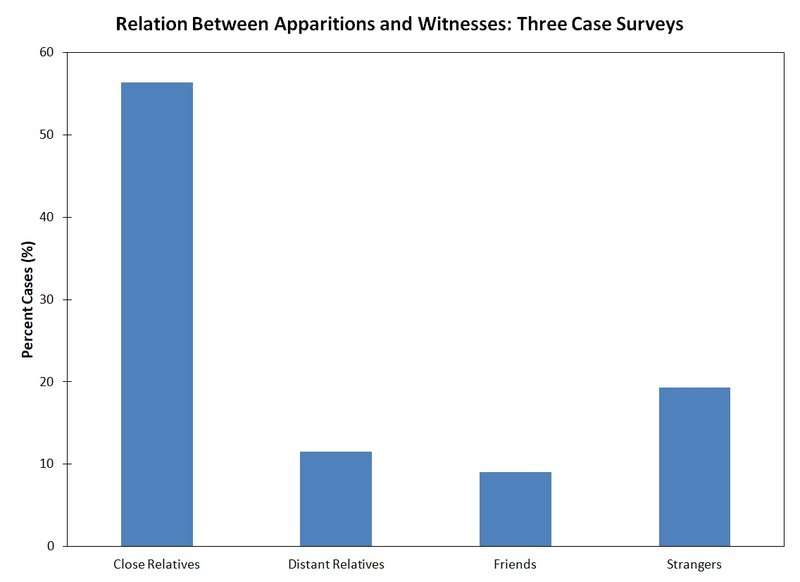
- Many spectral figures can (and do) represent someone known to the witness: As in this case, where the figure represented the salesman’s sister. Similarly, three surveys of apparitional case collections [3-5] also tend to indicate that the figure represents a close relative in just over half (56%) of the cases (see Figure 1 below). A very similar tendency is found in spontaneous cases of extrasensory perception (ESP), where a considerable fraction (40%) of the “ESP experiences involved the lives of people in the experiencer’s ‘immediate circle’ - parents, children, siblings, spouses, and friends” [6, p. 37]. Accounts of other apparitions of lost loved ones after Japan’s 2011 tsunami offer a separate, disaster-related comparison.
- Apparitions can (and apparently do) appear in daylight or lighted conditions: When he saw the figure of his sister, the salesman said the “...hour was high noon” [2, p. 18]. While folklore traditionally holds that apparitions primarily appear at night, there are actually a fair number of witness accounts where sightings occurred during the day or in conditions of fairly bright light. For instance, in her 1885 case survey, early psychical researcher Eleanor Sidgwick noted that ghosts have been sighted “...in all kinds of light, from broad daylight to the faint light of dawn” [7, p. 144]. More recently, in his 2012 survey, Icelandic researcher Erlendur Haraldsson found that the amount of apparitional sightings reported at night was roughly equal to the amount reported during the day. And in a slightly smaller subset of cases, he found that half (52%) of the sightings were said to have occurred in full daylight or artificial conditions of electric lighting [5, pp. 57 - 58]. Psychical researcher Andrew MacKenzie even devoted a whole chapter of his 1971 book Apparitions & Ghosts to cases that took place either during the day, or near dusk, when there was still just enough daylight remaining to allow one to see their surroundings [8, Ch. 3]. So contrary to what media depictions often claim, these findings suggest that one doesn’t necessarily have to conduct a ghost hunt at night or in darkness in order to have a chance of witnessing an apparition.
- Many apparitions can look solid and life-like: The salesman stated that his sister’s spectral form “...appeared as if alive” [2, p. 18], which goes against the common folkloric stereotype of apparitions being white, misty, translucent-looking figures. Case survey findings seem to further contradict this stereotype, as well: In his survey, Haraldsson found that roughly three-quarters (73%) of the witnesses “...said the deceased person had been physically present until he or she disappeared...which could be understood to mean that they felt as if the person was there in the flesh” [5, p. 121]. An earlier survey by British researchers Celia Green and Charles McCreery also found that 91% of the apparitions were described as being “...completely opaque like a normal object so that nothing was visible through it” [9, p. 150].
- The outward appearance of a deceased person’s spectral figure may often reflect the style of dress that the witness was accustomed to seeing that person in life: The salesman stated that his sister looked “...perfectly natural, and dressed in clothing that she usually wore in life, and which was familiar to me” [2, p. 18]. This is consistent with an early observation made by Myers himself, in which he noted that “...it is usual for a witness to say ‘he [or she] appeared to me in the dress he habitually wore, and in which I knew him [or her]’” [10, Vol. II, p. 295]. Similarly, parapsychologist Richard Broughton pointed out more recently that: “Often the clothing that the ghost appeared in was what the deceased customarily wore, not necessarily those in which the person died” [11, p. 150].
A Further Link with Memory?
This can lead one to wonder: Why might witnesses report seeing spectral figures clothed in such a familiar manner? (A question that ties into the broader issue of why ghosts wear clothes at all - something which has been long been the subject of debate, and which still occasionally comes up in general discussions about apparitions - see e.g. [11-12].) Partly following from ideas proposed by psychical researchers G. N. M. Tyrrell [13] and C. D. Broad [14], one possibility to consider here (simply as a bit of “food for thought”) is that the witness may play a (largely unconscious) role in producing the apparition that he or she ultimately sees, perhaps by mentally contributing some of the details (such as the clothing) that the deceased person’s spectral figure will ultimately display. And perhaps these details might stem from familiar memories about the deceased person that the witness happens to have.
This might be easier to see if we turn our thoughts back to the recent PDN article on ghosts sighted in the workplace: There are many jobs which call for a particular type of uniform to be worn while one is working - a business suit if you work in a corporate office, coveralls if you work in repair services, etc. So whenever you go into the workplace, you might be used to seeing your fellow co-workers being dressed in that particular uniform. This becomes so familiar to you that whenever you happen to be reminded of these co-workers (like when you hear their names mentioned), you might find yourself tending to envision them in your mind as being dressed that way, because that’s how you are used to regularly seeing them. You are most familiar with them in that context, and so your own personal memory of them may also be familiarly shaped around that context.
Perhaps these same familiar memories are also activated in an instance where you find yourself encountering the apparition of someone you know (like a co-worker), leading to that person’s spectral figure to be donned in the clothing that you are most familiar with seeing them wear. This would be premised on the theoretical approaches proposed by parapsychologists William Roll [15] and Harvey Irwin [16] which link (long-term) memory with ESP functioning: Perhaps our memory isn’t only useful for learning and remembering the information we gather in the course of our ordinary waking lives - it might also be useful for conveying information in the psychic experiences we spontaneously have. Irwin suggests how in a relatable imaginary scenario:
“Suppose that by [ESP] you learn of the death of your friend John in a car accident some distance away. Now, to your knowledge John has never died before, so there cannot have been a (single) trace in your memory corresponding to John’s death in his car. However...each discrete piece of information is already contained in [your] memory at the time of the experience: there is stored information about John, about death, and so on.” [16, p. 87]
Perhaps in a psychic experience, these memory traces get activated and link together to form the ESP response, thereby conveying the information that John has died in the accident. This would be very similar to the role memory serves in our (ordinary) visual perception, as well: If we’d witnessed the accident first-hand, these memory traces - relating to John, the car, and the concept of an accident - would’ve also been activated and linked together in our mind, so that we’d understand the meaning of what we are seeing. This might also be what happens when we spontaneous see an apparition of a deceased person we once knew. If John was our co-worker, then the familiar memory trace we have formed of him (and which is activated in the ESP response) may include his work uniform, leading us to see him clothed in that manner. Several lines of anecdotal and experimental evidence seem to point toward there a being link between ESP and memory [11, 15-19], which may offer a preliminary basis for this conceptualization.
Of course, as mentioned, this would only offer a way to conceptualize apparitions which seem to represent other people we once personally knew. Apparitional sightings of people we don’t know, like those reported in hauntings, may be different. Perhaps these latter instances might involve some kind of persisting localized psychic “trace” that is somewhat akin to memory, which is psychically perceived whenever we occupy the location where that “trace” seems to linger [20]. This remains to be only a basic working idea which is largely speculative at this point - the details are still sketchy and require additional research to further develop and test.
Coming back to the “Scratched Cheek” case, it’s interesting that the scratch mark noticed by the salesman on his sister’s face - a detail that he was unaware of at time he saw her, as mentioned - was later verified by his mother. This appears to be an aspect of the experience which is particularly difficult to account for by ordinary means. Is it possible that the sister was trying to convey this detail to her brother as a sign that she’d somehow survived beyond the grave?
Perhaps, but one must also recognize the alternate consideration that this detail was also known by someone who was still living - namely, the salesman's mother. This makes it alternatively conceivable that the salesman’s mother could’ve also conveyed this detail to him through some form of psychic connection, as well. Determining who exactly was the source of the detail - the salesman’s sister or his mother - is one of the issues which tends to make it difficult to put forth a reasonable argument for life after death in these cases. But as psychiatrist Ian Stevenson once pointed out [21], there are certain apparition cases which contain details which may be difficult to account for when another living source for those details doesn’t seem to be immediately apparent - although they tend to be exceedingly rare and relatively few in number. If a greater number of cases of this type can be identified, documented, and carefully evaluated to determine (to the best degree possible) that neither the witness nor any other living person has prior knowledge of them, then perhaps a more extensive assessment can be made of the likelihood that some apparitions may represent some form of life after death. And so for now, it seems, the larger question of survival remains open.
References
[1] Ebon, M. (Ed.) (1968). True Experiences with Ghosts. Signet Mystic Books/New American Library.
[2] Myers, F. W. H. (1889). On recognised apparitions occurring more than a year after death. Proceedings of the Society for Psychical Research, 6, 13 - 65.
[3] Osis, K., & Haraldsson, E. (1977). At the Hour of Death. Avon Books.
[4] Arcangel, D. (2005). Afterlife Encounters: Ordinary People, Extraordinary Experiences. Hampton Roads Publishing Company.
[5] Haraldsson, E. (2012). The Departed Among the Living: An Investigative Study of Afterlife Encounters. White Crow Books.
[6] Feather, S. R., & Schmicker, M. (2005). The Gift: ESP, the Extraordinary Experiences of Ordinary People. St. Martin’s Press.
[7] Sidgwick, E. M. [Mrs. H.] (1885). Notes on the evidence, collected by the Society, for phantasms of the dead. Proceedings of the Society for Psychical Research, 3, 69 - 150.
[8] MacKenzie, A. (1971). Apparitions & Ghosts: A Modern Study. Arthur Barker Ltd.
[9] Green, C., & McCreery, C. (1975). Apparitions. Hamish Hamilton Ltd.
[10] Gurney, E., Myers, F. W. H., & Podmore, F. (1886). Phantasms of the Living (2 vols.). Trubner & Company, Inc.
[11] Broughton, R. S. (2006). Why do ghosts wear clothes? - Examining the role of memory and emotion in anomalous experiences. European Journal of Parapsychology, 21, 148 - 165.
[12] Braude, S. E. (2019). Why do ghosts wear clothes? [Editorial]. Journal of Scientific Exploration, 33, 351 - 358.
[13] Tyrrell, G. N. M. (1953/1961). Science and Psychical Phenomena/Apparitions. University Books.
[14] Broad, C. D. (1953). Phantasms of the living and of the dead. Proceedings of the Society for Psychical Research, 50, 51 - 66.
[15] Roll, W. G. (1966). ESP and memory. International Journal of Neuropsychiatry, 2, 505 - 521.
[16] Irwin, H. J. (1979). Psi and the Mind: An Information Processing Approach. Scarecrow Press.
[17] Palmer, J. (2006). Memory and ESP - A review of the experimental literature. European Journal of Parapsychology, 21, 95 - 121.
[18] Stanford, R. G. (2006). Making sense of the “extrasensory” - Modeling receptive psi using memory-related concepts. European Journal of Parapsychology, 21, 122 - 147.
[19] Carpenter, J. C. (2008). Relations between ESP and memory in light of the first sight model of psi. Journal of Parapsychology, 72, 47 - 76.
[20] Roll, W. G. (1981). A memory theory for apparitions. In W. G. Roll, J. Beloff, & J. McAllister (Eds.) Research in Parapsychology 1980 (pp. 5 - 7). Scarecrow Press.
[21] Stevenson, I. (1982). The contribution of apparitions to the evidence for survival. Journal of the American Society for Psychical Research, 76, 341 - 358.


No comments:
Post a Comment