Tuesday, 25 October 2022

Your reality is in fact, a conscious universe

There are many theories of reality out there ranging from the religious to the mathematical to elephants on top of turtles. What I’m going to do here is demonstrate that you can break this down into two paths which are incompatible with each other. To chose one is to completely reject the other. It all seems very complicated on the surface, but understanding the basics of reality is actually quite straightforward once you take step back and look at the problem as a whole.

Those two points of view are materialism and idealism. Materialism means that you believe that everything is ultimately made out of material and idealism means that you believe that everything is ultimately made out of ideas.

These two ways of looking at reality are incompatible because a universe that is strictly material cannot create ideas and a universe that is strictly ideas cannot create something material. Yet we seem to be in a universe where both exist. However, one of these two things must be right and the other must be wrong.

Physical vs. Mind

If you’ve never explored this topic, then it can be difficult to follow; particularly in understanding the difference between thought and physical reality since we blend the two together seamlessly.

The short version is This:

  1. If it is physical, it can be measured and it has no inherent meaning.
  2. If it is an idea, it has inherent meaning, but cannot be measured.
conscious universe

To take a rather mundane example, an actual wooden chair has measurable height, weight, and volume. If you throw it, it has the velocity as well. But if you asked the question: What does this chair mean? That is nonsensical. The wooden chair doesn’t mean anything, (and neither do any other physical objects.)

But suppose I say: “It’s a chair.” “Chair” doesn’t refer to a particular object, so there is no height, weight or volume to measure. And if I ask what does “chair” mean, you could easily reply with “something to sit on.” It’s an idea and therefore contains meaning, (all ideas contain meaning) and is not measurable.

Something can either be measurable or it can have meaning, but it cannot be both.

Is the Universe Material?

If the universe is strictly material, then everything in the universe can be broken down into reducible physical processes, nothing has any meaning at all, and consciousness doesn’t really exist; it is considered an epiphenomenon: A secondary process that occurs as the result of brain activity that can’t affect physical reality. In this scenario, only physical things that happen through purely physical processes are real. Our thoughts and memories are just stored electro-chemical reactions managed by an organic supercomputer.

Life is created out of an enormous multitude of random reactions that eventually get complicated enough to create a self-perpetuating thinking machine.

Everything to do with consciousness, therefore, also doesn’t exist. A physical universe exists without meaning because physical objects have no meaning.

So why would we believe that this is correct?

The Argument for Materialism

We need only look around to be aware of this physical, material world that we live in all our lives. To say that we have to pay attention to it is a massive understatement. We have bodies that must be managed, physical lives that are lived and we interact with the physical even while we’re sleeping. There is never a moment during our lives when we’re not attached to physical reality.

The world we live in behaves in a very physical, mostly predictable way. Most of what happens in our lives can be explained by material processes, whether through biology, chemistry or physics. We use physical processes to think and our thinking is affected by changes in our brains. No brain = no thinking. Our emotions correlate somewhat to physical processes in our bodies.

Different people all see the same thing and interact with it in the same way, and this seems to prove that an objective, physical reality exists.

what would a conscious universe look like

If reality were based on ideas, you’d think that reality would be a lot more . . . bendy and dreamlike, people would see different things based on their inner worlds and that we wouldn’t ever grow old and die. You’d think that an idea based universe would allow you to change reality just by thinking about it.

But that doesn’t seem to happen. If you want to change physical things, you almost always have to engage in some task in the physical world to make it happen. If your car is making a weird noise, you can’t just wish it away, (although we’ve all tried at some point), you’re going to have to repair it.

There are, in other words, very good reasons to think that physical reality is primary and that consciousness is secondary.

The Problem With Materialism

While this all seems very obvious, there are serious problems with this approach, and it all starts with the fact that our entire experience of our physical reality happens in our minds.

All we will ever know of our physical world, we will know because of our conscious minds. There is absolutely no way around this. We cannot “get behind” consciousness and examine it from the perspective of being outside it. For example, if we are studying a car, we can handle it, take it apart and look at the various pieces. But consciousness doesn’t work that way. There is no way to stand apart from it, take it apart and see how it works. We have to be it, to look at it.

Our minds are what translates our body’s interactions with reality into something comprehensible. You cannot experience our physical reality without it.

thoughts in the universe

Patterns and Meaning Are Not Physical

Here is where things get difficult. Patterns, codes and information are ideas. They have meaning and are not measurable. They are not physical objects. We assign patterns, codes and information to our physical universe, but these are not inherent properties of a physical reality. They are created by consciousness.

And now the hammer comes down: We experience our reality as patterns, codes, meaning and information. (These are all different names for the same thing.) We cannot experience reality any other way. This makes a truly physical universe impossible to prove.

Do you see where I’m going with this? The physical reality that we know is made up of patterns, which are creations of consciousness, and therefore our physical reality, as we know it, is utterly and completely dependent on consciousness to exist.

Another way to say this is that forming patterns is an act of consciousness. Because we can only see our reality in terms of meaning and patterns, we are experiencing a reality that our consciousness has created. If you are talking about a reality that exists without consciousness, you are talking about a reality that is without meaning and is patternless. We have no means of demonstrating such a thing to be real.

We Have to Reject Materialism

And if we can’t demonstrate it to be real, it can’t be our reality. The reality THAT WE HAVE requires consciousness to perceive it. That’s what we have to work with. In the case of materialism, there is no point in pursuing an avenue of investigation where it is impossible to gather any evidence.

Here we are then: A physical world which is impossible to disentangle from the consciousness that recognizes its existence. And with this, the philosophical approach of materialism comes to a dead end.

“Once you eliminate the impossible, whatever remains, no matter how improbable, must be the truth.” - Sherlock Homes

We know that if materialism is false, then that leaves idealism. The material cannot create the immaterial and the immaterial cannot create the material. So if the universe isn’t material, then it is immaterial. The physical reality that we know must be a creation of consciousness.

Reality is Made of Ideas

This is completely counterintuitive. Our thoughts certainly do not feel as real as the physical world around us, so it’s going to take some effort to explain this. Let’s start with the obvious: our minds can function without input from our bodies, but take away the mind and there’s nothing there. The body can live for a little while, but it can’t even eat.

This leaves a very significant questions about a physical world made of thought, such as “why do we share this reality?” and “How does it hold together?” and “Why does physics work so well?” For the answer, we look to a feature of quantum physics known as entanglement and take the data to its logical conclusion based on the assumption that our physical reality is made of ideas.

The 2022 Nobel prize in physics is relevant here:

Three physicists won the Nobel Prize together for their work on entanglement. We already knew that entanglement was real; what they discovered was that no one has been able to prove the existence of hidden variables, (which would support materialism) and that reality is in an indeterminate state until it’s observed:

This is somewhat simplified, but if you split an electron, sending the two halves in different directions, you can know the spin of one by looking at the other no matter how far apart they are. If the wave function of one collapses, so does the other, apparently instantaneously. You can’t set up any situation where they act independently of one another.

Reality is Actually Timeless and Spaceless

No information can travel between them, so the only other conclusion that fits the data is that they were never separated in the first place. Although the subatomic particles move through time and space, their entanglement behaves as though time and space don’t exist. If you can demonstrate that anything at all ignores time and space, then time and space cannot be fundamental attributes of our reality, which means that our physical 3D reality isn’t fundamental. It is a kind of scaffolding over the top of a fundamental timeless, spaceless reality.

There is stuff there; reality is not an illusion; but because it is fundamentally timeless and spaceless, it’s not physical in any way that we would understand. Our connected consciousness is creating a template to translate it into a scaffolding, which is the physical reality that we understand and experience.

This doesn’t mean that we’re living in an illusion or the matrix, just that we’re dealing with a layered reality. That’s why I use the term “scaffolding.” The scaffolding is real, but the reality that we experience is not strictly physical, but probably better described as representative.

Separateness is Not Fundamental to Reality

The deeper reality, which is timeless and spaceless means that we are fundamentally not separated from each other or the rest of reality. People, and in fact all of life are not really separate. The separateness is just scaffolding. This is a concept that we need to grasp in order to understand what holds it all together. Our connectedness; oneness or whatever you want to call it, is what gives the physical world: (the scaffolding), its “stickiness.” We are not individuals, individually responsible for the creation of our own realities. We’re more like cells in a larger organism and our reality is massively shared.

This physical reality is made “real” by the connectedness of every living thing that shares in the experience. We’re not living in our own little worlds creating our own private physical realities, we’re following a ready made template.

Now, in that light, let’s look at that Nobel prize again:

Here’s a quote from Scientific American:

One of the more unsettling discoveries in the past half century is that the universe is not locally real. “Real,” meaning that objects have definite properties independent of observation—an apple can be red even when no one is looking; “local” means objects can only be influenced by their surroundings, and that any influence cannot travel faster than light. Investigations at the frontiers of quantum physics have found that these things cannot both be true. Instead, the evidence shows objects are not influenced solely by their surroundings and they may also lack definite properties prior to measurement.

In an idea based universe, this describes a quantum level process of creating a local, physical reality scaffolding over the non-local timeless, spaceless, reality of consciousness. A collective, connected consciousness is giving physical form to what is fundamentally timeless and spaceless at the quantum level.

Conscious Universe - Quantum Weirdness Explained?

This might explain the general weirdness of quantum mechanics. It may occupy the liminal space between our physical reality and the underlying timeless, spaceless reality.

Living things physically live within their physical worlds, but our minds are timeless and spaceless. It may help to visualize collective thoughts vs individual thoughts. A collective thought would be what creates the template for our shared physical reality. It is almost entirely subconscious and virtually unchangeable. If I have a spoon in my hand for example, that would be a collective thought; it is unaffected by my conscious thoughts and it reliably and very predictably interacts causally with the rest of the physical world.

Individual thoughts are how we normally use our minds. These are transitory. They don’t have physical form and change rather frequently. We can make them stronger or weaker depending on our level of focus, but it’s extremely rare for them to overcome collective thought. Our individual thoughts don’t normally affect the template. Someone could possibly bend a spoon with their mind under very specific conditions, but it’s not the norm.

Our Minds are Timeless and Spaceless

I know that for many readers, all of this probably seems quite bizarre, but let me ask this question: How do you perceive time and space in your mind? Do you feel the passage of time? What about events, do events long in the past seem long ago? Do places that you know well seem far away in your mind? Chances are, the answer is no to these questions. We tend to perceive things not on their physical or temporal distance, but rather on our familiarity. Our personal experience can be described as a continuous “now”. We can remember the past and imagine the future, but only from a position of experiencing “now.”

My point here is that our mind is experiencing the deeper timeless, spaceless reality all the time. It’s so completely normal that we don’t even think about it. We have to stop and think about how much time has passed and how far away things are. These things are not wired into our thinking.

And this is just the tip of the iceberg. What I want to leave you with here is that getting away from a strictly physicalist model of reality doesn’t change much about how we live our lives or even how science is conducted. While our reality might be based in ideas, it’s still very much a robust, measurable physical reality to us and it doesn’t detract from scientific accomplishments.

Reality Is The Conscious Universe

But we need to be aware of the underpinnings of our reality. We’re not working with the details of a physical world, but rather an idea based scaffolding. Learning about the scaffolding is extremely valuable to our well being, but we need to remember that we’re dealing in information when we do that and we are creators of information. It’s not all as separate as it appears to be.

Tuesday, 27 September 2022

Shaping Humanity’s Future at Skinwalker Ranch

Faith. Hope. Love. Most people would not expect those words to be associated with Skinwalker Ranch which is said to be “the most scientifically studied paranormal hotspot on the planet,” according to the ranch’s official site. When current owner Brandon Fugal first visited the ranch, he observed animal bladders and carcasses posted at its fence perimeters apparently to keep evil entities from escaping outside its boundaries. Despite this graphic sight, the reputation of curses, and stories of paranormal events, Fugal’s motivation for purchasing the property is steeped in faith, hope, and love.

Skinwalker Ranch Changes Name

Previously known as the Sherman Ranch and the UFO ranch, it was rebranded as “Skinwalker Ranch” to align with the location’s indigenous roots. Brandon Fugal describes the landscape as surprisingly beautiful and worthy of an old western movie background. Skinwalker Ranch lies in the centre of the geological depression known as the Uintah Basin in the state of Utah. Spanning 512 acres, it is located south of the Uintah Mountains and southeast of the city of Ballard. It borders the Ute Indian reservation and is surrounded by tribal land. The only access to the ranch is a gated road which Fugal applied to have declared private.

skinwalker ranch
Source: Google Maps

The area is rich in Native American history and folklore and replete with petroglyphs carved into its rock faces and within its caves sometime before 1200 AD. These ancient drawings tell strange and violent stories about the experiences of those who inhabited the land many years ago, including depictions of severed heads, giants, and other mysterious horned figures, portals and pathways. What did the ancient civilizations witness here? Could these be the very first reports of UFO sightings? Was this rock art created to warn future generations?

The ranch gets its name from the malevolent shapeshifting witches of the Navajo people, called skinwalkers. Skinwalkers are believed to be shamans who sold their souls in exchange for the ability to assume different forms and for immortality. It is said that during the American Civil War(1861-1865), the Ute tribe ousted the Navajo people from the area. In revenge, the Navajo placed a curse on the Ute ensuring they would be forever terrorized by skinwalkers.

What Really Scared the Shermans Away?

From 1934 to 1994, the land was owned by Kenneth and Edith Myers. They lived on the property until Kenneth’s death in 1987. Edith stayed on the property until 1992 when she moved to an old age home. After Edith died in 1994, Garth Myers and his sisters inherited the property and sold it to cattle rancher Terry Sherman and his wife Gwen.

According to Fugal The Myers reported several occurrences on the ranch. Retired deputy Sheriff Kris Porritt provided testimony that he responded to several incidents on the ranch in an official capacity involving strange & disturbing events/activity during Myers’ ownership, and considered Kenneth Myers a friend. This was later contested in an interview with Frank B. Salisbury, author of the book, The Utah UFO Display, Garth Myers denied any kind of UFO activity on the property during the sixty years his family lived there. Clearly, the testimony holds more weight than statements made in a media interview.

The subsequent owners, the Shermans, told a different story. The Shermans owned the property from 1994 to 1996. After living on the ranch for less than two years, the Shermans went public with claims that they had been the victims of numerous frightening paranormal incidents since the day they moved in. Investigative journalist George Knapp detailed the Shermans’ accounts in a series of articles published in the Las Vegas Mercury newspaper. The pieces included descriptions of unexplained cattle mutilations and disappearances, strange objects in the sky, crop circles, and encounters with wolf-like creatures.

Skinwalker and George Knapp

Is it a coincidence that George Knapp has a connection to the individual who would eventually buy the property from the Shermans? Knapp worked with the National Institute of Discovery Science (NIDS), which was founded by well-known Nevada billionaire, real-estate developer and owner of Bigelow Aerospace, Robert Bigelow. He is also well-known for his passion to discover an afterlife. Recently, in 2021 he created the Bigelow Institute for Consciousness Studies and offered $1 million in prizes in a competition for essays “for presenting the evidence for survival of human consciousness after bodily death.”

After the Shermans’ claims were publicized in 1996, Bigelow immediately purchased the property from them for $200,000, apparently less than what they paid for it. The Las Vegas Sun confirmed that the Shermans moved to another property only 15 miles away and that Terry Sherman took a caretaker job on the ranch. This raises some questions: If the events they experienced were so frightening and disturbing, why didn’t the Shermans move farther away than a mere 15 miles? Why did Terry Sherman return to the ranch to accept employment from Bigelow as a caretaker?

The year before purchasing the Sherman Ranch, Bigelow formed the National Institute for Discovery Science (NIDSci) to enable scientific research of the paranormal. The events reported by the Shermans caught Bigelow’s attention. Twenty-one years later, it would be revealed that those details also caught the attention of the United States government.

The New York Times broke the story in 2017 with details about the Advanced Aerospace Threat Identification Program. It was formed in 2007 and dissolved in 2012 after spending over $22 million in funding to study UFOs. According to Fugal, Robert Bigelow became part of the program after former Senator Harry Reid and officials from the U.S. Defense Department visited the ranch.

A Christian Skeptic Buys Skinwalker Ranch

During Bigelow’s twenty years of ownership, Bigelow invested massive resources into the research carried out by NIDSci. At some point, while Bigelow owned the ranch, he participated in discussions with Brandon Fugal. Fugal maintains that although the property was not for sale, this was not just another real estate deal. Bigelow was seeking a successor to its stewardship, and he chose Fugal. Perhaps Bigelow and Fugal bonded over their shared certainty of the existence of an afterlife. Under his company, Adamantium Real Estate LLC, Brandon Fugal anonymously purchased Skinwalker Ranch in 2016.

Brandon’s Story

Brandon Fugal was born on April 1, 1973. He is a successful and prominent businessman, chairman and co-owner of Colliers International in Utah, a top commercial real estate firm, and he was previously named EY Entrepreneur of the Year. Fugal was raised by his parents in the religion of the Church of Jesus Christ of Latter-Day Saints. Somewhere along the way, Fugal became fascinated with science fiction as evidenced by the name of his company, Adamantium, paying homage to Marvel Comics. Adamantium is a fictional indestructible alloy and that of which Marvel character Wolverine’s claws are made.

Brandon and Skepticism

Despite his keen interest in science fiction, Fugal claims to have been a skeptic when he bought Skinwalker Ranch. However, his skepticism didn’t stop him from reinforcing the existing security systems put in place by the previous owner. He installed additional cameras, motion detectors, and a 24-hour patrol.

Keep Out

His reasons for elevated security include keeping people out for their own protection from unknown dangers. Fugal doesn’t allow his own children to visit the property. He told Utah Business, “I have four kids but they have never been to the ranch,” Fugal says. “The danger is real, and we have to approach the ranch with a degree of reverence and caution.”

Skinwalker Ranch

Science Steps In

Fugal also put together his own multidisciplinary team of scientists, engineers, and military personnel to embark on “the greatest science project of all time” he says in an episode of Jessop’s Journal – ABC4 News. This team includes his friend, Bryant “Dragon” Arnold, installed as the Chief of Security for the ranch. In a 2020 tweet, Fugal reveals that he met Arnold in 1992 while on a missionary assignment in Hawaii.

skinwalker ranch
Source: Twitter, @BrandonFugal

Soon several team members began to experience strange occurrences. They reported acute medical episodes, electromagnetic anomalies, high levels of radiation, and equipment malfunctions. Tom Winteron, the ranch’s maintenance superintendent, suffered three unexplained serious head injuries.

However, Fugal himself hadn’t witnessed nor experienced anything unusual, preserving his skepticism for the first six months of his ownership of the ranch. Then, in the Autumn of 2016, while outside with a group of others, Fugal witnessed his first UFO. He reported that it was a silver object approximately 50 feet long that hovered in the sky before disappearing with inexplicable propulsion movements. “I can’t unsee that.”, Fugal says. He became a believer or as Fugal prefers, “an experiencer.” The event was not caught on any devices due to battery power drainage occurring in the hour prior to this sighting.

“My perception of the world and universe has been forever changed by my experiences. Now, I believe the adventure of owning this "paranormal" property is just beginning.” - Fugal’s article in Newsweek.

A Hit Show Is Born

Following his purchase of the ranch, it was 4 years later that he admitted he owned the ranch. Consequently, after that time Fugal began negotiations with producers at The HISTORY Channel to create a new television series called The Secret of Skinwalker Ranch.

In his own words, he stated “I owned the ranch for nearly 4 years before agreeing to go public in conjunction with the docuseries, allowing television cameras for the first time."

Initially, he insisted on keeping his identity as the owner of the ranch anonymous for fear that it might damage his business reputation. Fugal says that he also demanded that the show would only report the truth of the events at the ranch and that his own team would play themselves, rather than a cast of actors. He also insisted on having the final cut on the content that would be broadcast. The wheels for the new show were set into motion and Fugal became a co-executive producer.

Skinwalker’s A Brand

On February 15, 2017, Adamantium Real Estate, LLC filed two trademark applications with the United States Patent and Trademark Office. The trademarks Skinwalker and Skinwalker Ranch were both registered for use in association with “Providing recreation facilities; Entertainment services, namely, creation, development, production, and distribution of multimedia content, internet content, motion pictures, and television shows.” Later, on June 21, 2021, Adamantium filed another trademark application to expand the use of the Skinwalker Ranch trademark to cover its use on products such as “stickers”, “cups and mugs” and “Shirts and short-sleeved shirts; Sports caps and hats”.

The Secret of Skinwalker Ranch first aired on The HISTORY Channel in 2020 and immediately became a hit. The show is now in its third season and has documented numerous strange and mysterious phenomena. In Season 1, after a young cow is found dead, Fugal’s team of investigators view the security camera footage. The footage shows a UFO directly above the cow prior to it dropping dead.

Season 3 Of Skinwalker Ranch

More recently, in Season 3, Fugal and his team gather around a table with journalist George Knapp and former Governor of Utah Gary Herbert (2009-2021), who Fugal says has been an important part of elevating the formality of this research. The group has gathered to review the 3D photogrammetry results of the property. The results reveal solid vertical structures suspended in the sky above the ranch. Fugal states, “It appears we are triggering contact in some way shape or form, and it’s manifesting itself above the ranch in a very profound way.”

Could these structures represent the disappearing portals that have been alleged around the Skinwalker Ranch property? Are they what the ancient petroglyphs were attempting to depict? What is the role of the former Governor of Utah in these investigations? Is the U.S. Government still secretly involved in programs at the ranch? Are military decisions being made as a result of Fugal’s findings?

In Brandon’s Words

“The scientific investigation at Skinwalker Ranch continues 24/7/365 with full-time onsite professionals and is the most significant privately funded research program of its kind on the planet. Now in our 4th season of filming the docuseries, we have brought more 3rd party professionals than ever before, with a diversity of skills, resources & technology platforms being deployed in service to documenting the reality of the phenomenon. Understanding the origin and agenda of what is being observed is a high priority.”

When Science and Religion Live Together in One Mind

Growing up in the Church of Jesus Christ of Latter-Day Saints, Brandon Fugal was raised to believe in the spirit world. “We lived before we came to earth, and we will continue to live after we die,” as stated on a Latter-Day Saints website. When asked by Doug Jessop if he feels a conflict between his religious beliefs and his scientific endeavors at Skinwalker Ranch, he asserts that there isn’t a conflict and that purchasing the ranch is in alignment with his faith. With a perspective that religion and science are complementary, Fugal and his ranch may hold the key to proving the existence of other dimensions. Even before the late Stan Lee of Marvel Comics popularized the concept of a “multiverse" consisting of thousands of separate universes, Christianity and other religions already supported the existence of another dimension: the spirit world. If there’s one, perhaps there are more.

“My goal with Skinwalker Ranch is to bring together a multidisciplinary group of people for the purpose of using science and technology in order to prove that we are not alone in the universe and that there is more to our existence than meets the eye.” - Brandon Fugal in an interview with Joe Murgia of UFO Joe

Fugal admits that he is compelled to find hard evidence of a multidimensional universe. He also told UFO Joe that he was considering expanding his investigations to the study of consciousness. Such studies would reach beyond the materialist view of humans whilst adhering to the third-person perspective of scientific pursuit.

Empirical Evidence

If Fugal can show empirically that other dimensions exist, then it follows that one of those dimensions could be the spirit world. It could also lead to substantive proof of an afterlife and the presence of angels among us. Fugal’s goal is to have data to confirm that we are not alone in the universe and that we are part of an intelligent design. His research findings may unlock unlimited possibilities for the future of mankind and accelerate the evolution of theology. In a time when we are experiencing divisiveness amongst ourselves, Fugal’s research has the potential to unite us as one race, the human race, and to restore our faith, hope, and love for one another.

What do you think is going on at Skinwalker Ranch? Is the U.S. Government operating secret programs again and making contact with extraterrestrial beings? Have both angels and aliens found the doorway into our world? Or has Brandon Fugal found the doorway into theirs?

Correction, (Fri Sept 30, 2022): A previous version of this story was corrected with information gained directly from Brandon Fugal. The editorial team has made the necessary corrections, and thank Brandon for the clarification. We incorrectly stated that Myers never reported phenomena at the ranch when testimony from an officer of the law proved otherwise. Fugal also confirmed the correct timing of his public admission.

Wednesday, 14 September 2022

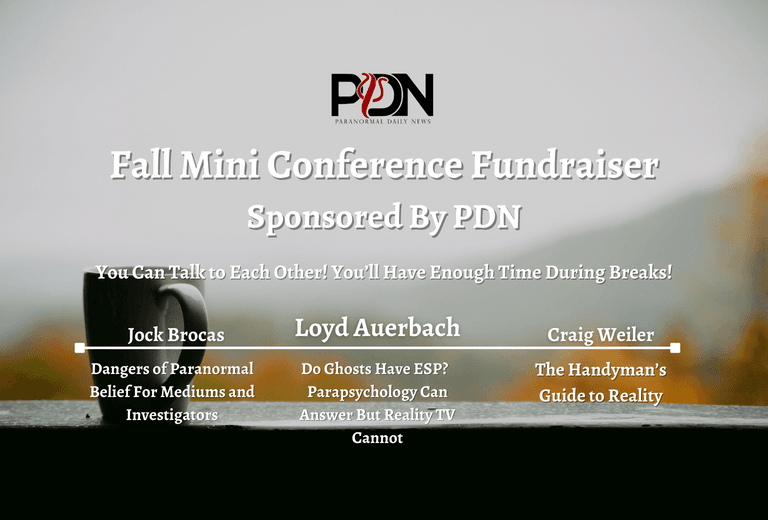
PDN Paranormal Mini Conference Fall 2022 Fundraiser

PDN has an exciting mini-conference for you coming up very soon.

Sign up here: Book Your Ticket Here

You are invited to our small mini-conference. This is a fundraising event that will take place online and will cover 3 main topics by three passionate speakers and advocates for Psi, Parapsychology, and Spiritual Science.

This conference is to help educate and sow seeds of inquiry into the minds of those interested in a professional approach to the subject. The speakers have been chosen for their knowledge, experience, and passion to educate and support a misunderstood subject. Each speaker brings a unique skill set and their topic is chosen to give our attendees a unique perspective that they can discuss with other attendees.

We can’t wait to see you there. The cost is $20 USD and a portion goes to psi research.

PDN Paranormal Mini Conference

We’ve made some innovations to help you enjoy the experience without feeling information overload and give you some time to either chat up other people in the audience, grab something to eat, or get a couple of chores done around the house to clear your head before the next speech.

We do this by having a ten-minute Q&A after each speech and then a 20-minute break. Whatever time zone you’re in, you won’t be rushed.

We’re using a sophisticated networking software program that puts you at tables, so that it’s not a free for all, and you can leave a table if you’re not grooving with the conversation there.

Typical table arrangement

This is what your screen looks like. If you join one of those tables, it looks a lot like a Zoom conversation. It’s a great way to find people to talk to or locate a friend who is also attending. Take the time to put in a profile and people will be able to see who you are at a glance. You can message anyone or join group messaging at a particular table to share info with each other.

For some people, this is the best part of conferences.

We have a great lineup of speakers:

Our featured speaker Loyd Auerbach:

M.S. (Parapsychology), Director of the Office of Paranormal Investigations and President of the Forever Family Foundation, has been in the field for over 40 years focusing on education and field investigation. He is the author or co-author of 10 nonfiction books and one novel and teaches online Parapsychology courses through the Rhine Education Center.

He is on the Board of the Rhine Research Center and the advisory boards of the Windbridge Research Center and the Forever Family Foundation. His media appearances on TV, radio, and in print number in the thousands, including The UnXplained, ESPN’s SportsCenter, ABC’s The View, Oprah, and Larry King Live. He works as a parapsychologist, professional mentalist/psychic entertainer (Professor Paranormal), public speaking & media skills coach, and as a professional chocolatier.

Loyd will be talking about:

Do Ghosts Have ESP? Parapsychology can answer, but Reality TV Cannot

Description:

The field of Parapsychology/Psychical Research, with its over 140-year history, provides much from both field investigations and laboratory findings that are generally ignored by the paranormal reality TV shows, and therefore unknown to or ignored by most who follow the often TV-producer-influenced methods. Parapsychologists, as scientists, have to assess their cases carefully, always looking for alternative "normal" explanations for every reported event, not just the overall case (this is not "debunking," by the way, but rather the process of applying science).

Also speaking: Jock Brocas

Photographer: W. V. Pattison |

Jock Brocas is the founder of PDN, an evidential Spiritual Medium, and spiritual author of several books. Jock’s latest book “Deadly Departed” challenges the widely accepted paradigm of the afterlife. Jock writes with passion and in-depth knowledge. The books are written with one common goal, which is to enlighten and teach spiritual lessons of love, compassion, and forgiveness. Jock has appeared in national media and has written for global media on the paranormal, spirituality, and the afterlife. He has dedicated his later years to his own spiritual development and the professional development of his Mediumship and understanding of Parapsychology. Jock takes a more scientific view of the paranormal and the afterlife.

As a proponent of many disciplines, these skills have culminated in developing unique perspectives on spirituality and spiritual life. Jock teaches regularly and works tirelessly to help those developing on a spiritual path.

Jock’s Speech:

Dangers of Paranormal Belief for Mediums and Investigators

Description:

Are we wired for belief in the paranormal, and does a common bias cause more problems when it comes to the investigation of potential anomalous phenomena? Mediums, Uninformed Investigators, Religious perceptions, and the uneducated public could cause more suffering for a family, individual, or community under spiritual crisis. Jock will cite examples of mediumistic bias and the dangers associated with paranormal belief.

Also speaking: Craig Weiler

Craig Weiler is the science editor for Paranormal Daily News, a parapsychology journalist, author, and blogger.  Craig covers controversies in parapsychology (and occasionally other topics) as well as interesting studies, various researchers and projects, and the occasional topical subject related to parapsychology.  In particular, Craig covered the TED controversy of 2013 extensively as well as a Wikipedia controversy later in the year and was the first to report on Russell Gruber's Mirror Worlds Research.

His book: Psi Wars:  TED, Wikipedia and the Battle for the Internet follows the TED controversy while taking a broader look at why this sort of thing is happening in the first place.

Craig’s Speech:

The Handyman’s Guide to Reality

Description:

Craig’s nuts and bolts approach takes you on a practical and easily understandable discussion of the ongoing debate between people who believe in a totally physical world and those who believe that consciousness is fundamental. He then shows how you can use this information to practical effect in your life.

Miss Something? The Conference is Being Recorded

The conference will be recorded and each paid attendee will be able to watch the conference recording within our new private community at any time. Buying a ticket to the event ensures access to the new para community app.

Sunday, 17 July 2022

Defending The Soul

This article is a rebuttal to the article; “Souls: It’s Time We Give Up the Ghost” recently published in Psychology Today by Bill Sullivan Ph.D. While I am not an academic, I am an author and paranormal researcher who can certainly spot a bad argument when I see one.

The article suggests that we should give up the idea of a soul. It suggests we find the hidden power in refuting the idea of a soul. It is rather like saying one should deny the existence of our thoughts. These thoughts certainly exist but have no material form. The author suggests that all emotion is controlled by the brain. Therefore, that would suggest that no matter what emotion we experience, it would be a purely physical process. But emotions are also thoughts, and the physical experience of emotion comes from those non-material thoughts.

The arguments put forth regarding emotion and healing or experiences of a visual nature and degeneration or disease, suggest that split-brain means that consciousness is the brain when in fact, this could not be further from the truth. Conclusive research, as noted in Science Daily and Brain, indicates that split-brain does not mean split consciousness (Split brain: divided perception but undivided consciousness)

The Argument Against The Soul Is Weak

Sullivan begins his argument with an example of how split-brain patients experience two different realities at the same time. He then argues that this would not happen with a unified soul. This argument is one of the better ones that are made in defense of materialism, but it relies on materialist assumptions.

Once you examine those assumptions, the argument is less clear-cut. Consider this, if a radio is broken or cannot receive transmissions in the field - perhaps in a military environment. The soldier or operator would not blame the signal. It is not the signal that is broken. In fact, the signal is still operating perfectly. The radio signal does not require a receiver for its existence. Therefore, the signal exists whether the receiver is there or not. The reality is the radio receiver is broken. Therefore, the only issue is the receiver. Should the soldier Sullivan is therefore blaming the radio signal, which is nonsensical and the argument is rather futile.

In my opinion, it seems to me that Sullivan is labeling the soul as a being or separate entity. Suggesting the doppelgänger if you will, existing as an entity on its own with form and function parallel to the material form. The article actually shows that he has very specific perceptions of the reality of the soul. He thinks he understands what the soul actually is, and what part it plays in human function. His belief is based upon the assumption the brain is acting as the soul, or that because the brain acts within its varying pathways based on stimulus and emotion, the soul cannot exist.

A Potential Understanding Of The Soul

defending the soul
Defending The Soul’s Existence

If one is forced to believe a soul is a separate form, that it has its own identity and personality, then of course Sullivan’s assumptions may have some merit. But this assumption is at best, based on a reductionist, materialistic view of science and does not look toward the plethora of survival evidence that suggests the contrary. Consequently, in the article, the author tries to forcibly play his hand by claiming the newest research in this field supports his assumptions. Furthermore, it is noted the article does not cite any real case studies that have valid efficacy and are replicable, as continually pointed out - a requirement of real scientific inquiry. The scientific evidence for Psi is overwhelming and serves to refute materialist claims and assumptions. Not including this research as part of the discussion in Bill's article, means the conclusions are cherry-picked to suit.

The soul, like any word in our language, has an etymological history. We find it easier to attach labels to concepts in order to satisfy our need for understanding. If we look at the origin of the word, we can deduce where this concept or construct has come from.

The modern English word soul derives from the Old English sáwol, sáwel, which itself comes from the Old High German sêula, sêla. The Germanic word is a translation of the Greek psychē (ψυχή- "life, spirit, consciousness") by missionaries such as Ulfila, apostle to the Goths (fourth century C.E.).

This has become increasingly misunderstood, as in modern times, many people tend to label the soul and give it form with the assumption of it being a separate form from consciousness. The reality, of course, is the soul is not formed and is not biological or physiological in function.

Theories In Biocentrism

Again, this is my own opinion with regard to the soul and whether it exists as a separate being or energy. In my mind, the soul is an aspect of the animating force that gives life, that allows the functioning of the being in human form within the constructs of material existence. This is also an opinion shared by others and noted in Robert Lanza M.D's article: “Does the soul exist, the evidence says yes!”. Robert cites many new hypotheses from modern research on the subject titled Biocentrism. This theory challenges the model widely accepted in the science community, which is based in materialism and draws many conclusions based on false assumptions.

Soul, therefore, is spirit and spirit is the aspect of the animating force that is creation itself. It is not a separate being that is outside the human form and in the same way that the brain is needed to function in the rest of the material or corporeal form, so too, the spirit is needed for the human brain to function. Without this animating force, the brain is lifeless and is connected to nothing.

Where are the replicable studies?

Sullivan further states in his article,

"Science has definitively shown that all of the things that define us, including our thoughts, emotions, and memories, are generated by the brain."

Where are these studies cited and are they replicable? Scientists are forever hammering us about the need for studies to be validated through replication. Yet nowhere in this article does the author try to prove his assumptions. He only gleans over information that is gathered from hypotheses and perceptions. His argument also falls flat with other studies that have further evidence of a vastly different hypothesis that can be replicated.

Intelligent discourse and reasoning

We know from afterlife research and evidential communications from discarnate beings, that reasoning and intelligent discarnate communications exist. Yet, if we were relying on the assumptions of the author, this would be impossible. Why? Because there is no human brain, which means that these beings who communicate from the other side of life would not be able to communicate intelligently or reason with information being gleaned.

Near-Death Experiences

If indeed the brain is the only form of consciousness and all emotion is contained within those neural pathways, then how can near-death experiences give empirical evidence of events and intelligent information with the capacity to reason, when the brain is in fact - dead - for lack of a better term.

Empirical Mediumship Evidence

the soul

Afterlife Research

One particular medium stands out in the annals of parapsychological history. Leonora Piper was one of the most remarkable mediums in the world and one of the most researched mediums. Piper produced remarkable empirical evidence over many years and was subjected to rigorous scientific research by notable pioneers in parapsychology. Professor William James of Harvard sat with Piper and was so convinced of the evidence that he continued to arrange sittings for research purposes. James arranged for a colleague from the Society of Psychical Research (SPR) to carry on the sittings. Richard Hodgson, an Australian who had been teaching law and philosophy in England, began to work full time on the sittings which were conducted three times per week.

Several reports were presented on the sittings with Piper and research continued. Noted researcher Sir Oliver Lodge remarked:

The trance is, to the best of my belief, a genuine one. In it Mrs. Piper is (sometimes, at least) insensible to pain, as tested by suddenly pushing a needle into her hand, which causes not the slightest flinching; and her pulse is affected beyond what I can imagine to be the control of volition.8Remarkable Evidence Verified.

Frederick Myers Founding Member Of The Society Of Psychical Research

Frederick Meyers, who also researched Piper noted her integrity and honesty. In a statement made as to the nature of the intelligent discourse, he confirmed the following:

that many of the facts given could not have been learnt even by a skilled detective; (2) that to learn others of them, although possible, would have needed an expenditure of money as well as of time which it seems impossible to suppose that Mrs. Piper could have met; and (3) that her conduct has never given any ground whatever for supposing her capable of fraud or trickery. Few persons have been so long and so carefully observed; and she has left on all observers the impression of thorough uprightness, candour, and honesty.

Cross Correspondences

If we are refuting the idea that the brain controls all intelligence and consciousness, it is important to also consider examples of cross correspondences. This was a research modality that was prevalent in the early 20th century as scientific research into the phenomenon of automatic writing. Piper was also involved in these formal studies and research. This form of communication, performed under scientific conditions, is perhaps one of the best forms of evidential communication that refutes the necessity of the existence of the brain for the existence of consciousness. In fact, by 1936, there were over 3000 transcripts recorded and analyzed by notable SPR researchers. The evidence contained within those transcripts was considered to be the best proof of survival of bodily death.

Cross correspondences demonstrate that information coming from a discarnate being through automatic writing under trance conditions can not only be validated but the information gained could not be attained through other means. Again, this would be impossible if the brain was indeed in control. Even though cross correspondences are still controversial, the given examples of intelligence still refute the necessity of the brain for consciousness to exist.

Further Empirical Validation

Another example of this type of empirical evidence was demonstrated in another séance by a medium known as Estelle Roberts and her guide Red Cloud, who was known to get it wrong on occasion. Nevertheless, during one particular sitting, Bessie Manning came through the medium and asked Barbanell to pass a message to her mother. Barbannel sent her mother 2 telegrams in order to relay the message and the evidence given by the discarnate spirit was properly validated.

This should be impossible under Sullivan’s materialist assumptions, but it did indeed happen and here we are.

Past Lives

Research into past lives suggests the existence of more than one personality experience in other lives prior to the one in the present moment. Dr. Ian Stevenson (Now Deceased) was perhaps the most notable researcher in the field of past life research. His work is now continued by Dr. Jim Tucker of the Division Of Perceptual Studies At Virginia University. Stevenson’s work spanned many years and culminated in thousands of cases of children whose evidence of past lives was incredibly accurate.

If memory was stored in the brain only and the soul contained only in the brain, how can the evidence of a past life surface when the brain of the subject would be different from the brain in the past life's existence? This suggests that consciousness or the existence of the soul is not a prerequisite of brain function.

In Memory Of You

In another remarkable statement, the author suggests that memory is indeed a function of the brain and that losing memory in a case such as Alzheimer's would mean the soul does not exist. The following statement is a weak point of his argument for the non-existence of the brain.

If our soul contains our memories and experiences, then the amyloid plaques that form in the brain of Alzheimer’s patients should not rob us of them. If our soul was separate from our brain, lobotomies should not work. Anesthesia should not work. Novocain should not work.

Our memories here are not as full and real as the memories in the spirit; what escapes us here, cannot escape the memory in the spirit. The reality is that we are all a sum total of all memories. There have been examples of discarnate beings who in this life suffered from memory loss or from the effects of psychological disturbance, yet the evidence relayed brings forth the memories they once forgot that had to be third person validated. Once more, this refutes the idea that the brain is the constant in all forms of conscious experiences.

Jungian Psychology

“I shall not commit the fashionable stupidity of regarding everything I cannot explain as a fraud." —address to the Society for Psychical Research in England” ― C.G. Jung

In this article, Sullivan tried to argue that the soul did not exist. However, the basis of the argument is in material assumptions and beliefs. He fails to consider other evidence that weighs heavily in favor of the soul, and he further rejects other parapsychological evidence that supports the survival of consciousness. To a materialist, he is convincing, but his argument fails when you provide research that adequately refutes his argument.

Citations:

Etymology of the soul: https://www.newworldencyclopedia.org/entry/Soul

Split Brain Does Not Lead To Split Consciousness: https://www.sciencedaily.com/releases/2017/01/170125093823.htm?fbclid=IwAR1dw38PnZ8oIaf8qm44gw0s0dELkH_S9sGe_bc4f3ourDTgBuXkDL7W3Yk

Split Brain Theory: Sperry, R.W. (1968) Hemisphere deconnection and unity in consciousness. American Psychologist, 23, 723-33

Brain: Yair Pinto, David A. Neville, Marte Otten, Paul M. Corballis, Victor A.F. Lamme, Edward H.F. de Haan, Nicoletta Foschi, Mara Fabri. Split brain: divided perception but undivided consciousness. Brain, January 2017 DOI: 10.1093/brain/aww358

SPR (Cross Correspondences) : https://psi-encyclopedia.spr.ac.uk/articles/cross-correspondences

Parapsychology - https://ameribeiraopreto.files.wordpress.com/2018/12/The-Experimental-Evidence-for-Parapsychological-Phenomena.pdf

Psi - https://www.researchgate.net/publication/287911609_The_Unbearable_Fear_of_Psi_On_Scientific_Censorship_in_the_21st_Century

Robert Lanza, MD - https://www.psychologytoday.com/us/blog/biocentrism/201112/does-the-soul-exist-evidence-says-yes

Myers, Frederic et al. (1890). ‘A Record of Observations of Certain Phenomena of Trance’, Proceedings of the Society for Psychical Research 6, pp. 436-660.

McLuhan, R. and Matlock, J. G (2015). ‘Children with Past-Life Memories (overview)’. Psi Encyclopedia. London: The Society for Psychical Research. https://psi-encyclopedia.spr.ac.uk/articles/children-past-life-memories-overview.

Wednesday, 18 May 2022

Skeptics Are Psychic: The Mirror Worlds Studies

In sum, just as the magical traditions have maintained, belief modulates psi performance. In other words, if you don’t believe in magic, then no magic for you.

Real Magic, by Dean Radin

For the first time in the 14 years I’ve been writing about parapsychology, I’m writing about a group of experiments directly from the original studies and only from the original studies with help from the researcher. Why? Because I’m one of the first people outside of the research team and faculty committee members that’s read them. These experiments focus on psi missing (missing targets in excess of chance rates) which has some pretty interesting ramifications.

What usually happens is that by the time I see a particular area of research, it’s already been picked over like a Christmas turkey at a homeless camp. There are typically lengthy technical summaries, news articles, blog posts, skeptical commentary and other explanations that paint a picture of the research through various eyes.

It is quite strange to have no skepticism to wade through, no other articles examining the research and no one else to talk to about it aside from the original researcher. Outside of the original papers, which have been online, hidden in plain sight for a few years, this research is being shared with the world for the very first time in this article.

Most people have very little contact with scientific research into psychic ability outside of the occasional item they might see in a magazine or newspaper about a new study. Very few people, scientists included, know that credible research even exists.

Psi Wars: TED, Wikipedia and the Battle for the Internet, by Craig Weiler

The Professor

Meet Russell Gruber, PhD, who ran a parapsychology lab at Eastern Illinois University (EIU) for 18 years.

psi missing
Russell Gruber image credit: Russell Gruber

He grew up in White Plains, a suburb north of New York City, with a social worker mom, a father who built animatronic puppets, an older sister and a younger brother.  He remembers being an introspective child, and recalls, from a young age, being fascinated by the ability to vividly imagine things in daydreams and the more vivid realities created in dreams at night. These early interests eventually led him to a career in psychology with a focus on the study of consciousness.

Recently retired, Gruber summarizes his professorship at Eastern Illinois University:

After earning a BA from Stony Brook and a PhD in clinical psychology from the University of Cincinnati in 1988, I joined the psychology department at Eastern in 1991.  My early research focused on lucid dreaming, nightmares and uncovering styles and functions of dreaming but I shifted in mid-career to the study of parapsychology.
During my 28 years at Eastern I taught primarily as a member of the Clinical Psychology master’s program, including courses on psychotherapy, cognitive assessment, and internship seminars.  I also really enjoyed the chance to teach at the undergraduate level.  My favorite course, each spring semester, was a capstone seminar titled the psychology of mind that allowed me to integrate my interests in consciousness, dreaming, mind-body health, and parapsychology.
In addition to teaching and conducting my own research, I chaired over 30 Masters theses, supervised over 100 interns and many undergraduate researchers.

Gruber also won 5 awards for teaching excellence from EIU along the way. Like many parapsychologists, his personal psychic experiences initially drew his interest towards psi research, but because controversy follows parapsychology everywhere, he wisely followed the well worn path of waiting until he had tenure to open a parapsychology lab. As he says: “I feel like what I’ve been doing for my job is more entertaining than what a lot of other people do for fun. Once I started finding psychic stuff in the lab, I was hooked.”

Truly Independent

Gruber’s research was done completely independently of the parapsychology community for many years while using his own novel methods, and in the process he replicated many important findings in this field of research. This is huge for parapsychology because it means that these findings confirm that previous research results didn’t occur because of peculiarities or flaws in the original studies.

Innovations in Psi Research

Gruber and his team of undergraduates and graduate students did not set out to prove the existence of psi. Given the many successful experiments dating back to the 1950’s, that would not have contributed much to the field. After examining the literature, they concentrated on finding out more about what it takes to successfully test for psychic ability.

Gruber, along with many other parapsychologists operate from a field theory perspective, which assumes an underlying, unseen interconnectedness between people. He began by placing people in social groups (this creates a social field) to test the theory. The experiments were essentially replications of phenomena that had already been observed in other studies. Gruber and his team, with this one simple methodology, explored multiple phenomena including the effect of belief, psi missing, differentiation and field effects.

The Answer is a Battleship

The team began with an experiment where the group attempted to psychically help the receiver find a target in a series of Where’s Waldo pictures. It didn’t work. The pictures they used had so much information in them that may have overloaded any telepathy that might have occurred. Gruber describes this as “way too much noise.”

Next, the team tried an experiment with unscrambling anagrams, but again, it just wasn’t a good task for psi research.

Then, one evening, during a research meeting, one of the assistants, Mike Steinhour, suggested using the board game Battleship, and it worked.

psi missing
Pencil and paper version of the game “Battleship.” Image: Actam, CC BY-SA 4.0 <https://creativecommons.org/licenses/by-sa/4.0>, via Wikimedia Commons

Using the battleship game as a model, the team ran a pilot study using a nine grid square to see how the test subjects would do. They were allowed to keep trying until they got a hit. The results were promising right away and then here’s what happened on the 12th run:

psi missing
Image: Russell Gruber

This research assistant got six direct hits out of twelve possible. The odds of this happening by chance are less than one in a thousand. Gruber and his team felt pretty sure that they were on to something.

Gruber explained:

We tried a grid of nine targets (allowing repeat calls) and very quickly got strong evidence of psi – but the task was tedious and frustrating. We then tried a rectangle with four targets – one in each corner and this became the forced choice, spatial location task that we used for the majority of experiments. I consider these to be mental telepathy experiments, (as opposed to clairvoyance or precognition) as senders were an integral part of the method.

Nine Theses Tell the Tale

This kicked off 18 years of process oriented research. Many of the findings from the experiments were written up in the form of 9 master theses by his students over the course of several years. An advantage of master theses over published experiments is that they go into far more depth both in the literature review and the explanation of the experiments themselves. The students spent a lot of time and effort on these theses, making them clear and thorough. As a result, they are easier to follow than most experiment write ups.

Gruber ran the studies with a team of research assistants while graduate students performed the task of literature review and write up. (There are actually ten parapsychology theses, but one of them is a telephone telepathy replication.) There are a number of studies that didn’t make it into theses, some successful, some not. While many directions were explored over the years, the nine theses represent the core of the work.

When the masters theses are read in chronological order, they lay out the evolution of an increasingly sophisticated, yet relatively simple experiment that lends very convincing support to many previous researcher’s findings. In addition, the research shows glimpses into how we are all shaping our own realities. More on that later.

Running in Silent Mode

Gruber made the decision early on to run his parapsychology lab with a low profile, which is why the research hasn’t gone the route of formal publishing, which in turn is why it’s only now being widely shared. There were several very good reasons for this.

First, he would have had to spend time publishing instead of doing experiments, so he and his team would have accomplished far less. Once the research got out into the world, he would have to fend off skeptics and defend the experiments rather than improve them.

Second, this is process oriented research, not proof oriented, so the emphasis was on learning from previous experiments as a guide to designing the next, not proving a specific hypothesis. Dealing with criticism while you’re still working things out isn’t helpful. Third, the low profile meant that the lab wasn’t drawing unwanted outside attention, so Gruber and his team were left alone.

Hits and Psi Missing

A key component of this research centers around a well known phenomena in parapsychology known as “psi missing.” In testing, you typically measure for psychic ability by comparing it to purely chance results. Success is typically called a “hit” and a failure is called a “miss.” Since the objective is to produce results that are not the result of pure chance, you can do this either by succeeding in excess of chance rates or missing in excess of chance rates. The latter is what’s called “psi missing.”

Gruber’s research leaned into examining the psi missing effect and found that it was often easier to trigger than psi hitting in a lab setting.

The experiment evolved over the years, centering around the relatively simple concept of choosing between four locations with one space randomly designated as a hit and one randomly designated as a miss. If you got a hit or a miss, you stopped there, but any other result allowed you to keep trying.

This eventually evolved into a challenge for money. For example, in some studies test subjects got paid for hits, while in others, they competed with each other in teams. This was primarily intended to keep them actively engaged and focused. Even with a monetary incentive for correct answers, psi missing was often the expected outcome.

Speaking of money, the research was self funded by Gruber. On the days he ran experiments he withdrew $100 of his own money in $1 bills occasionally clarified to the tellers that this was for scientific experiments, not a strip club. Parapsychology research is rarely properly funded and he spent thousands of dollars of his own money to support the research.

psi missing
This is a foam board from one of the earlier studies, before the studies were automated as a computer program. Image: Russell Gruber

Heather Warner-Angel explained the methodology in her thesis:

An example of a typical methodology is as follows: A receiver, picked at random from a group of senders, sits in an isolated room in front of a foam board marked with four target circles (one in each corner). Three red discs with strips of Velcro adhered to the backs are used as target markers.
The receiver is viewed via closed video feed by a group of senders who are facing an identical foam board in a separate room with only two red discs, one marked (+$) and the other marked (-$). Target locations for the (+$) and (-$) discs are selected in the sender room by using random numbers. The receiver is signaled by a bell tone that the target locations have been chosen. The senders try to transmit the (+$) target location to the receiver telepathically and the receiver attempts to locate it marking it on the foam board with one of the discs.
The receiver continues to place discs on the board until either the (+$) or (-$) target is found. If the (+$) is selected by the third attempt, a bell is sounded to indicate that the receiver has scored a "hit." If the (-$) target is chosen, a buzzer is sounded to indicate that the receiver has scored a
"miss." Several trials (usually 16) are run. The receiver is returned to the sender room and another receiver is randomly selected from the group. A single response is referred to as a trial, a set of trials constitutes a run, a series of runs constitutes a session, and several sessions comprise an experiment. (Warner-Angel, 2017)

Gruber explained that this methodology uses a number of innovations. He pointed out that a problem with forced choice psi tasks is the strong tendency of participants to avoid repeating previous answers. He explained that by allowing more than one try to locate a target, and using location instead of a picture or a symbol, and adding a “miss” target, this tendency may be significantly diminished.

Another advantage of adding the miss target is that it makes hits and misses equally likely to occur by chance, which in turn may allow better measurements of “psi defensiveness” – the unconscious creation of a defensive state of mind- leading to the rejection of useful psychic information.

Social Groups

In an early study, the experimenters created an artificial social situation by separating people into two groups to test the field theory hypothesis. In-groups (people who were members of a large group of senders) did much better than Out-groups (people who were excluded from the group).

Image: “The Effects of Social Fields on the Telepathic Reception of Information” Yarnell (2003)

The graph shows the In-group beating the Out-group 12 nights in a row. (12 hits on the graph is a chance result.) While In-group participants scored significantly higher than chance, the far stronger effect was the psi-missing of the Out-group members.

Psi Missing or Psi Defensive

The problem is that if all you were to do was simply combine everyone’s results in a psi experiment, the combined results would mostly cancel each other out and the experiment would appear to get chance results.

The concept of psi missing is not new in parapsychology literature and this study replicates previous findings, but it does so in very clever ways.

Certain people have a tendency to score in opposite directions because of personal characteristics or experimental conditions. Gruber’s team manipulated and measured this, whether it was belief, friendliness, group membership or other criteria, and the results were striking.

Image: “Psi Performance, Belief in Psi, and Competition in a Game-Show Format” Warner-Angel (2017)

The high belief group and the low belief group mirror each other. For each belief group, the number of people who scored below chance are blue and the number of people who scored above chance are orange. For high believers 21 scored above chance, while 7 scored below chance. While for low believers, 8 scored above chance, while 15 scored below chance.

Image: “Social Fields, Belief In Psi, And Their Effects On
Mental Telepathy” Brandy McWhorter 2005

You can see in the second chart from a different study that this effect was not a one-off. The odds that this kind of lineup would happen by chance is thousands to one.

The phenomena of missing in excess of chance tells us something important here. You can’t consistently miss in excess of chance unless you’re psychic on some level. It means that the low believers must subconsciously know the correct answer and are going out of their way to avoid it (aka psi-defensiveness). At a subconscious level, these test subjects seem to be attempting to confirm their belief that psi doesn’t exist, but paradoxically, the effort requires psychic ability.

There were more tests to do in order to confirm this observation. Gruber and his team did experiments where they asked low and high believers to hit the targets. As expected, the high believers scored above chance and the low believers scored below chance.

Great, Now Please Miss the Target

In two experiments they asked the test subjects to intentionally miss the target. In the first experiment, (Parker, 2006) the participants missed the targets, exceeding expectations. In the second experiment however, high believers performed the task asked of them, but amazingly, the low believers actually started getting hits in excess of chance. It appears that the psychic ability is functioning, but that the low believers are using it to act against the requested intent of the experiment.

High believers and low believers operate with the same information but process it differently, solely due to what they believe is possible. I have suggested that this be called “The Mirror World Effect” and Gruber agrees.

Like the Mirror Universe in Star Trek, where people from the mirror universe have a darker frame of mind, which has led them into a darker, more hostile society, low believers have the same access to their useful psychic abilities, but subconsciously reject the correct information because they don’t believe in it. It isn’t much of a stretch to imagine that this kind of rejection is probably carrying over into other areas of their lives.

Even in their unconscious rejection of their own psychic ability, low believers seem to use it anyway, although at cross purposes with their own intentions.

The Mirror Worlds Effect

Image: Canva

While differences in the belief in psychic ability were the strongest indicator of this mirroring effect, it occurred in other areas as well. In-group vs. out-group, enthusiastic vs. bored, men vs. women, previous experience vs. novice, known vs. unknown senders and friendly vs. unfriendly interactions. What makes the mirror effect stand out is that you have both significantly above and significantly below chance results from the same procedure within the same experiment when you divide the data according to these dichotomies.

This effect is not entirely unknown in parapsychology. Ramakrishna Rao referred to this as the differential effect in his book “The Elements of Parapsychology” (McFarland & Company, Inc. 2017). By assigning equal probabilities to hits and misses, Gruber’s methodology is particularly sensitive to this differential/Mirror Worlds effect.

The experimenters made no attempt to select participants based on any psi ability they had. They did make sure to ask questions in order to distinguish, in various experiments, between high and low believers; they rated friendliness vs. non friendliness and noted enthusiasm vs. boredom. Or they created competing teams or divided participants into in-groups and out-groups using an experiment that measured hits and misses the same way. That’s because they weren’t looking specifically for psi hits or psi misses, but rather the mirror worlds effect, which is the opposing tendencies between the results of these groups.

Gruber and his team did the seemingly impossible: regularly getting significant results from an unselected population. This is rarely accomplished in psi research.

The results of these experiments strongly support “First Sight” theory, which holds that psychic ability is “on” all the time. The theory states:

• Psi is not unusual or non-normal; it is a characteristic of all living organisms.
• Psi is not rare; it is continuously ongoing for each organism.
• Psi is not an ability; it is a perpetually active aspect of our engagement with reality.

This research also sheds some light on why psychic ability can be so hard to measure. If it’s functioning all the time, then the noise of randomness that is measured in experiments is as much a part of psychic functioning as any of the more obvious displays of it, but we only notice it when it rises above the noise of randomness. “Water? asked the fish, what water?”

Out of curiosity, I asked Gruber how the low believers approached the psychic task. Did they instinctively clear their minds and focus on the task? This led to a broader discussion. Gruber explained:

It’s hard to say for sure how any one participant felt ….in the first place you have to understand that these experiments were taking place at six in the evening in the science building on a college campus for people to receive course credit.
Depending on the time of semester and other characteristics of the individual groups, it was a challenge to get people to participate enthusiastically . . . We had groups of researchers and an interesting study, a chance to win money . . . But, now imagine that you’re a little bit annoyed about having to be here . . . and somebody asks you “on a seven point scale do you believe in mental telepathy“ and you say “one“ very unlikely to exist . . . . My sense is that most people who answered low on the belief scale didn’t really try (consciously) at all and thought that it was silly.
[A] lot of these things are related to why it is easier to get people to miss targets then to hit them in a lab. Sometimes people with high belief scores, possibly because they are psychically sensitive, score well below chance. [There is] a psychic sensitivity that allows them to know where the targets are and the same sensitivity [also] causes them to reject the targets as intrusive information.
. . . The problem was getting students in the sender room to focus – a lot of times they were distracted and we considered this a problem… But again not so much for psi missing.
I think the people with high belief scores took the task much more seriously and tried hard to find the targets. Unfortunately, for low believers, the data appears to show that they actually are missing without thinking… Maybe to maintain [their] belief system… Maybe to be stubborn.
One thing that has become clear to me in my years of running a parapsychology lab focusing on social situations on a college campus, is that creating an atmosphere that is perceived by most participants as psi conducive (warm, friendly, spontaneous, and open) is not easy. Doing this under strictly controlled laboratory conditions with an unselected population (subject pool), is harder.  And doing this in a consistent, replicable way, with multiple groups, over multiple evenings, over the course of a semester, is almost impossible.
Another thing that has become clear to me is that significant psi missing is much easier to elicit in a lab than psi hitting. It seems to me that psi defensiveness is omnipresent, unconscious, and is, for many people, a natural reaction to day-to-day life – particularly in the individualistic, competitive society we live in. I have found that this is easily exaggerated in an unselected population by the laboratory conditions in psi experiments.

What these experiments show us, by focusing on psi missing, is that our subconscious appears to be presenting us with the reality that we believe in. This includes active subconscious avoidance of things that we don’t think are true, causing us to reject useful information. We are left to wonder how this might be affecting us in our daily lives.

References:

The Unbearable Fear of Psi: On Scientific Censorship in the 21st Century

The Experimental Evidence for Parapsychological Phenomena: A Review

First Sight Theory

An Analysis of Extended Strings of Hits and Misses
in a Mental Telepathy Task
(Peck, 2018)

The Effects of Belief, Gender, and Setting on a Psi
Task
(Hinman, 2017)

Psi Performance, Belief in Psi, and Competition in a
Game-Show Format
(Warner-Angel, 2017)

A Three Part Study Exploring Psi-Conduciveness
And Psi-Defensiveness In Groups
(Conner, 2009)

Psi hitting and missing: The effects of belief, order
of run, and previous experience
(Parker, 2006)

Mental telepathy and social fields: A within session
decline effect
(Bunfill, 2006)

Social Fields, Belief In Psi, And Their Effects On
Mental Telepathy
(McWhorter, 2005)

The Effects of Social Fields on the Telepathic
Reception of Information
(Yarnall, 2003)

The Effect of Telepathic Assistance on Performance
in a Visual Target-Search Task
(Wachtel, 2002)

Knowing whose [sic] calling: Telephone telepathy (Clint Harvey, 2011)