Showing posts with label Ancient Mysteries. Show all posts

Friday, 3 July 2026

Wayland's Smithy - Where Excalibur was Forged, Apparently

England's Wayland's Smithy is a place of great mythic meaning, a tangible link to times of gods, elves, evil kings, and Arthurian legends. The atmospheric, eerie, early-Neolithic, chambered stone long barrow can be found close to the village of Ashbury in England’s leafy Oxfordshire.

Wayland’s Smithy is approximately 185 feet (56.4 metres) long by 43 feet (13 metres) wide, and was built in two distinct phases – well before the mythic Wayland apparently resided there. The ruin resonates with three periods of time: pre-recorded history, Anglo-Saxon England, and the Middle Ages.

Wayland's Smithy
The entrance to Wayland's Smithy
​The entrance to Wayland's Smithy by Steve Daniels, CC BY-SA 2.0, via Wikimedia Commons

The first Wayland’s Smithy was a mortuary structure of stone and wood. A narrow wooden box lay on a pavement of sarsen stone slabs, in which folk were buried. The remains of 14 people – 11 men, two women and a child – were found when it was excavated in 1963. The first burials were probably placed there in 3590–3555 BC, and the last in 3580–3550 BC. Used for no more than 15 years, less than a single generation, or maybe an even shorter period, perhaps just a year, some have speculated.

A second, larger barrow (now known as Wayland’s Smithy II), with a monumental stone facing, was built over the top between about 3460 and 3400 BC, absorbing the older mound altogether. This barrow is thought to have remained in use for burials for less than 100 years. The second Wayland’s Smithy II was a very late construction compared to other long barrows, built in the style of older monuments such as the West Kennet Long Barrow two centuries earlier. Did the builders feel the need to create a sense of history, claiming an ancestral connection to the area?

Legend of ‘the invisible smith’

In the Dark Ages, Wayland’s Smithy (once known as Wayland Smith’s cave), was first mentioned by either name in an early medieval land deed (908AD) from Compton Beauchamp, documented in a charter from King Eadred in 955 AD.

An old tale says if a traveller’s horse lost a shoe on the road, he should bring the horse to the barrow and leave it overnight with a coin. When he returned the next day, the horse would be shod and the money absent. The legend of ‘the invisible smith’ was well-known by the 18th century, and familiar to both Walter Scott (1821’s Kenilworth) and Rudyard Kipling (Puck of Pook's Hill, 1906) both using the legend and place in their novels.

Reviving the tradition, coins have been left at at the site since at least the 1960s, visitors lodging the coins into cracks in the site's stones. Coins assiduously removed by the wardens of the Smithy are donated to local charities. Folklorist Ceri Houlbrook noted on the leaving of coins it,"contributes to the ritual narrative of a site."

However, the association with the mysterious Wayland the Smith is far, far older...

Norse elf, Völundr, a smith of brilliant, supernatural skill

Weland, as the Anglo-Saxons knew him, was in reality the Norse elf, Völundr, a smith of brilliant, supernatural skill, whose reputation for creating both beautiful weapons and jewellery was known throughout Scandinavia. Greedy King Niduth of Sweden thus desired Völundr as his personal smith, kidnapping and ham-stringing him to prevent escape, forcing the elf into servitude.

Völundr went along with this as a pretence, but then hoodwinked the king’s two young sons into his forge, chopped their little noggins off to make gold goblets from their skulls and glittering jewels from their eyes and gnashers. Akin to Shakespeare’s Titus Andronicus and the cooked Gothic brats*, he presented these wonderful gift baubles to the avaricious king, his queen, and their daughter, who were all predictably very happy - the fools.

Although happy to gulp wine from his new goblets, Niduth sent servants out to track down his now-missing lads. Meanwhile, the king’s daughter Princess Beahilda asked crafty Völundr to fix a beautiful-but-too-large ring her loving father had recently gifted her. Recognizing it as the one he had made for his wife the Swan-Princess (presumably slain by Niduth’s minions), Völundr became even more incensed at his cruel treatment by the king.

Völundr, in his rage, drugged and raped the princess, flying from Niduth’s castle on magic wings, taunting the king that his only male heir now was now growing inside Beahilda’s womb – as indeed it was.

After a long, weary flight, Völundr descended to the Berkshire downs, making an new, enchanted abode inside the ancient tomb. From then onwards, the elven smith made many great things there, such as the sword Excalibur, that his chum Merlin asked him to fashion.

The industrious elf also made Durandal - the indestructible sword of Roland (737-778 AD), legendary paladin of Emperor Charlemagne (748-814 AD). Tradition has it that Roland cut a huge gash in the rocks with one blow, forming Roland's Breach in the Pyrenees. Local folklore also claims Durendal still exists, embedded in a cliff wall in Rocamadour, France. But the local tourist office says it is a mere replica. And, in addition, Weyland also created the chain mail shirt worn by the heroic Beowulf.

In late June 2024, the mythical, centuries old Durandal sword mysteriously vanished from the cliff wall in Rocamadour.

Representation of the Durandal sword embedded in a rock wall in Rocamadour, France
​user:Patrick Clenet, CC BY-SA 3.0, via Wikimedia Commons

Völundr – or Wayland as he became known as to the English (named by the Saxons who settled in the area some four thousand years after Wayland's Smithy was built) - lives there still. And, some say, can be still be heard, busy knocking stuff up at his forge.

But what happened to Princess Beahilda and her child by Völundr?

According to the 13th century Þiðrekssaga, she gave birth to a son called Viðga. Wayland settled a peace agreement with Otvin (supposedly the older son of Niduth, which kind of negates the point of the earlier telling) and he then married Beahhilda/Böðvildr.

The 10th century Anglo-Saxon poem Deor suggests not- such-a-happy ending:

so painful to her heart as her own problem
which she had readily perceived
that she was pregnant; nor could she ever
foresee without fear how things would turn out.
That went by, so can this

In yet another version, their son is the hero Witege, who wielded the sword Mimung, forged by his dad. He is mentioned in the fragmentary Anglo-Saxon poem Waldere, together with the blade:

a better sword
except the one that I have also in
its stone-encrusted scabbard laid aside.
I know that Theodoric thought to Widia's self
to send it and much treasure too,
jewels with the blade, many more besides,
gold-geared; he received reward
when Nithhad's kinsman, Widia, Welund's son,
delivered him from durance;
through press of monsters hastened forth.

Great White Horse of Uffington awakens every hundred years

In the distance from the Smithy, Uffington Castle looms; when our distant ancestors built the hillfort, the people laid to rest in the barrow had already been dead for two thousand, eight-hundred years.

Some used to say the great White Horse on the hillside at Uffington is the magnificent Grannie, shod by Wayland for Norse hero, Sigurd, now frozen in chalk. That is until every hundred years, when the White Horse awakes, and thunders across the sky to Wayland’s Smithy, where the smith has to shoe the horse once more. This, apparently, last happened in 1920 at a local tavern.

One evening at the White Horse Inn, at Woolstone in the vale below the Uffington, an unknown man in archaic clothes entered and ordered a pint of the local brew. The sound of a hunting horn then resounded loudly; when it was repeated, the mysterious stranger leapt to his feet and limped hurriedly outside.

The pub’s customers looked up to the hillside - the White Horse was gone, but the next morning it was back, with hooves that appeared to glisten in the sunlight.

The White Horse, The Manger, Dragon Hill, Uffington Castle
​The White Horse, The Manger, Dragon Hill & Uffington Castle by Dave Price, CC BY-SA 2.0, via Wikimedia Commons

Wayland's Smithy masked night-time shindigs

Disturbingly, in recent years, Wayland's Smithy has been used for masked night-time shindigs by the neo-Nazi Woden's Folk, The Telegraph newspaper reporting that swastikas had been carved into trees at the site.

Something of Hitler’s obsession with the occult and Nordic gods?

Modern Pagans, including Druids and Heathens have also frequented Wayland's Smithy for ritual purposes, attempting to communicate with Spirits of the Earth, long-deceased ancestors and the also Earth Goddess (Danu?) there.

Stephen Arnell’s novel THE GREAT ONE is available on Amazon Kindle now:

*

Drawing of a portion of Franks Casket relevant to the tale of “Wayland the Smith”
​unknown artisan, Public domain, via Wikimedia Commons

​“The earliest extant record of the Wayland legend is the representation in carved ivory on a casket of Northumbrian workmanship of a date not later than the beginning of the 8th century. The fragments of this casket, known as the Franks casket, came into the possession of a professor at Clermont in Auvergne about the middle of the last century, and was presented to the British Museum by Sir A. W. Franks, who had bought it in Paris for a dealer. One fragment is in Florence. The left-hand compartment of the front of the casket shows Völundr holding with a pair of tongs the skull of one of Níþoþr's children, which he is fashioning into a goblet. The boy's body lies at his feet. Bodvildr and her attendant also appear, and Egill, who in one version made Völundr's wings, is depicted in the act of catching birds.”

Links

Rings of Nibelungs movie trailer: https://youtu.be/o_T0Vji6evg?si=CBy65kR3OMf9-shS

https://www.english-heritage.org.uk/visit/places/waylands-smithy/history/ https://www.berkshirehistory.com/legends/smithy01.html

Wednesday, 20 May 2026

Satan Summoned by Stone? England’s Ancient Demonic Rocks, Lore & Legends

​The Devil, Probably?

In England, there’s a plethora of ancient stones associated with the Devil - and in many cases with related lore in how to summon him in. Here are just a few of them.

Ladies and Gentlemen, Boys & Girls, Angels & Imps, I give you... England’s Satanic Stones. This one, a mere 5 minutes by motor vehicle from my abode.

The Devil’s Boot (Soulbury, Buckinghamshire)

Not a summoning place, as such, but worth a mention; a glacial chunk of 300-million-year-old carboniferous limestone deposited from the Peak District some 450,000 years ago. Oliver Cromwell has speechified from it, tanks during WWII tried to dislodge it and boy racers have pranged it, but the Boot abides on its hillside vigil. Come the stroke of midnight and the chime of the bells at Soulbury’s All Saints Church every evening though, the object rolls down the hill to face The Boot Inn public house - and presumably then swiftly returns to its original site. Therein lies a tale. The ‘Boot’ is in fact the Devil’s Hoof, sheared off by irate Soulbury villagers after Old Nick tried to trash the church.

The Blood Stone (Wiltshire)

Near the ancient battlefield of Edington (Alfred the Great vs Guthrum’s Danes, 878 AD) in Wiltshire is The Blood Stone. This from The Witchery Arts:

“One of the smallest and most overlooked of these sites is the Blood Stone, situated in the center of a sheep infested valley between Westbury White Horse Hill and Picket Hill in Bratton, on the edge of Salisbury Plain.

The stone itself is about three feet across, two feet high and a dark, scabby red in colour. It’s said that the stone was one of those used by King Alfred’s men as a block upon which to behead Danish prisoners of war after the Battle of Ethendune of AD 878, which is how it is supposed to have got its particular shade. There are even paired indentations in the surface of the rock, which look uncannily like the marks left by a pair of front teeth.

There is archeological evidence to suggest that it really is an ancient execution site since a large pile of headless skeletons, dated to around that time, were excavated from the nearby watercress beds at the bottom of the valley in the 1970s. The skulls were found a half mile away, buried upside-down, apparently according to the Saxon tradition that if a soul escaped through the top of the head it could be thus trapped into heading straight down into the bowels of the Earth.”

The 'blood stains' are actually Iron Oxide traces. Apparently.

​The Devil's Stone (Kent)

The Devil’s Stone is noted for what appears to be a cloven strange footmark indented in it. The Devil, who so annoyed by the sound of Newington-next-Sittingbourne’s church bells, climbed the steeple with a bag over his shoulder, and nicked them.

As the fiend leapt from the tower, he slipped, and his foot hit the stone, the bells rolling out of the bag and into the nearby Libbet Stream. As a result, the well was said to continuously bubble, and bizarrely, the stone is also said to sparkle when hit. Another version of the legend blames the church wardens, who decided to sell the great bell of the church to pay for the repair of the remaining bells. Under the cover of darkness, the bell was drawn up to the roof of the bell tower in order that it could be lowered from outside. The Devil appeared, and seized it. The church wardens, after seeing that Old Nick had gone, attempted to remove the bell with grappling irons and ropes. At first, they had great success at raising the bell to the surface, but the rope broke and down went the bell! Again, they tried and again they failed. In both versions, a local witch arrived and told them that the only way in which the bell could be raised is by drawing it up by four pure white oxen. This was done, and it was almost raised to the surface until a local urchin, who was passing, shouted out at the top of his voice, 'Look at the black spot behind that bull's ear'. The rope instantly broke, and the bell was lost forever!

The Devil’s Stone in Crook (County Durham)

You must run around it seven times anticlockwise at midnight, sometimes with added, much darker rituals.

​The stone is an erratic glacial, beginning in the Lake District more than 10,000 years ago during the last Ice Age. A glacier moved it 60 miles east and dropped it on the edge of the Durham market town of Crook. It is now made up of three large lumps of igneous rock after someone blew it up looking for a diamond reputed to be hidden inside.

Chanctonbury Ring (Sussex): Run round this prehistoric ring fort three or seven times backward or naked and the devil will appear and offer a bowl of soup or porridge for your soul. Nice deal.

​The Witch's Stone (Westleton, Suffolk)

Place a handkerchief or piece of straw in the grating beside the chancel door and (using the Witch’s Stone) as a base – run around the church three or seven times widdershins (or counter-clockwise) without looking at the grating; once back at the Witch’s Stone, the item in the grating will be gone and the eerie rattling of the Devil’s chains can heard from the church crypt. Cool. I guess.

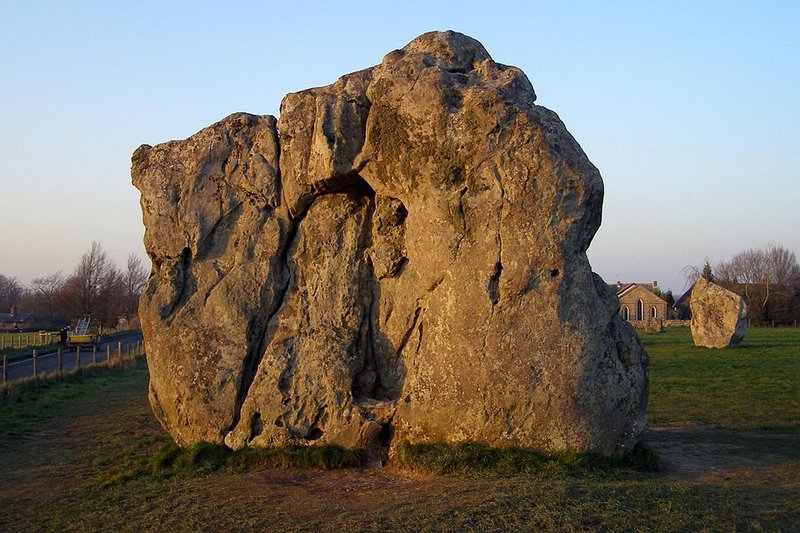
​The Devil's Chair, Avebury (Wiltshire)

devil
The Devil’s Chair
​See page for author, Public domain, via Wikimedia Commons

L​egend says that if you run around this megalithic stone at Avebury Henge one hundred times, the Devil will pop up for a chat.

​In an original ceremony devised by Philip Shallcrass of the British Druid Order in 1993, pagans assemble and divide into two groups, one the God party and the other the Goddess party. Those with the Goddess party go to the Devil's Chair, where a woman representing the spirit guardian of the site is a vessel for the voice of the Goddess.

Avebury in fiction:

​Children of the Stones (1977) - full series

The Devil’s Den (Avebury)

​A dolmen burial chamber, part of a Neolithic passage grave on Fyfield Down.

A local tradition says if water was poured into hollows on the capstone, Satan would come in the night and slurp it. Super.

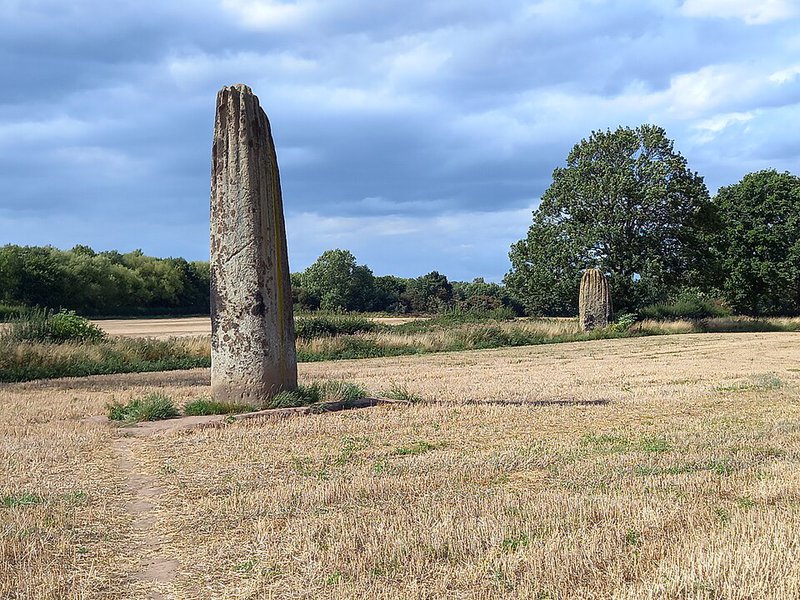
The Devil's Arrows (North Yorkshire)

Two of the Devil's Arrows
​Two of the Devil's Arrows by Gordon Hatton, CC BY-SA 2.0, via Wikimedia Commons

​These millennia-old standing stones in North Yorkshire are the second tallest in the United Kingdom, after the Rudston Monolith.

The common Dark Age belief was that the Devil was shooting or throwing arrows from a neighbouring hill at the Christian settlement of Aldborough nearby, but he fell short of his target. Human sacrifices were supposedly conducted on the top of the stones, where the bodies were left to rot.

​​The Devil's Ring and Finger (Staffordshire)

​Some posit this Neolithic pile as a Druid’s altar within a sacred grove, the circular Ring Stone an altar piece for the Sun God, who represented the power of life, of good, of increase, and the Finger representing the Serpent God, which represented evil and death - in other words Satan, to later inhabitants. The Ring Stone’s porthole, is large enough for a person to climb through, or be passed through, to increase fertility. Or is it a portal to another dimension? Faerie perhaps?​

The Devil's Quoits (Oxfordshire)

​The Devil's Quoits are located in Oxfordshire, Neolithic henge and stone circle near the village of Stanton Harcourt. Folklore says the Devil threw large stones from Wytham Hill, some 8 miles away, during a game of quoits with a beggar for his soul. The beggar lost.

In a different version, Satan was actually playing solo on a Sunday and was b*llocked by God for playing games on His Holy Day. Understandably, a frustrated Old Nick threw his huge stones down in a hissy fit at Stanton Harcourt.

Traditionally, the stones were thought to resist being moved; one story tells of a stone moved to make a bridge that would not stay in place. In fact, the henge has been disturbed many times in recent history. The stone circle originally featured 36 stones, some removed during the medieval period (used as building materials); during WWII, the site was levelled for an airfield. More recently, there have been efforts to restore the henge; the remaining stones being re-erected, missing stones replaced with modern blocks, and the earthworks surrounding the circle re-dug between 2002 and 2008. So a tad ersatz then.

The Devil's Stone (Shebbear, Devon)

The stone is rolled over every November 5th to "turn the Devil away" and prevent the next year's crops failing. Also, if the stone is NOT overturned, Satan will the appear. The Shebbear Yeomanry has yet to try leaving the stone unrolled as a test, local parish records show.

​​The Nine Stones, Winterbourne Abbas (Dorset)

These sarsen stones were erected in the Bronze Age; legend claims they were the Devil, his wife, and his children and cannot be counted; others say they had once been children who were turned to stone as punishment for playing ‘Five-Stones’ on a Sunday. A bit severe.

​In 2007, the Dolmen Grove Druids claimed they’ve had to confront individuals hurling abuse at them as they performed their rituals at the Nine Stones.

The Devil’s Toenail (Bedfordshire)

​This Neolithic stone (10,000 to 4,500 BC) marks the spot where the Devil joined some local kids who were defying the sabbath by enjoying a cheeky game of leapfrog. Satan merrily participated in their game, then opened a hole in the ground into which they were cast and never seen again.

20 minutes or so from my dwelling.

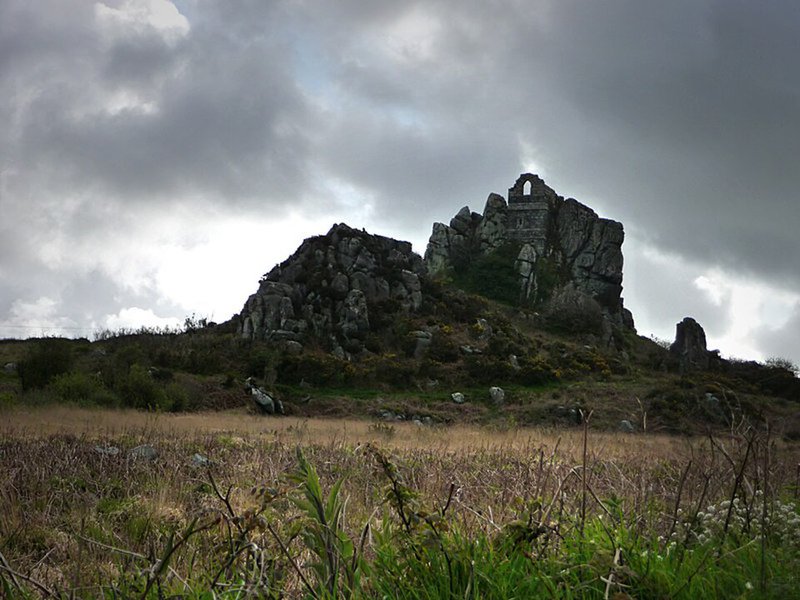
Roche Rock (Cornwall)

devil
Roche Rock
​Roche Rock by Chris Gunns, CC BY-SA 2.0, via Wikimedia Commons

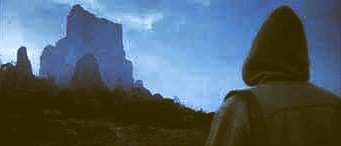
I’ve been to Cornwall’s chapel of St Michael at Roche Rock, mainly I admit from curiosity to see the location for one of the doomed killer monks attempts on Damien’s life in 1981’s Omen III: The Final Conflict than anything else.

The Chapel in Omen III: The Final Conflict (1981)

​Roche Rock features in Cornish myth; the ruined chapel that we see today was built more than 600 years ago in 1409 by the wealthy Tregarrick family. The last resident of Roche Rock is said to have been Sir John Tregarrick who hid himself there for many years after contracting leprosy. His only visitor was his daughter who brought him food and fresh water from a nearby well. 17th century magistrate Jan Tregeagle’s evil spirit was set to roam the wilds of Cornwall pursued by Satan’s demons. Tregeagle sought sanctuary in the chapel’s holy ground, but only managed to get his head stuck in the east window, with his body dangling outside to be welted by the Devil’s eager helpers. On a stormy night you can still hear the howls and tortured screams of cornered Tregeagle on the wind.

​In the time of King Arthur, it was said to have been the base of hermit/holy man Ogrin. Ogrin helped the famous star-crossed lovers Tristan and Isolde in their attempted escape from an enraged King Mark, hiding the couple with him on the rock.

​Devil's Chimney (Gloucestershire)

The Devil, cheesed off by the many Christian chapels in the area, took to perching on Leckhampton Hill, mocking and hurling rocks at those who attended church on a Sunday. But the treacherous, turncoat rocks rebelled and drove Satan back beneath the ground, preventing him from harassing the pious villagers any further.

The mass of stones then formed a chimney to hell - as can be seen by tendrils of smoke that waft from the structure at night. Visitors still leave a coin among the stones, to protect them from the wrath of the Devil.

​The Devil's Lapstone (Durham)

The Devil himself offered to help build Durham Cathedral but with the wicked intention of constructing foundations of such crumbly rock, the building would soon collapse, killing anyone inside. Naughty Satan.

Lucifer would fly up and down the length of the River Dene, collecting stones for the cathedral, but one day, his leather apron snapped and the stone within plummeted to earth. The Devil snatched at it, trying to catch it again and again, leaving deep scratches and Satanic blood in the rock. If you ever see the Devil’s Lapstone, take a close look, as you can still see the rents and blood left by The Horned One in his fury.

LINKS:

​The Blood Stone at Luccombe: https://www.gothichorrorstories.com/journal/folk-horror-from-wiltshire-the-blood-stone-at-luccombe-spring-starving-out-the-vikings-at-bratton-camp-the-white-horse-of-westbury-and-the-nature-of-folklore/

​The Devil’s Boulder: https://www.shebbearvillage.co.uk/people/the-devils-stone/

​Soulbury Stone: https://www.bbc.co.uk/news/uk-england-beds-bucks-herts-36024009

​Sitting in The Devil’s Chair: https://marywoodenglandandireland2015.wordpress.com/2015/05/29/sitting-in-the-devils-chair-erasure-of-ancient-culture-and-fear-of-the-other/

​Devil's Toenail: Bedfordshire's frightening version of Stonehenge: https://www.bedfordshirelive.co.uk/news/history/devils-toenail-bedfordshires-frightening-version-5808785

​Ritual Protection Marks & Ritual Practices - The Devil’s Stone: https://ritualprotectionmarks.com/2022/10/31/a-chill-tale-for-halloween-the-legend-of-the-devils-stone/

​The Devil's Den and Fyfield Down: https://www.hiddenwiltshire.com/post/the-devil-s-den-and-fyfield-down

​The Devil in Westleton: The Westleton Witch’s Stone: https://withthefaeries.wordpress.com/2022/11/27/the-devil-in-westleton-the-westleton-witchs-stone/

The British Druid Order: https://web.archive.org/web/20120808075032/http://www.druidry.co.uk/bdocaerabiri.html

​The Devil’s Ring and Finger: https://thehistorydetective.org/2019/02/15/the-devils-ring-and-finger/

​The Devil's Quoits: https://www.darkoxfordshire.co.uk/explore/the-devils-quoits/

​Pagans suffer ritual abuse: https://www.dorsetecho.co.uk/news/1267293.Pagans_suffer_ritual_abuse/

​The Nine Stones of Winterbourne Abbas: https://shows.acast.com/dark-darzet/episodes/the-nine-stones-of-winterbourne-abbas

​Devil's Lapstone: https://www.atlasobscura.com/places/devils-lapstone

​Roche Rock: https://www.cornwalls.co.uk/st-austell/roche-rock

​A tale of rocks and rogues: https://www.boltholeretreats.co.uk/blog/a-tale-of-rocks-and-rogues/#

​Why not visit the enigma of the Devil's chimney: https://www.bbc.co.uk/gloucestershire/content/articles/2005/06/17/devils_chimney_feature.shtml

​A look at devil-lore in Gloucestershire and Oxfordshire: https://www.greatbritishlife.co.uk/magazines/cotswold/24329332.look-devil-lore-gloucestershire-oxfordshire/

STEPHEN ARNELL’S NOVEL THE GREAT ONE IS AVAILABLE ON AMAZON KINDLE NOW:

SAMPLE: